Artist Profile: Mapping the Sonic World of Courantes with Dylan Rhee ’25 and Grant S.C. Shueh ’27
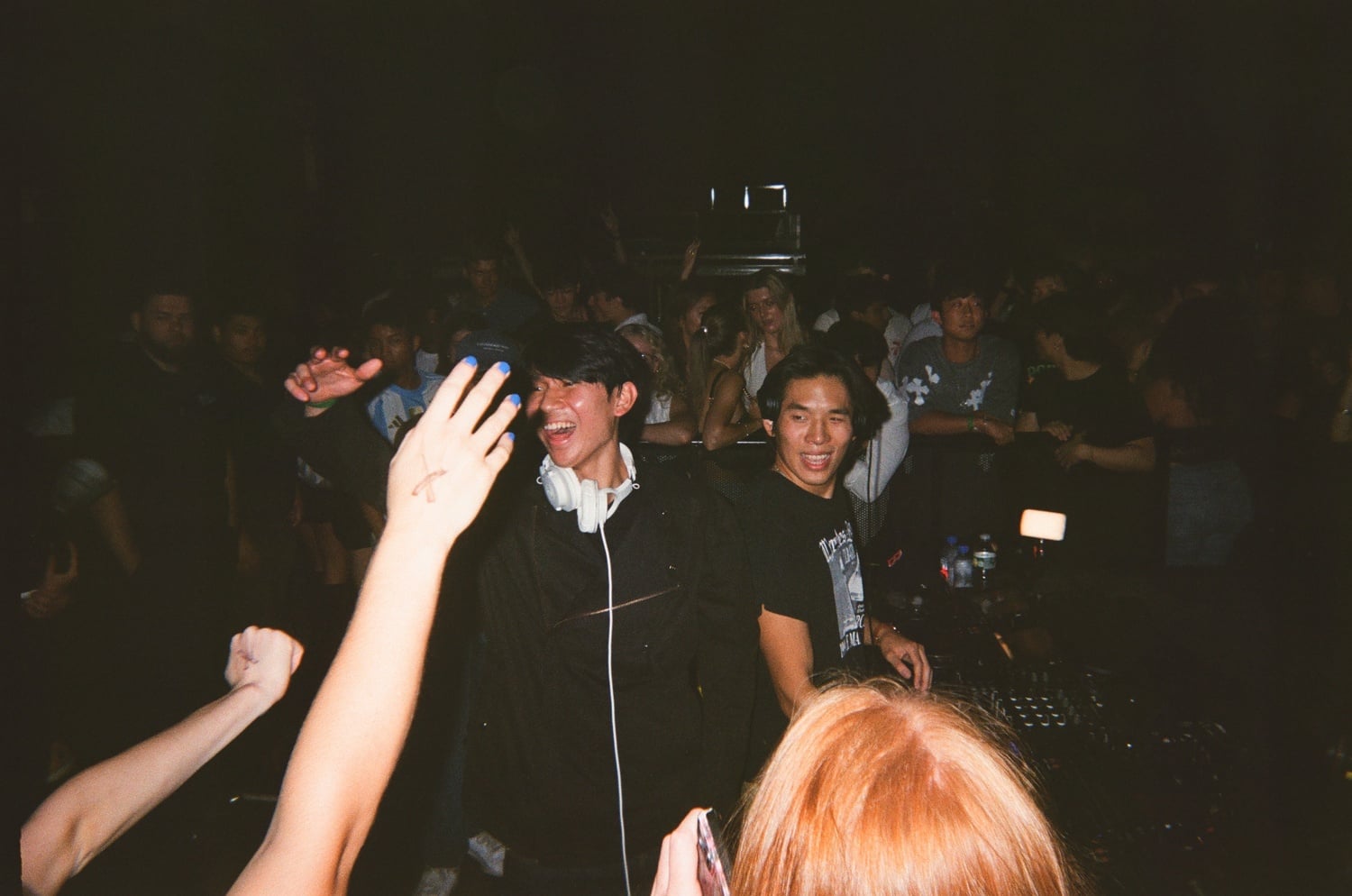
Whether in the basement of a Harvard house or in the corner of a crowded club, the distance between a classical conservatory and a strobe-lit dance floor is smaller than one might think. For Dylan Rhee ’25 and Grant S.C. Shueh ’27, that gap is where their partnership — a musical DJ duo known as Courantes — was born. A project built on the idea that electronic music does not have to be a rigid sequence of programmed beats, the duo found that the genre can instead involve the same kind of spontaneous, emotional improvisation found in a jazz club.
The name Courantes is a deliberate nod to their pasts. Derived from the courante, a traditional Baroque dance movement, the word also carries a literal meaning in French: “running.” This motif became a central theme in their early work. As Shueh explains, the name draws on their backgrounds in classical and dance music.
“Generally, the courante is the liveliest movement of a baroque dance suite, so if a cellist or pianist will play six different movements, that will generally be the fastest dance in that whole suite of pieces,” Rhee said in an interview with The Crimson.
For the duo, the name ties the formal structure of their classical music past to the high-velocity world of modern DJ music. In fact, their paths into music were markedly different. For Shueh, it was an immersion into the classical and jazz realms.
“I’ve been composing classical piano my whole life,” Shueh said.
Shueh, having “always loved all genres of music,” has written just about everything, from jazz combos and big band to string quartets, choirs, and organ. While he produced rap on SoundCloud in middle school, his shift into electronic music happened later in his academic career.
“I really fell in love with electronic music towards the end of high school and into college and had a lot of admiration for the kind of production that Dylan did, and we ended up collaborating as a result for a shared love of electronic music,” Shueh said.
Rhee followed a very different path into the world of electronic music. A serious cellist for eight years, he eventually put down the bow to focus on swimming, even competing for the Harvard Varsity team. As Rhee was about to enter college, originally as a member of the class of 2024, the COVID-19 pandemic arrived, after which he found himself looking for a new creative hobby — specifically within the music sphere.
“I learned how to DJ from a guy in Korea who now runs a pretty successful club in Apgujeong-dong, Seoul,” Rhee said. “He introduced me to the world of electronic music. I fell in love with it and started producing in 2022 — my freshman year at Harvard, actually.”
Once Rhee and Shueh met through a mutual friend, they soon after got to work. Their first collaboration was a “flip” of the 1980 soul track “Midnight Dancer” by Arabesque. Shueh recalls that when he sent the track over, they both realized they could bounce ideas off of each other.
“He saw what I was trying to do with it musically, but just had a more extensive knowledge of electronic music arrangement, how to program drums, had more experiences with remixes, and really executed what I had been imagining in my head and made this really cool track,” Shueh said.
This initial synergy quickly evolved into a mentorship that allowed both artists to expand their technical skills.
“I wanted to learn more about production from Dylan, and Dylan learned more about the composition side of things from me,” Shueh said.
When performing for campus nightlife, both artists voice frustration about the expectation to simply play recognizable hits. Rhee, who co-founded the Harvard electronic music group known as Reverb, started the organization to carve out a space where the music itself was the priority.
“The biggest misconception is that the DJ is seen as a jukebox,” Rhee said. “As in, the DJ is expected to play tunes that are familiar. The same tunes that everybody else plays that are familiar. And yes, there are times and places for that, I would say. But I don’t think anybody who enjoys it really as an art, or who enjoys making music as an art, loves to do that. I think the goal of DJs, especially in electronic music, should be to introduce people to new music that they didn’t know that they liked but that they really enjoyed.”
However, the duo acknowledges that exposure to new music is not the only purpose of their work.
“[The goal] is to still keep them dancing, of course, but it’s really tied to that element of discovery and exploration that I think is missing in many situations,” Rhee said.
A hallmark of Courantes’ live sets is a spontaneous performance.
“One of my favorite elements of music and one of my favorite aspects of the way we perform is how improvisatory it is,” Shueh said. “We don’t really plan out a very defined roadmap. A lot of it is based around our love for improvised music, like jazz. So, we’ll perform with a piano and live improvisation and a very dynamic setlist. We have an idea of what genres we’ll be in and what songs we’re picking from. I think one of the joys of performing with Dylan is navigating the improvised space together and not really knowing what’s going to come next in the set, and being able to riff off of each other, and to build something new on the spot.”
One such moment occurred last summer on a rooftop in New York City, when the duo was fine-tuning an unreleased track titled “And The Way I Look At You.” As they practiced improvising and tightening the arrangement, friends began to arrive and caught them in the middle of the process.
“Some of my hometown friends just came up the elevator to the roof, walked in as we were playing it, and to see the joy on their faces, and seeing their love for something that we had just created was one of the most rewarding music experiences I’ve had,” Shueh said.
The transition from being campus neighbors to a long-distance duo has brought new challenges. Rhee is now in his first year out of college, while Shueh remains a busy Junior. Their collaboration has moved into virtual settings, a process that requires more patience.
“It’s definitely been harder to align schedules, but I think it’ll be a lot easier this summer ’cause I’m going to be in New York as well,” Shueh said.
With their new synchronicity, the duo is anticipating the opportunity to rekindle their creative fire.
“I’m also very excited to get back together over the summer and just start bouncing ideas off each other again,” Rhee said.
Their recent work shows an evolution toward intersecting jazz piano and electronics. In January, they released “The music is too loud,” a track featuring classmate Alexandra S. Mahajan ’28.
“I have a goal with this project that I just really want to be able to unlock emotion, even in electronic music, which people don’t necessarily see as a genre with a ton of emotional depth, so I want to explore that,” Rhee said.
Shueh further elaborated on how the duo wants to evolve their work.
“I think bringing something very emotionally vulnerable, raw, and spontaneous to electronic music and being able to imbue our music with that emotion is one of our big goals,” Shueh said.
Looking ahead, the ambitions for Courantes are high. While they mention their dream of headlining festivals like Coachella, their underlying goal is one of artistic identity: a quest for their signature sound.
“My goal is to have such a unique sound that you can hear one of our songs in two seconds and say that it’s a Courantes song,” Rhee said.
As they bridge the gap between the conservatory and the club, Shueh and Rhee are proving that electronic music can be just as emotional as a jazz solo and as melodious as a fast paced baroque suite. By blending the technical precision of Rhee’s production with the harmonic soul of Shueh’s arrangements, Courantes is building a sound that is as much about human connection as it is about the digital signal.
—Staff writer Maya Y. Koreth can be reached at [email protected].
Want to keep up with breaking news? Subscribe to our email newsletter
Have a tip for The Crimson? Share it confidentially