‘Yesteryear’ Review: The Birth and Downfall of a Tradwife
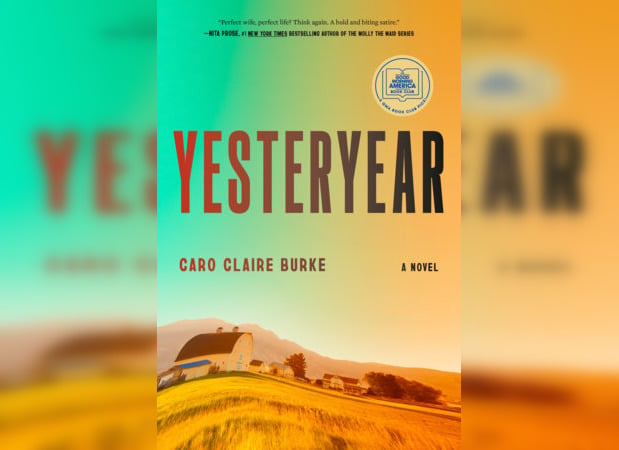
What would a modern-day tradwife and mom influencer do if she was suddenly dropped in the 19th century? That is the central question of “Yesteryear,” the debut novel of the “Diabolical Lies” podcast co-host Caro Claire Burke. Natalie — a mother of six and social media personality who secretly relies on nannies and farmhands while selling her traditional Christian lifestyle to her millions of followers — suddenly wakes up in the 1800s. While “Yesteryear” sets itself up to be a potent critique of tradwife influencers, it falls flat due to uncompelling plots and a rushed, disappointing ending.
The beginning of “Yesteryear” is the strongest part of the novel, as the characterization of Natalie really shines. While following her everyday life, it becomes clear just how cruel and insecure Natalie truly is — she mentally calls other women degrading names, is “crestfallen” when a sweet moment between her and her husband isn’t filmed, constantly dehumanizes her employees by referring to them by their roles in addition to their names, and internally puts down anyone who doesn’t follow her lifestyle to make herself feel better.
By far one of the most disturbing parts of Natalie’s inner monologue is how she views her children as vessels for content. She explicitly states that she prefers having daughters over sons because they’re “easier to train” for content and “could perform on film for hours.” She also becomes upset when her eldest daughter doesn’t want to be filmed and is very defensive over concerns about her content violating her children’s privacy. Burke exposes Natalie’s complete hypocrisy, clearly critiquing the false personas adopted by social media influencers. This endorsement of authenticity and children’s autonomy is very refreshing, and this messaging — which continues throughout the novel — is a highlight of the book.
However, when Natalie wakes up in 1855, the structure of the story is thrown off completely. For the bulk of the novel, the narrative oscillates between Natalie’s new life adjusting to the harsh realities of the 19th century and how she became a tradwife influencer sensation, particularly focusing on her brief time as a student at Harvard, her dissatisfaction with motherhood and her husband, the degradation of her familial relationships, and the founding of her family farm. While these would be equally compelling storylines, Natalie’s origin plotline is given significantly more weight than her life in the 1800s. This imbalance makes it difficult to be emotionally invested during the chapters set in the 19th century — even though they should be the most dramatic part of the novel, Natalie’s present-day life is so much more compelling, despite being more mundane in terms of content.
The lack of emotional connection to the historical scenes becomes confusing by the end of the book, which synthesizes the past and present storylines. The ending relies on the reader having a heavy emotional connection to the storyline set in the 1800s as well as some characters within that part of the plot, but the rest of the novel doesn’t foster this connection, leading to a disappointing conclusion.
The finale is also emotionally dissatisfying, as multiple emotional arcs of the novel don’t seem to end anywhere, especially with Natalie’s character. Before the conclusion, Burke’s character work is amazing, from major characters like Natalie and her husband to minor characters such as Natalie’s mother and mother-in-law. However, the ending shatters much of the book’s development, showing Natalie’s mindset as simultaneously growing and staying the same without spending enough time to develop a nuanced emotional state. Burke’s character also comes off as strange as a key twist plays out in a way that feels unsupported from the rest of Natalie’s character throughout the novel’s arc.
This lack of cohesion is noticeable through the novel with core facts that are established early about Natalie being reneged for shock value. The narration gives the impression that Burke wants the audience to have a certain picture of Natalie in the beginning of the novel only to reveal more about her true self as the plot goes on, but it ends up feeling like the Natalie at the start and the Natalie throughout the novel are different people with different ideologies.
While an engaging and character-driven novel, the ending of “Yesteryear” leaves readers searching for more. As the book goes on, it gets increasingly harder to ignore some of the inconsistencies within the plot and characterization, watering down any potential messaging. While “Yesteryear” does have a few issues, it overall shows a lot of promise, especially for a debut project — as Burke continues to grow as a writer, there is no doubt that she could craft a truly amazing novel.
—Staff writer Olive J. Ritchie can be reached at [email protected].
Want to keep up with breaking news? Subscribe to our email newsletter
Have a tip for The Crimson? Share it confidentially