‘Sanctuary City’ Review: What It Means to Belong While Undocumented Post-9/11
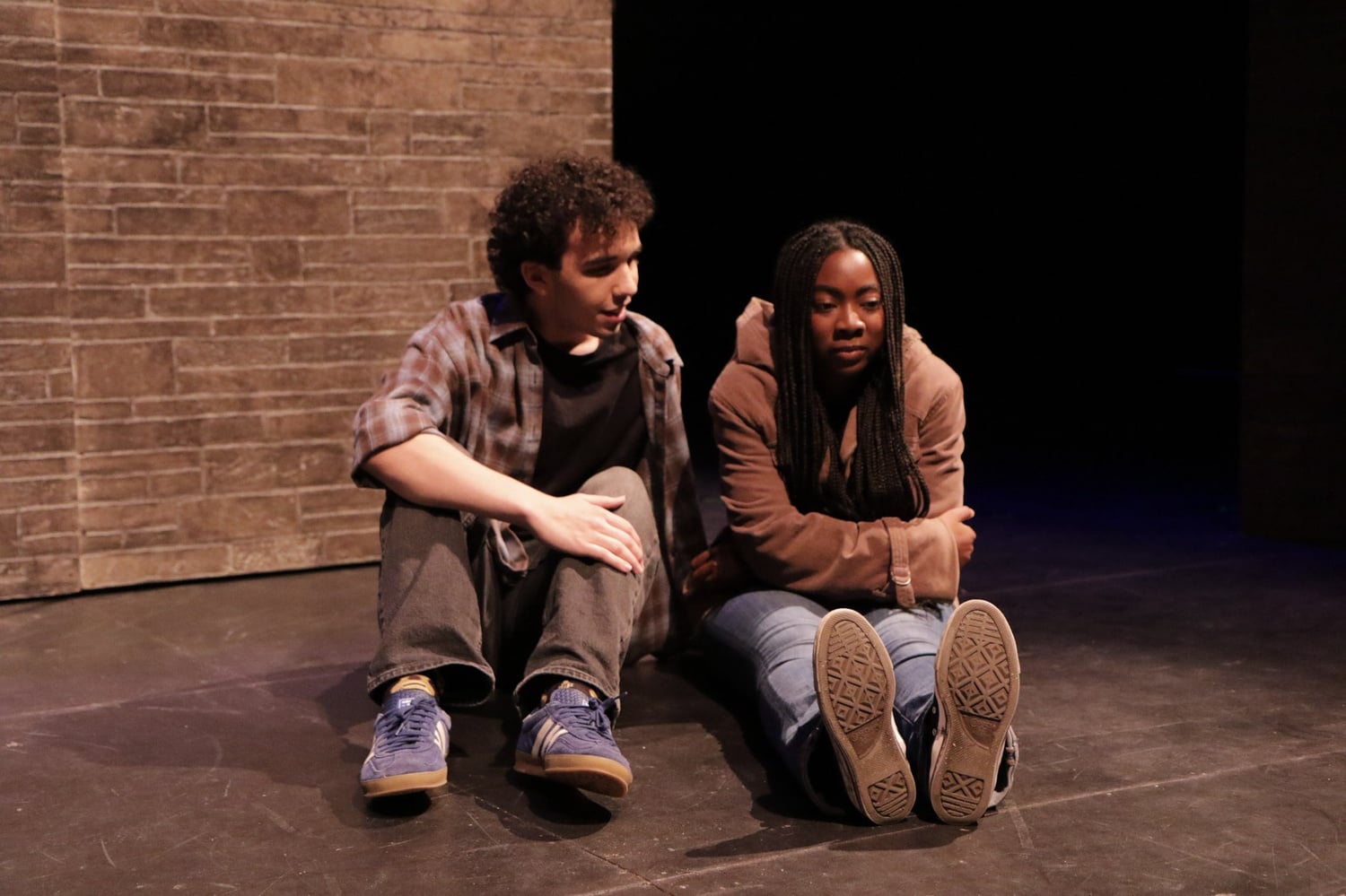
Imagine the desire to live a normal teenage life — going to school, doing homework, studying, going out with friends, and enjoying those fleeting high school years. The two teens at the center of “Sanctuary City,” inhabit a strikingly different reality. Set in Newark, New Jersey in 2001, their story offers a soul-stirring glimpse into the reality of growing up undocumented, where survival often outweighed adolescence itself.
Martyna Majok’s 2018 Pulitzer Prize-winning drama, “Sanctuary City” — directed by Jocelyn E. Shek ’27 — follows two undocumented teens, G (Dzifa A. Ackuayi ’28) and B (Pablo A. López Garrido ’29), as they navigate precarious lives, uncertain futures, and the fragile hope of living in America. The play grounds post-9/11 immigration with lived experiences that feel intimate, immediate, and, most importantly, painfully unresolved.
Upon entering the theater, the production opened in a Blackbox, presenting a set that resembled a cramped bedroom. Co-scenic designer and technical director George S.H. Atkin ’28 staged a three-walled structure, bare yet enclosed, which conveyed a sheer sense of emptiness, mirroring the characters’ internal states. Before the play began, a content warning announced the emotional weight.
Ackuayi’s performance in the opening scene masterfully ground the play’s core themes of terror and forced instability. Rather than merely acting out a scene of entry, Ackuayi marks the trembling voice and the guarded physicality while she asks B, “Can you close the window?” Her expressions about feeling cold communicates fear of a conflict-ridden home, of authority, of what awaits outside the ‘three-walled’ structure. This transforms the simple act of closing the window into a desperate bid for sanctuary. This scene is an example of shifting the focus from the immediate, frantic action to the broader, thematic reality of life lived constantly on the edge and safety is fragile.
Lighting designer Adam J. Wang ’26 and assistant lighting designer Motoko Akiyama ’28 play a critical role throughout the production. The abrupt blackouts separated scenes, creating a fragmented structure where moments felt pieced together rather than seamlessly told. This repetition was seen throughout many scenes in Act I, particularly when G would enter through the window, building tension and reinforcing the cyclical nature of the duo’s struggles. The format forced the audience to find hidden meanings, making each moment like a private conversation overheard.
A particular strength was present in how “Sanctuary City” balanced moments of humor despite its heavier themes. These scenes didn’t undermine the narrative’s seriousness. They highlighted the characters’ youth and resilience with uncalled childhood trauma in an impressive balance struck by Shek. In one scene, G asked B to cover for her absence at school by saying she has the flu although the truth revolved around a more serious issue. What followed was an unexpectedly light exchange about whether the “flu” is believable, diverting into a discussion about “measles and mumps” and what the two infections even were. Scenes like these showcased moments of levity that felt fleeting yet essential. They reminded the audience that beneath the trauma, the characters are still kids trying to hold onto fragments of adolescence.
At the heart of “Sanctuary City” was the idea of marriage as a means of survival through legal protection. The production framed this shift through the fragile yet deeply felt connection between G and B, where naive love was gradually overshadowed by the weight of systemic pressure. The introduction of Henry (In Seo “Inseo” Yeo ’26), whose composed yet emotionally layered performance brought a quiet intensity that further complicated the play’s dynamic. His presence disrupted the balance between G and B, transforming their bond into a tense negotiation between love, loyalty, and self-preservation with survival.
Rather than the centered focus on G’s individual betrayal, the play revealed the devastating influence of external forces, specifically when confronted with legal and social consequences of the group’s immigration statuses and romantic relationships. The revelation expressed how such pressures shatter even B’s most enduring bonds, including with G, his mother, and Henry.
Through the shifting tones of sadness, guilt, and restrained anger in López Garrido’s voice, the production built toward an emotionally suffocating dilemma — leaving a lingering sense of unease about what survival demanded. This is seen through the spotlight on López Garrido’s spiraled question reiteration paired with the sound reflecting the clamor of the city.
“Sanctuary City” stayed in between spaces — where choices are complicated, relationships are fragile, and outcomes are uncertain. Its emotional impact didn’t come from resolution but from discomfort, empathy, and the tension it refuses to resolve. This balance created an emotional rhythm between humor and hardships that felt authentic. “Sanctuary City” mirrored the complexities of real life, where laughter and pain coexist.
“Sanctuary City” ran at the Loeb Drama Center from Apr. 2 to Apr. 5.
Want to keep up with breaking news? Subscribe to our email newsletter
Have a tip for The Crimson? Share it confidentially