‘The Firm’ Review: A New Take on What It Means to Be Human
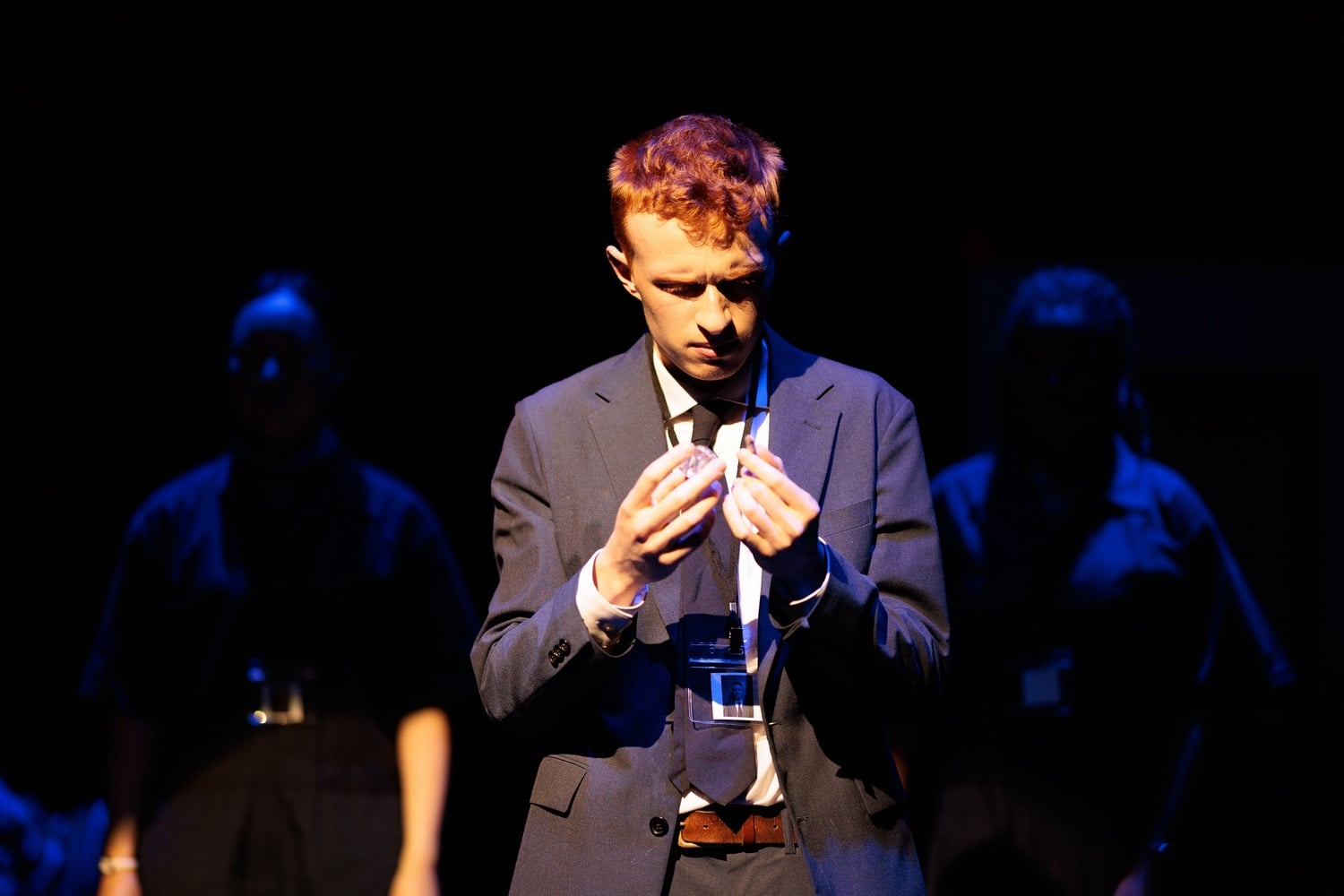
“The Firm” exists on a spectrum of genuine to nervous laughter. An experimental dystopian comedy told in one act, the jokes land upon first listen but grow eerie with their repetition and growing context as the play continues. Written, directed, and produced by Ihechikarageme M. Munonye ’26, The Harvard Radcliffe Dramatic Club’s “The Firm” follows Normal Guy, an office worker at The Firm, as he attempts to unravel the mystery behind his world. The production answered the age-old question: “What does it mean to be human?” This topic is difficult to explore without veering into cliches, and “The Firm” is not immune to this — yet the show managed to elucidate a novel take on humanity by placing it in the context of our current world.
From the opening scene, “The Firm” does an excellent job utilizing the Loeb Experimental black box theater space. Despite audience seating on both sides of the stage, they managed to organize the actors in a V-shaped position, with the main characters, Juzo (Gemma I. Dean ’27) and Normal Guy (George S. Atkin ’28), at the point so as to be seen by all audience members. The intimacy of the set-up, designed by Ida Chen ’27, added to the performance, particularly of Joe (Preston C. Bushnell ’26), Will (Pablo A. López ’29), and John (Adnan B. Alamgir ’29). When these three characters perform their scripted reenactment of “The Game” that the whole office had supposedly watched, their proximity to the audience seating made the performance all the more uncanny and hilarious. Bushnell delivered a particularly uncanny, funny performance with recurrent one-liner jokes. “Who are you telling?”
The script’s strength showed in the changed meaning of the repeated dialogue and scenes as the context of the play unfolded. The office scenes served as an anchoring point of the beginning, middle, and end of the performance to demonstrate how much the characters and world had changed — or not changed at all. It was remarkable to witness this evolution despite each repetition of the scene having the exact same script, choreography, and performance. The first instance of the workers’ morning in the office came across funny, if slightly unnerving, but by the final reenactment of the same scene, the tone had completely shifted to be robotic, sinister and ominous. It speaks to the power of Munonye’s script and direction that the same performance and dialogue were able to convey such different ideas at different points of the play.
Another strong point of the performance was the first set transition from laundromat to evil operating room of the Technicians (Brownwyn G. Vance ’28 and Chuchu Zhang ’27). The fog machine from beneath the stage released diegetic smoke, which caused Juzo and Normal Guy to pass out. Then, as the smoke continued to spread throughout the room, engulfing the actors and audience in a gray haze, the lights plunged the room into darkness and the Technicians and masked figures emerged. These effects, particularly the double use of the smoke as both sedative and a tool to set the mood, successfully created a chilling scene as the first explicit introduction into the dark side of “The Firm.”
Throughout the rest of the play, the secrets of the world and The Firm are expanded on and take the forefront. The plot was fascinating, but the worldbuilding explanations were occasionally too direct, dumping information in one character’s short dialogue. These moments were mostly in the character Ether’s (Micah A. Anderson ’28) dialogue, but Anderson gave a stellar performance regardless. Some worldbuilding elements, such as the description of the great war causing the post-apocalyptic world, led the play into some cliche tropes. At the same time, it was difficult to follow the exact reasons why The Firm was established and what its goal was. However, it is an uneasy task to fit such intense ideas into such a short play.
“The Firm” certainly did not shy away from complex topics. Despite the slightly cliche themes and dialogue, the show still examined nuanced ideas on what it means to be human. In one poignant moment of the show, Ether broke the fourth wall in her monologue, addressing the audience as just as manipulable as Normal Guy, just as susceptible to the human desire for hope. While watching the play and hoping “good” would conquer “evil,” Munonye’s words forced one to reflect on one’s own inability to break out of the hamster wheel of hope and entertainment.
The ending was frustrating in this same way, offering no real sense of conclusion but rather an unstoppable continuation of the cycle. Perhaps it was intended for the audience to be left frustrated at the show’s inescapable loop, entertained for no real purpose. The show’s message seemed to touch on the current state of the world — with countless people stuck in the endless doomscroll of social media — our human need for hope and entertainment is being hijacked, in the same way as Normal Guy, to be continually fixated on a story. Just as Normal Guy is stuck in the daily life and repetitive journey The Firm takes him on, people today are stuck in our same daily rhythms and stories fed to us by corporations. Hope — the key element of humanity in “The Firm” — can be exploited to trap people into endless, mundane cycles that chip away at human thought. In this way, “The Firm” gives a particularly relevant and interesting message about what it means to be human in the modern attention economy.
Want to keep up with breaking news? Subscribe to our email newsletter
Have a tip for The Crimson? Share it confidentially