The BSO Performs a Unique All-Brahms Program: Herbert Blomstedt Conducts the BSO Exceptionally Well
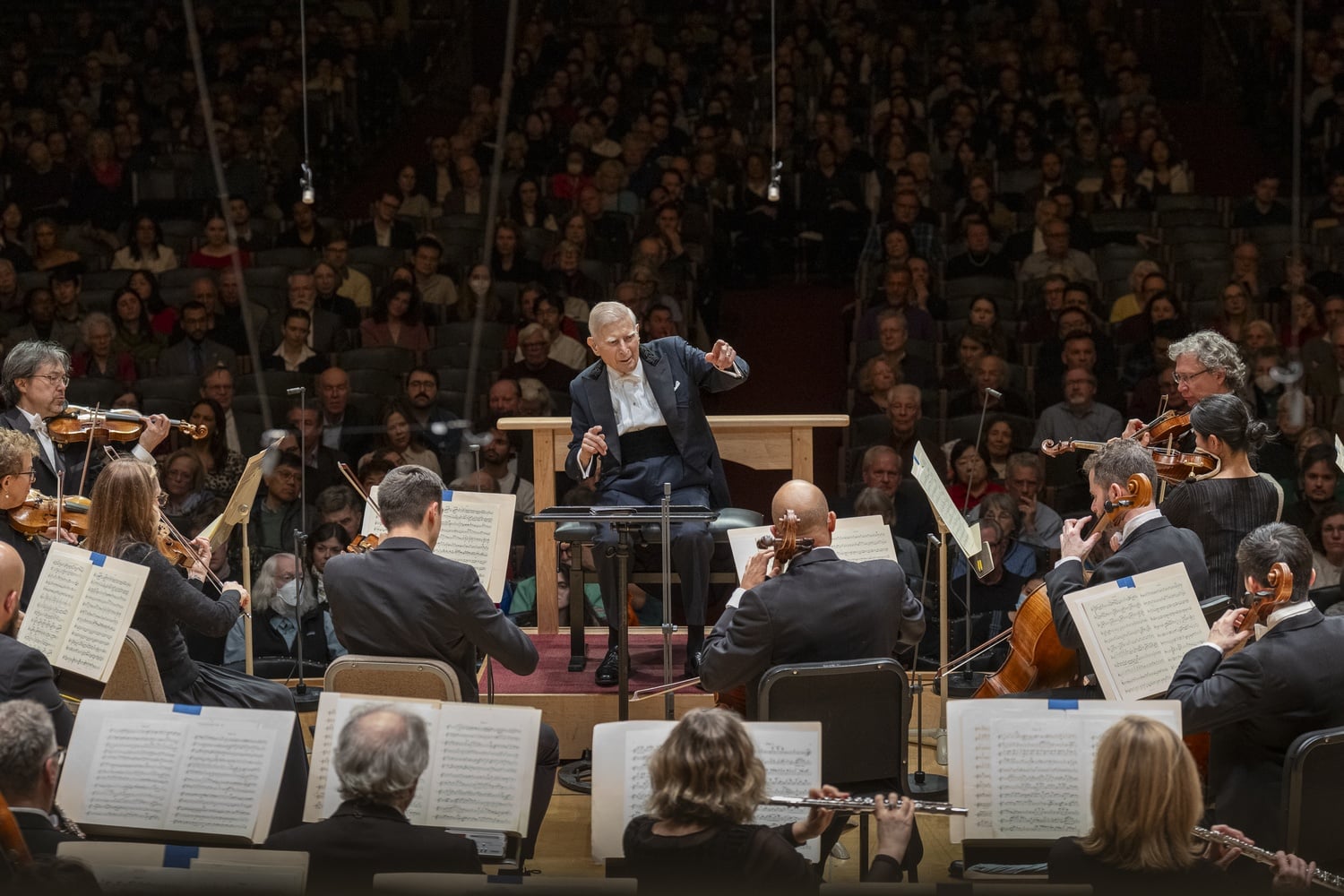
On March 7, the Boston Symphony Orchestra performed the final concert of their all-Brahms program from March 5-7. Herbert Blomstedt, the guest conductor, conducted the BSO with remarkable precision while preserving the aesthetics of Johannes Brahms’ choral works and his Symphony No. 4 in E Minor.
Born in the United States to Swedish parents, Herbert Blomstedt is a renowned conductor who has directed many orchestras across the world, including the Stockholm Philharmonic Orchestra, the Oslo Philharmonic, the Swedish and Danish radio symphony orchestras. Later in his career, he served as music director for the San Francisco Symphony from 1985 to 1995 and the Gewandhaus Orchestra Leipzig from 1998 to 2005, and served as chief conductor for the NDR Symphony Orchestra from 1996 to 1998.
The BSO program began with two choral pieces by Brahms, drawing from early German Romantic poetry by Friedrich Schiller — who famously wrote “Ode to Joy” in 1785 — and Friedrich Hölderin. Schicksalslied (“Song of Destiny”), the first choral work of the night — inspired by Hölderin’s 1797 novel “Hyperion” — delivered a striking image of the juxtaposition between the serene existence of the divine and human suffering. Similarly, Nänie (“Lament”), which Brahms wrote in response to a friend’s death in 1880, conveyed with poignant restraint the gods’ indifference to human fate.
The Tanglewood Festival chorus, under the direction of guest conductor Lisa Wong, joined the BSO to deliver a cohesive and expressive performance of both choral works. For non-German speakers, supertitles were illuminated above the stage, which enhanced the meaning of the choral works. It also helped foster the audience’s emotional connection to the music, beyond the beautiful performance from the orchestra.
The performance of some of the less known choral works was compelling. The string section provided a sustained foundation for the woodwinds to shine. The clarinets in particular added color and contour, shaping the emotional arc of both choral pieces. The orchestra and the choir worked well together under the direction of both Blomstedt and Wong, who never overshadowed each other.
Brahms’ last symphony, Symphony No. 4 in E minor, stands out from the rest, as it is his darkest and most densely crafted symphonic work. It is also a peculiar work, as it conceals the rhythms of polkas and waltzes within the weave of notes.
The first movement began with a swaying E minor theme which instantly captured the audience in a trance — ready to take on the haunting energy of the work.
The second movement echoed the previous one, but differed with its noble demeanour, introduced by the strong woodwind section. This movement is special, as it echoes the works of Wagner and Mahler, composers who Brahms studied intently. It unfolds like an elegy, mourning a fallen hero, with romanticism seeping from every note.
“Allegro giocoso,” the third movement of the symphony in C major, serves as a sharp contrast to everything heard previously. On the first listen, it catches the listener by surprise — it invites the audience to dance to the music with the momentum of its two-beat tempo.
The final movement, inspired by Johann Sebastian Bach’s chaconne — a Baroque-style musical composition in moderate triple time — was the highlight of the symphony. Back in the minor key, Brahms uses the chaconne to create a sense of impending doom, as everything joyous in the previous movement is gone.
Blomstedt’s conducting style was exceptional. Although his arm movements were minimal, he conducted the BSO with ease and precision. His excellence in conducting was especially evident in the fourth movement of the symphony as the orchestra’s marcato, in perfect synchronization, sounded with power across the hall.
The woodwind section carried the Brahms program to triumph. Across all of the program’s works, Brahms utilizes the woodwinds not merely to add support to the rest of the orchestra, but to give them special moments and inner voices that enrich the overall texture of his pieces. And with Blomstedt at the helm of the orchestra, Brahms’ vision was executed well, giving justice to the romanticism and the melancholy Brahms was trying to convey.
The BSO delivered their all-Brahms program with great success, thanks to the exceptional guest conductors Lisa Wong and, of course, Herbert Blomstedt.
—Staff writer Anastasia Poliakova can be reached at [email protected].
Want to keep up with breaking news? Subscribe to our email newsletter
Have a tip for The Crimson? Share it confidentially