‘So Old, So Young’ Review: Humanity in Tiny Heartbreaks
4 Stars
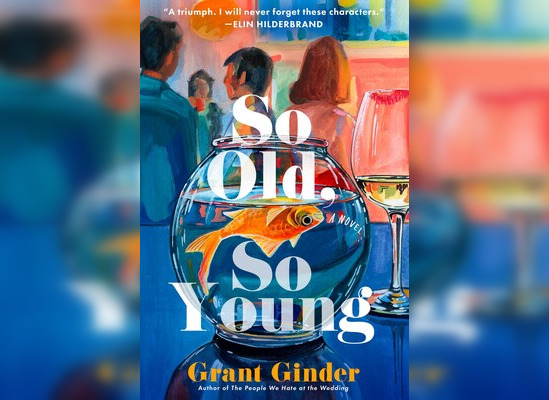
There are no heroes in “So Old, So Young,” the new novel by Grant Ginder, best-selling author of 2016 novel “The People We Hate at the Wedding,” which was later adapted into the 2022 Amazon Prime series of the same name.
Instead, there are six ordinary characters grappling — often unsuccessfully — with their jobs, marriage, grief, and other unexpected life twists over the course of 17 years.
“So Old, So Young” is reliant on these characters to drive the narrative — it is not a plot-focused novel. Rich and vibrant characters that the reader can care about and empathize with become even more important in such a story. If a novel is to stand on the shoulders of only its characters without a unifying plot, the characters must be strong enough to bear the weight.
But Ginder’s characters are not quite strong enough. They are compelling for their messy humanity, but they occasionally devolve into unconvincing caricatures that weaken an overall strong conceptual novel. “So Old, So Young,” revolves around five drama- and tension-packed parties as contexts to develop the complexity of its protagonists.
Sasha — one of the well-developed characters of the story — sneaks out of the apartment she shares with her boyfriend to attend one of these parties, blaming the noise she makes upon her return on an imaginary ghost. In Sasha’s characterization, Ginder displays some of his best character-building skills. He narrates her dissatisfaction with her mild-mannered boyfriend, Theo, with a shocking edge. With ample profanity, Sasha criticizes her boyfriend’s love-making and fantasizes about a “madman” Italian diplomat.
As the novel progresses, secrets like these, alongside general life circumstances — marriage, children, and the like — begin driving the friends apart. Ginder’s storytelling in moments like these is superb. He artfully represents the thousands of small heartbreaks, anxieties, and yearnings of each character as they grow distant and strike out onto different life paths.
Ginder masterfully displays the loneliness of another character, Mia. Sasha and Theo miss the wedding of a college friend, while Mia attends and discovers that her ex-boyfriend brought his new girlfriend to the wedding. In need of some comfort from a friend, she calls Sasha with feigned nonchalance. The geographic distance perfectly represents Mia’s emotional isolation. Ginder conveys that it isn’t necessarily Sasha’s impromptu return that Mia desires, but her understanding. However, Sasha does not grant it, and the phone call ends.
In a later scene, in which all six friends are staying together in Amagansett, New York, Sasha — now a mother — approaches Adam to ask him whether he could make her portion of dinner without cilantro. She admits that she has grown to dislike the flavor since her pregnancy. Later in the conversation, as Sasha turns to leave, she begins to say “and also, just a reminder —” before Adam cuts her off, saying, “No cilantro. I remember.”
The exchange is simple, but it offers a poignant reminder of how the friends, now drifting apart, are still intimate enough to care about each other’s seasoning preferences. But it also highlights the diverging paths they are now on: Sasha now having started a family, and Adam, unmarried and without children, does not fully understand how motherhood has changed her. The exchange is over something small and seemingly insignificant — her aversion to cilantro — but it concerns a bigger and all-encompassing tension as Sasha's life becomes more focused on raising her child.
It’s small moments like these in which Ginder’s storytelling shines. However, in more explosive periods of conflict between the characters, some subtleties and genuine emotion are flattened into extreme outbursts that feel performative.
Later in the novel, Sasha finds herself growing close to other mothers in her neighborhood, finding some of the mutual understanding and connection that she has lost with her college friends. As the distance and tension in Mia and Sasha’s relationship reaches a boiling point, Mia, enraged at Sasha’s defending of one of her new friends, shouts, “How many times do I have to tell you: you don’t like her, you like me!”
Imagining someone shouting this at someone else in real life is slightly difficult. While certainly adding shock value, this outburst might feel slightly alienating to a reader. Particularly for a novel that relies heavily on readers’ ability to engage with its characters, this line’s ridiculousness threatens any feelings of sympathy or understanding readers might feel toward her. Mia’s feelings of abandonment and betrayal in this scene are not unfounded, but this line jolts readers out of any relationship they might have built with the character over the 300-some pages leading up to this point.
But these slightly overdone scenes do not completely destroy the book’s characters as artistic objects — the conflicting emotions and desires of the characters shine through in small, relatable moments, even if they occasionally veer outside the realm of the convincing.
—Staff writer Francesca H. Vittorelli can be reached at francesca.vittorelli@thecrimson.
Want to keep up with breaking news? Subscribe to our email newsletter
Have a tip for The Crimson? Share it confidentially