‘Song of the Earth (Das Lied von der Erde)’ Review: Mahler’s Masterpiece Finds New Life Through Boston Lyric Opera’s Intimate Staging
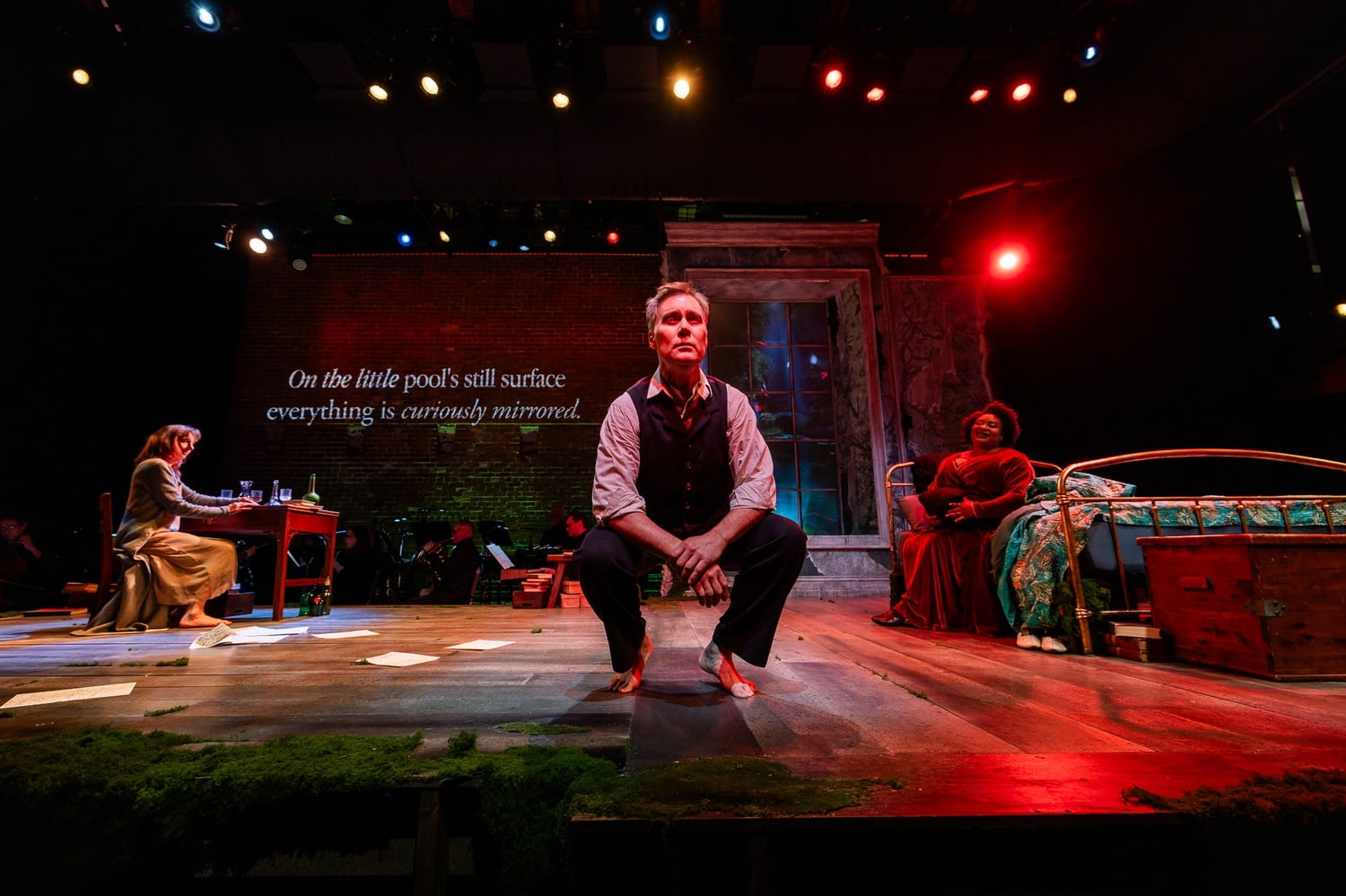
“How did I end up in this extremity called my life?” asks The Mother (Ellen Lauren), one of the three central characters in the “Song of the Earth,” a new reimagining of Gustav Mahler’s “Song of the Earth (Das Lied von der Erde).” Inspired by his 1911 symphonic song cycle set to ancient Chinese poetry, the 2026 Boston Lyric Opera production featured three sole figures — The Mother (Ellen Lauren), The Poet (Brandon Jovanovich), and The Lover (Raehann Bryce-Davis) — who inhabited a single room across different timelines. While the actors were only a few feet away from each other and interacted often, their stories were combined by their shared grief rather than a literal narrative. BLO offered an intimate experience that transformed Mahler’s late masterwork into a profound meditation on grief, memory, and the persistence of beauty in life.
Throughout the production, The Poet drinks, then crumples his verses. He recounts his former youth in the moments right before death. The Lover remains suspended in memory and loss. Her beautiful grief is what lingers. Lastly, The Mother is the most earthbound of the trio. She moves through her sadness as she mourns her lost child. While this kind of staging technique can be abstract, stage director Anne Bogart’s assured direction kept the narrative clear and instinctive.
The room — the main setting of the opera — was set on a small, level stage. On the audience’s right, an ordinary bed sat beneath a grand window, which had a window pane that served as a projection screen for various nature scenes throughout the opera. A simple wooden trunk sat in front of the bed. On the left, books littered the floor surrounding The Poet’s messy desk, buried under papers and bottles.
Set designer Sara Brown anchored the space with the details: The wallpaper and the bed’s blanket had floral prints, and pieces of moss were scattered across the stage floor, blurring the boundary between the room and the natural world outside it. The effect exemplified Mahler’s themes of how Earth blooms and endures as humans fade. Under conductor David Angus, the chamber ensemble shone in both quiet and loud moments. Chamber performers like oboist Grace Shryock emphasized the delicate undertones of the production’s pervading sense of longing.
Lighting designer Brian H. Scott and projection studio Masary Studios worked in tandem to animate the stage and extend the actor’s emotions. The first scene was illuminated by an ombre blue light in the back, offering a cool stillness. As the opera progressed, the lighting shifted accordingly. During songs like “Das Trinklied vom Jammer der Erde” (“The Drinking Song of Earth’s Sorrow”), the light wrapped The Poet in a warmer, more urgent orange-yellow tone, mirroring his restless energy.
Even the show’s subtitles were presented in a way that matches the visual energy of the production. For example, in “Von der Jugend” (“Of Youth”), the projected English translation subtitles on the back wall appeared in staggered, poem-like indentations while at other times they were projected in a cursive font.
Jovanovich commanded the stage as The Poet, pouring abandon and passion into “Das Trinklied vom Jammer der Erde” (“The Drinking Song of Earth's Sorrow”), Mahler’s opening song of dark exuberance. Most impressive was Jovanovich’s commitment to the role’s physicality. During the song, Jovanovich drank directly from the bottles on his character’s desk and continued to sing with full operatic power. At times, he even sang sitting on the floor or laying on his stomach without faltering. Although his character’s body dragged, his vocal instrument did not.
Mezzo-soprano Bryce-Davis delivered a performance of beautiful devastation throughout her portrayal of The Lover. In “Der Einsame im Herbst” (“The Lonely One in Autumn”), she mourned sweetly and cast her gaze into the distance as if searching for someone just out of reach. When she sang, “My heart is weary,” the desperation in her face and posture made the longing feel private and almost unbearable to witness. Her facial expressions did the most remarkable work as she displayed rapidly changing sentiments from warmth to bitterness.
The Mother stood out, as her character spoke in English in contrast to Jovanovich and Bryce-Davis’s German singing. Her monologues — written by director Anne Bogart for the BLO production — broke the fourth wall, which deepened the emotional gravity of her words and functioned as a dramatic counterweight to the music. The Mother filled every word with physical expression — her arms reaching, gesturing, pulling inward — so that her body became an extension of her sorrow.
Costume designer Haydee Zelideth dressed each character to capture attention as soon as they entered the stage. The Lover swept across the stage in a crimson floor-length velvet gown as a visual embodiment of her passion. In stark contrast, The Mother wore a tattered, plain nightgown beneath a long button-up cardigan — one she pulled off and on throughout the performance, as if to embody her uncertainty. The Poet wore a dark suit that he shed as his composure unraveled. Each character was barefoot, which grounded all three figures on the same earth.
The opera ended as the last song “Der Abschied” (“The Farewell”) gave way to its final verse, a continuous call to eternity. The Lover — inspired by The Poet’s poems — began to write her own and The Mother opened the trunk by her bed to read poems from her lost child. Both of them found empowerment in grief. The conclusion resisted the comfort of resolution by proposing that loss and creation are not opposites, but complementary. With remarkable acting and a skilled directorial vision, “Song of the Earth” transformed Mahler’s farewell piece into something that felt like a hopeful beginning.
“Song of the Earth (Das Lied von der Erde)” ran at the Boston Lyric Opera’s Opera + Community Studios from March 20 to March 29.
Want to keep up with breaking news? Subscribe to our email newsletter
Have a tip for The Crimson? Share it confidentially