Harvard Dining Workers Rally Outside Smith Center After University Rejects Key Contract Proposals
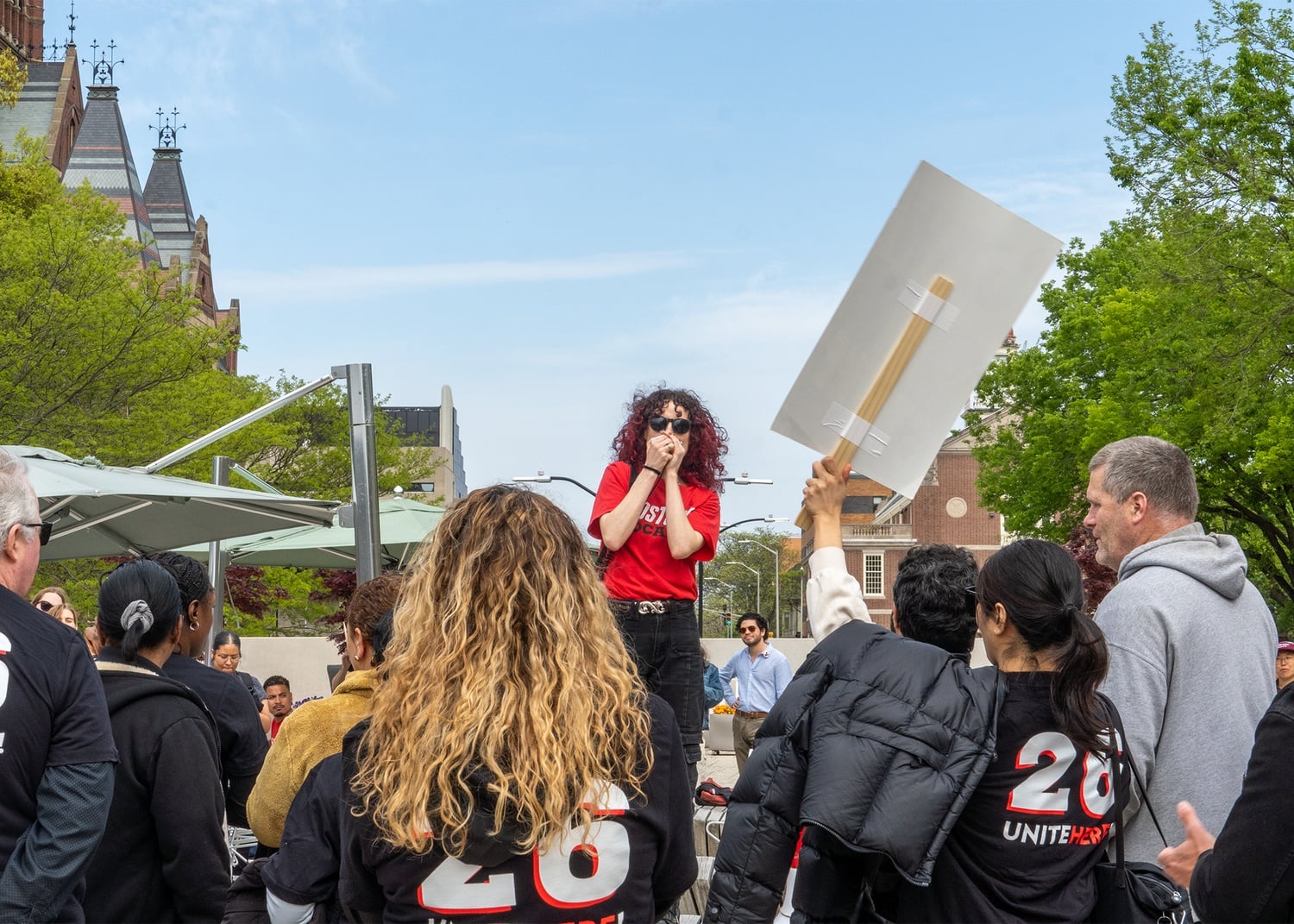
More than 200 Harvard dining workers rallied outside the Smith Campus Center on Wednesday after the University rejected most of the union’s contract proposals, escalating tensions in ongoing negotiations over wages and health care costs.
The rally, organized by UNITE HERE Local 26, came as Harvard University Dining Services workers continue bargaining with the University over a new contract. The union, which represents hospitality workers across Massachusetts and Rhode Island, including dining staff at Harvard and MIT, is seeking higher wages and lower health care costs for HUDS employees.
The current contract is set to expire this summer.
At the rally, union leaders said Harvard had rejected 37 of the 40 proposals put forward by Local 26. In its latest offer, the University proposed annual wage increases of 87 cents per hour over six years, according to the union.
Carlos R. Aramayo, president of Local 26, said Harvard dining workers now earn significantly less than their counterparts at other universities in the Boston area.
“The reality is that right now, a cook at Harvard makes about $31 and change,” he said. “If you go down the street to MIT, a cook makes between $35 and almost $37 depending on which dining hall they’re working at.”
Aramayo said Local 26 recently reached an agreement with MIT that will give dining workers there a $6-per-hour raise over three years — a deal he said would widen the gap between Harvard and MIT dining workers.
“10 years ago, Harvard was the leading employer in dining services in the region, and now they’re lagging behind, not just MIT, but Northeastern and a whole number of other places,” Aramayo added.
Workers at the rally described the issue as extending beyond wages, saying they were also frustrated by the cost of health insurance under Harvard’s benefit plans.
Daniel DeKorne, a HUDS employee who spoke at the rally, said some HUDS workers pay between $140 and $170 dollars per week in health insurance premiums, while dining workers at MIT pay substantially less under their union health plan.
Get The Crimson in your inbox.
“Not only are we getting paid the least, we’re paying the most for health insurance,” DeKorne said. “It’s ridiculous.”
Angel Hernandez, a HUDS employee of nearly 30 years and a union leader at Annenberg Hall, said workers are not asking for more than they need.
“All we do is work overtime, and we can’t even see our families,” he said. “We can’t go on vacation, we can’t do anything — school, gas, everything’s expensive.”
John E. Hughes, a HUDS worker of more than 10 years, said he attended the rally because he believed public pressure was necessary to move negotiations forward.
“Their offer to us — it’s embarrassing in terms of healthcare costs,” Hughes said. “It doesn’t address healthcare costs at all. It was like an insult for us to have to go in there.”
Harvard spokesperson Jason A. Newton wrote in response to the criticisms that the University “deeply values our dining services employees and the important work they do for our students, faculty, families and guests.”
“Harvard is bargaining in good faith and will continue to do so to reach an agreement,” he wrote, pointing to the University’s 97 percent retention rate among HUDS employees this past year.
After rallying outside the Smith Campus Center, roughly 100 dining workers marched to the Science Center Plaza, where members of the Harvard Graduate Students Union-United Auto Workers union were picketing as part of their now nearly month-long ongoing strike.
HUDS workers joined the picket line around 3:40 p.m., carrying HGSU-UAW signs as they circled the plaza.
Aramayo said the show of support reflected a broader tradition of solidarity across campus unions. During Local 26’s 2016 strike, he said, dining workers received support from students, faculty, and other unionized workers across Harvard.
“Solidarity is a lot of what labor movements are all about,” Aramayo said. “When other workers, — right now, the graduate teachers and researchers, are out there trying to fight for a fair contract — we’re going to back them up 100 percent.”
Aramayo said the union is prepared to continue escalating if Harvard does not change its position at the bargaining table.
“We’ve got to see what the administration’s response is,” he said. “Hopefully we can make some progress in the bargaining, but if not, we’re ready to take more action going forward.”
—Staff writer Thamini Vijeyasingam can be reached at [email protected]. Follow her on X @vijeyasingam.
Want to keep up with breaking news? Subscribe to our email newsletter
Have a tip for The Crimson? Share it confidentially