From Cannes: ‘Full Phil’ is Remarkably Empty
Dir. Quentin Dupieux — 2.5 Stars
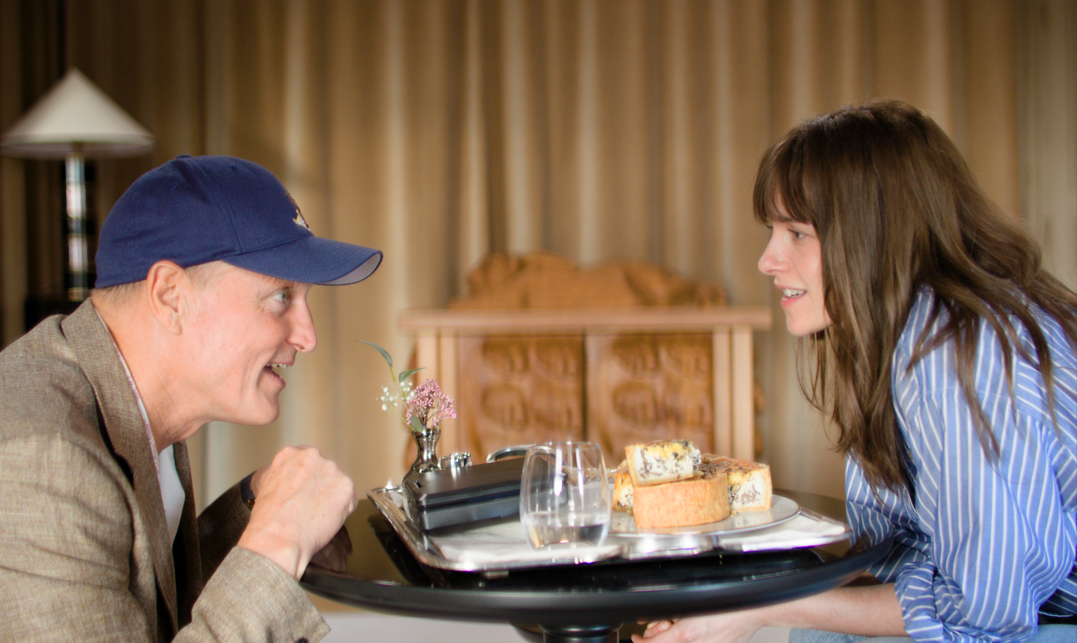
Quentin Dupieux’s “Full Phil” is an outlandish comedy that reaches for profundity but settles for spectacle.
The film follows Philip “Phil” Doom (Woody Harrelson) on a luxury trip to Paris with his estranged daughter Madeleine Doom (Kristen Stewart) — an attempt at reconnection which quickly unravels into gluttonous meals and escalating melodrama.
When hotel attendant Lucie (Charlotte Le Bon) overhears a fight between the two, she plants herself in the room, convinced Phil may turn violent. What follows is a claustrophobic character study, set against the backdrop of French protests in the street below.
Part of the film’s charm is that none of the characters are redeemable. They pay for overpriced food that they toss on the ground in spurts of anger and complain about trivial issues, such as how to divide their massive hotel room into two halves for each lodger.
The satire is clear: These Americans gorge themselves on cake while France revolts outside their window, an echo of Marie Antionette that the film actualizes when Phil steps onto the balcony and calls out to the protestors.
While the characterizations are intentional and well-executed, Dupieux takes their flaws too far. There is a difference between characters who are unpleasant and characters who are unpleasant to watch — “Full Phil” crosses that line into the latter. The father is narcissistic, high-strung, and stubborn, and yet the daughter still emerges as worse: self-righteous, ungrateful, and callous, all while somehow overly sensitive.
The film’s star-studded cast is, curiously, too good at its job. A less capable cast might have softened the characters’ more exhausting qualities but, instead, these actors fully lean into the toxicity.
Perhaps the characters would come out stronger if the film’s message was more definite. Yet it remains unclear whether Dupieux wants the audience to empathize with one character, condemn them all, or simply observe them. This ambiguity prevents “Full Phil” from building any real depth.
Part of the film’s comedy is achieved through the main cast itself, but the funniest element is the black-and-white monster movie that Madeline watches on her laptop throughout the film: a parody of 1950s creature features, complete with Hitchcock-esque scores and actors delivering their lines with just the right amount of sarcasm.
The contrast between a self-aware monster movie playing in the background and insufferable characters arguing in the foreground is perhaps the film’s cleverest joke, and one that sustains itself far better than the actual narrative does.
However, with its 78-minute runtime, “Full Phil” is unlikely to be nominated for any major awards. It sits at an awkward middle ground: too long for a short, too short for a feature. The runtime thus suggests that critical acclaim may not be what the creators are after — and hopefully that is the case, as the film received only a brief standing ovation, though that might also have to do with the fact that the premiere ended at two o’clock in the morning.
Still, the short runtime actually redeems the film, keeping it consistently funny even when not particularly meaningful. The film’s plot lacks the robustness of a traditional 90-minute feature, so instead of adding unnecessary minutes, Dupieux keeps the plot moving, always cutting a scene short before it threatens to lose momentum.
“Full Phil” is a well-made film, with great acting and comedy, that unfortunately remains hollow and superficial. But whether that is refreshing or frustrating depends entirely on what you are willing to settle for on a given evening.
—Staff writer Anat Goldstein can be reached at [email protected].
Want to keep up with breaking news? Subscribe to our email newsletter
Have a tip for The Crimson? Share it confidentially