At a faculty meeting last year, Harvard Faculty of Arts and Sciences Dean Hopi E. Hoekstra reached for an example to explain the limits of intellectual diversity.
FAS centers, she said, should engage the major debates in their fields. But some claims, she suggested, fall outside the bounds of serious academic debate. Creationism, for an evolutionary biologist, was one of them, she said, adding that she would not necessarily debate a creationist.
The analogy quickly turned back on Harvard.
Faculty members pressed whether the University’s new emphasis on viewpoint diversity risked elevating ideas that did not meet standards of academic rigor. English professor Elaine Scarry then reframed the question: What if Harvard accepted a false description of itself simply because powerful outsiders kept repeating it?
Scarry’s point was about antisemitism — and whether Harvard, under political pressure, had begun adopting the premise and language of its critics.
The exchange distilled the central tension in Harvard’s recent push toward viewpoint diversity: how to broaden intellectual life without turning external pressure into academic principle.
Now, that tension is moving into faculty hiring along two tracks.
The first is a centralized fundraising push, called the Initiative to Advance Free Inquiry, under which top officials have approached donors since last summer about endowing $10 million professorships earmarked for “viewpoint diversity.” The name of the initiative has not been previously reported.
The second is unfolding in individual departments, where new faculty searches and school-level initiatives suggest that the University’s once-abstract commitment to viewpoint diversity is finally beginning to take form. But even as the term appears to be shaping searches, administrators and faculty have yet to settle on what it means.
A Harvard spokesperson said none of the current or planned faculty searches identified by The Crimson are part of the Initiative to Advance Free Inquiry.
Get The Crimson in your inbox.
But the activity at the department level marks a new stage in Harvard’s effort to respond to one of the most persistent critiques it has faced since Oct. 7, 2023: that its classrooms and faculty are too ideologically narrow to meaningfully support open inquiry.
Widening the Search
The clearest sign of the shift in hiring is in the FAS’ Government department.
Two new searches — one in American politics and one in international relations — have moved forward despite a University-wide hiring freeze. Faculty involved in both searches were instructed to consider viewpoint diversity as they evaluated candidates, according to two faculty members familiar with the matter.
Neither search is for a routine replacement. Both are new professorships. And the public postings for the roles do not directly use the phrase “viewpoint diversity.”
Instead, they ask for scholars who would broaden the intellectual range of their fields.
The American politics listing says Harvard is “particularly interested in scholars whose research and teaching significantly expands the traditional academic discourse about national and world affairs.”
The international relations listing uses similar language, seeking scholars whose work expands traditional academic discourse on “interstate security conflict and cooperation.”
The wording is careful. It does not directly ask for conservatives nor does it mention party affiliation. But inside Harvard, the searches are being understood against the backdrop of Harvard’s broader push to expand the range of views represented in academic life.
“These search areas are vitally important for teaching and research,” Harvard Dean of Social Science David M. Cutler ’87 wrote in a statement. “The search committees are operating with utmost care and openness. We are optimistic that these searches will lead to hires that enrich the entire community.”
For the American politics search, the committee is currently considering three candidates: Stanford University professor and Hoover Institute senior fellow Justin R. Grimmer; University of Chicago professor Anthony G. Fowler; and Johns Hopkins University professor Hahrie C. Han, according to two faculty members familiar with the matter.
For the international relations search, the committee is currently considering four candidates: University of Pennsylvania professor and former Biden administration official Michael C. Horowitz, Georgetown University professor Yuri Zhukov, Rice University professor Brett Ashley Leeds, and Brown University professor Rose McDermott, the two faculty members confirmed.
In particular, the committee is “learning strongly toward making a recommendation for an offer to Horwitz,” according to an email obtained by The Crimson.
Horwitz declined to comment on the circumstances of his recruitment. Grimmer, Fowler, Han, Zhukov, Leeds, and McDermott did not respond to requests for comment.
The names under consideration complicate the idea that the searches amount to a straightforward conservative hiring push. The candidates span a range of methodological approaches, institutional backgrounds, and areas of expertise — suggesting that, at least in practice, Harvard’s viewpoint diversity push may be less of a partisan screen than a broader mandate to find scholars whose work departs from the dominant approaches in their fields.
The Harvard Kennedy School has also received approval for a public policy search focused on American politics. A posting for the position says scholars who study “American principles, institutions, and norms that support a free and fair society” are “welcome to apply.”
Possible areas of specialization include individual liberties, federalism, government regulation and efficiency, electoral campaigns, social and religious movements, and the relationship between government and private citizens.
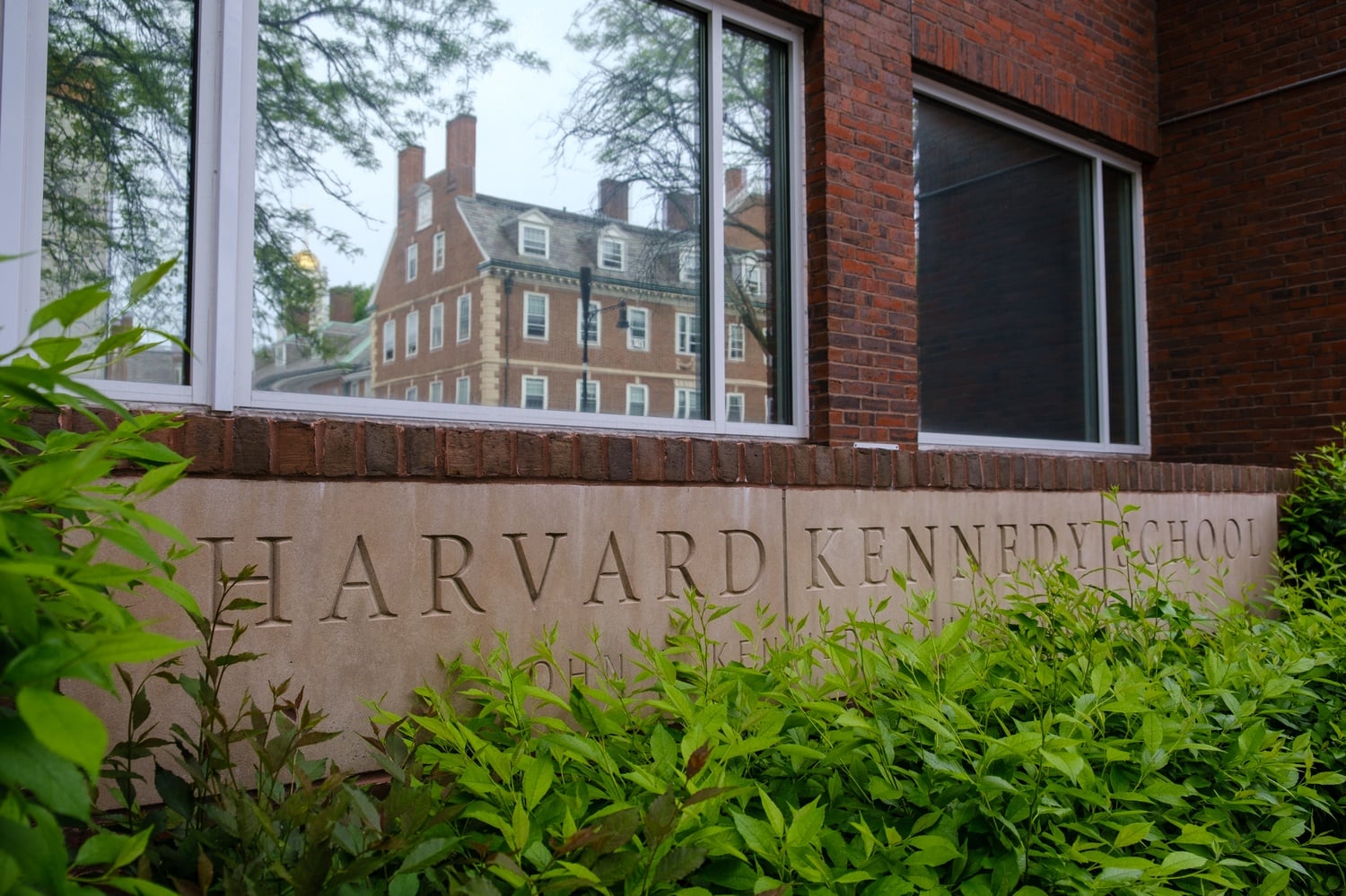
Matthew A. Baum, an HKS professor, said the search is intended to fill gaps in the school’s faculty expertise. He said viewpoint diversity has been a priority at the Kennedy School for years, reflected in public programming, internal meetings, student interactions, and classroom life.
“The administration of the Kennedy School has been significantly focused on viewpoint diversity for quite a few years now,” Baum said. “It’s been something that has been reflected in public programs, in internal meetings, in interactions with students in the classroom, and pretty much every environment around the Kennedy School.”
At Harvard Law School, hiring has continued with fewer interruptions. This spring, HLS extended the offer for a professorship to Notre Dame law professor Sherif Girgis, according to an HLS faculty member familiar with the matter.
Girgis, who served as a visiting professor at Harvard Law School in spring 2026, is known in part for co-authoring “What is Marriage? Man and Woman: A Defense,” which argues that marriage is inherently a union between a man and a woman. He has not yet accepted the offer, the faculty member said.
An HLS spokesperson declined to comment on his recruitment. Girgis did not respond to a request for comment.
An Existing Issue
The push for viewpoint diversity did not begin with the Trump administration. But it accelerated after Oct. 7, 2023 and took institutional form under Harvard President Alan M. Garber ’76.
Faculty including University Professor Eric S. Maskin ’72 said concerns over viewpoint diversity have circulated at Harvard for decades.
“I think there have been problems with viewpoint diversity for many, many years going back to my student days,” Maskin said. “A speaker would be invited to Harvard and then they’d be shouted down rather than listened to.”
Maskin later helped found the Council on Academic Freedom at Harvard in 2023, with academic freedom, viewpoint diversity, and civil discourse as its core missions.
Former Harvard College Dean Rakesh Khurana said the issue became more visible around 2017 and 2018, as students voiced concerns about the social consequences of challenging what he called a “perceived progressive orthodoxy.”
But Khurana also said the discussion then was less about hiring new faculty than about making better use of the perspectives already present on campus.
“Discussions about the kind of range of viewpoint diversity in the classroom” and the “openness of people to talk about different perspectives and points of view” have been around for more than a decade, Khurana said.
That changed after Hamas’ Oct. 7 attack on Israel and the war in Gaza. Harvard came under sustained criticism from students, alumni, donors, lawmakers, and federal officials over its handling of antisemitism, anti-Muslim and anti-Arab bias, protest, and academic speech.
In January 2024, Garber announced presidential task forces on antisemitism and anti-Israeli bias and on anti-Muslim, anti-Arab, and anti-Palestinian bias. When the final reports were released in April 2025, Garber wrote that the previous academic year had been “disappointing and painful” and said members of the community reported feeling targeted and shunned based on their identities.
The task force response folded bias prevention into a broader project of open inquiry. Garber pledged new efforts to combat antisemitism and anti-Israeli bias, address anti-Muslim and anti-Arab bias, and “speed the establishment” of a University-wide initiative to promote viewpoint diversity.
That spring, the federal government pushed the issue further. In an April 2025 letter, the Trump administration demanded that Harvard audit its faculty, students, staff, and leadership for viewpoint diversity and reform any department found lacking by hiring a “critical mass” of new faculty in that field.
Garber rejected the demands — but also acknowledged that Harvard had “unfinished business” and needed to reaffirm “a culture of free inquiry, viewpoint diversity, and academic exploration.”
That meant Harvard began facing internal pressure to translate that commitment into practice.
In March 2025, Hoekstra asked FAS center directors to meet with divisional deans and explain how their programming promoted respectful dialogue across controversial topics and engaged the major debates in their fields.
Two months later, Garber described the problem in sharper terms. In a May interview with the Harvard Gazette, he said Harvard faced complaints that it had a “political monoculture” because faculty and students skewed left compared with Americans overall.
“This means that there is at least a risk — particularly in the social sciences and humanities — that our community will not be exposed to the full range of ideas that should be discussed and debated,” Garber said.
By August, the Government department’s hiring plans were being described to a donor in similar terms. In a “talking points” document — prepared ahead of a call between a donor and Government department chair Daniel Carpenter — the department was reported to have stood at a “tipping point” as a senior faculty approached retirement and student interest drove increased enrollments.

The report, which was leaked in February by ShinyHunters, described the searches as a “pivotal strategic opportunity” to shape the future of Government in FAS and said the department was recruiting “a cohort of eminent scholars whose research interests and methods will expand the breadth of scholarly perspectives among its faculty.”
It also said the department had a particular interest in recruiting scholars who “contest prevailing paradigms,” and “critically engage with commonly held assumptions.”
A Term Broad Enough to Divide
Harvard faculty do not agree on what viewpoint diversity is supposed to fix.
For some, the term names a shortage of conservatives. For others, it describes narrower blind spots inside particular disciplines. Still, others say it should refer to classroom practice, not faculty politics.
The University has not yet resolved those tensions.
Harvard College spokesperson Jonathan Palumbo pointed to the College’s Intellectual Vitality initiative when asked how the College defines viewpoint diversity, describing it as a commitment to “a campus culture where curiosity is expected, tough questions are welcome, and diverse perspectives are the backbone of who we are.”
FAS spokesperson James Chisholm pointed to the School’s civil discourse initiatives, which aim to build “an inclusive academic environment that fosters critical thinking, empathy, and mutual understanding.”
Both definitions place viewpoint diversity within Harvard’s broader push for open inquiry. But neither answers the question now before search committees: which viewpoints Harvard believes are missing from its faculty.
A University spokesperson did not provide a definition for viewpoint diversity.
For Harvey C. Mansfield ’53, a longtime Government professor and one of Harvard’s most prominent conservatives, the answer is straightforward.
Viewpoint diversity, he said, is about “bringing conservatives” to Harvard.
“It begins from the almost total absence of one of America’s two major parties in higher education,” he said. He noted that this fact was finally being recognized by Republicans such as Donald Trump — “it’s become an issue that Republicans resent,” he said.
Mansfield said Harvard could pursue that goal directly by asking faculty to identify respected coverages in their field, and indirectly by hiring in areas likely to attract conservative scholars, such as military history.
Tyler J. VanderWheele, a professor of epidemiology at the Harvard School of Public Health, also tied the issue to ideological imbalance, but framed it as an academic problem.
He said that the lack conservative faculty members is “actually impeding academic progress and discourse and the rigorous evaluating of evidence.” He added that “that then goes on in turn to affect classroom settings, and the extent to which students feel comfortable expressing what might be a less popular position.”
Other faculty said the term should not be reduced to partisanship.
Martin Puchner, a professor of English and Comparative Literature, said viewpoint diversity should be defined by discipline. In literary studies and cultural history, he said, the problem is not simply a lack of Republicans, but a “contraction of viewpoints.”
“What we need in this context is not just a few hires that carry the label conservative thought, but a broader conversation, discipline or division specific, about the kinds of perspectives that we need for the health of these disciplines that we don’t have right now,” he added.
Maya Jasanoff, a History professor who co-chaired the FAS Classroom Social Compact Committee with Economics professor David I. Laibson ’88, was more skeptical of applying viewpoint diversity to hiring.
Jassanoff said the phrase can “ossify people’s opinions” by assuming faculty will always represent a fixed set of views. She said the Classroom Social Compact Committee was more concerned with creating classrooms while being evaluated by academic standards.
“Good classroom teaching is about the quality rigor of discussion and engagement,” Jasanoff said. “It’s not about the perspective that you happen to take on.”
Khurana made a similar distinction.
He said because Harvard should seek scholars from a wide range of backgrounds and experience, because those differences can shape the questions scholars ask. But he said searches should remain focused on evidence.
“We want to make sure that different backgrounds and experiences do really strengthen the types of research questions people ask, but we want to make sure that people also at the same time evaluate the evidence objectively,” Khurana said.
University Professor Danielle Allen, who co-chaired the 2016 Presidential Task Force on Inclusion and Belonging, said viewpoint diversity was not a break from Harvard’s earlier diversity work. It was part of the original conception.
“We let out a concept of diversity that was very broad,” Allen said.
Allen said Harvard had institutionalized a narrower version of diversity than the task force envisioned.
“That institutionalization did not happen, a narrow conception got institutionalized, and now the aperture is being widened again, and that’s a good thing,” she said.
—Staff writer Alexa M. Schmitt can be reached at [email protected] or Signal at alexaschmitt.15. Follow her on X @alexa_m15_s.
—Staff writer Abigail S. Gerstein can be reached at [email protected] and on Signal at abbysg.97. Follow her on X @abbysgerstein.
Want to keep up with breaking news? Subscribe to our email newsletter
Have a tip for The Crimson? Share it confidentially