
A Month Without TFs: How HGSU-UAW’s Strike Reshaped the End of the Spring Semester
When the Harvard Graduate Student Union-United Auto Workers set its strike deadline for the end of April, undergraduates were already counting down to summer.
Classes had weeks left before final exams, internships were locked in, and graduation plans were falling into place as semester commitments wound down.
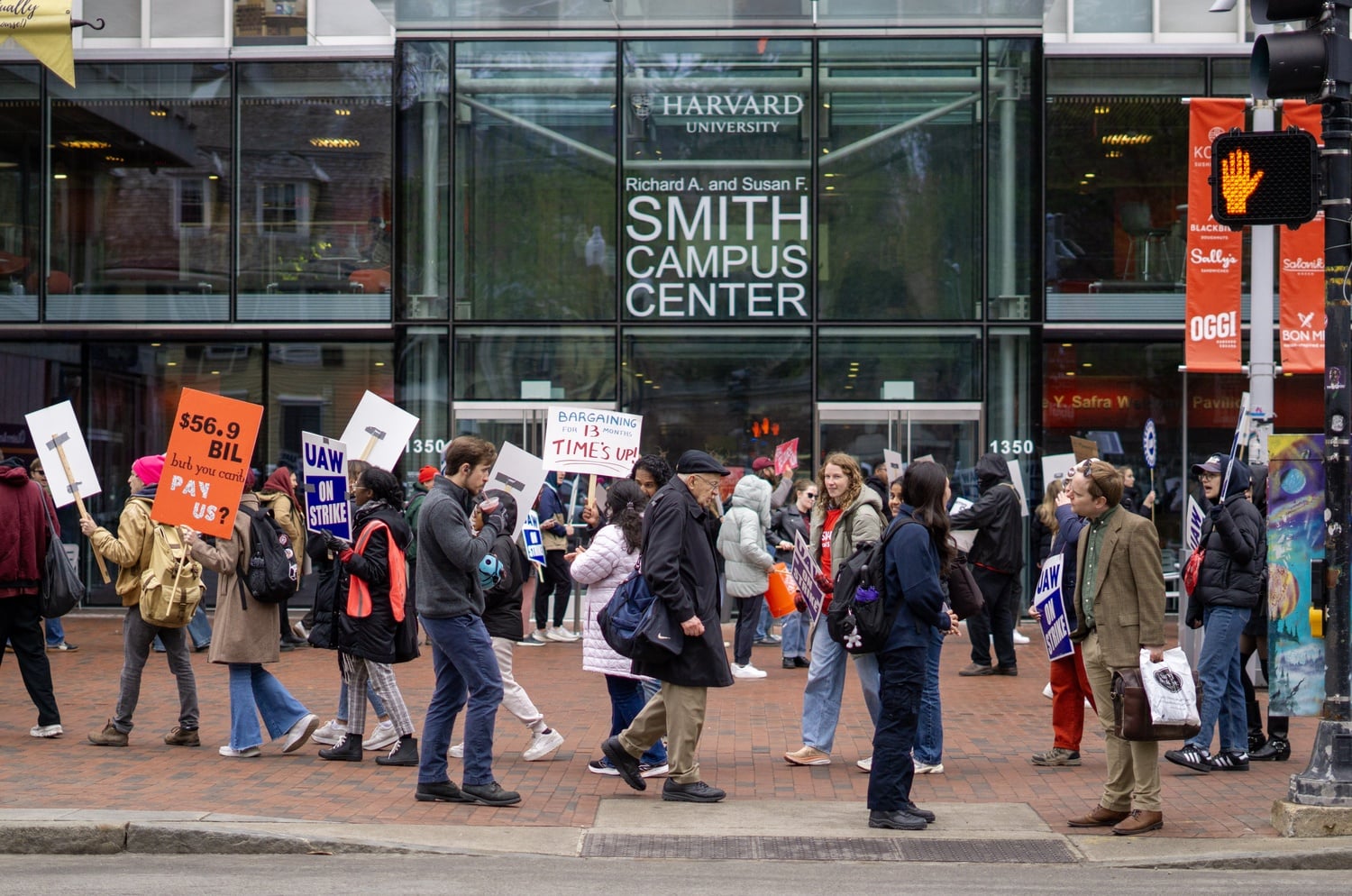
That changed at 6 a.m. on April 21, when another failed bargaining session put the strike into effect and union members raised picket lines across campus. Professors scrambled to reschedule courses and grade assignments without their teaching fellows for the first time since the union’s last strike in 2021.
Over the next month, the pockets of College academics that depend on graduate student labor exposed themselves one by one. Instructors lost the TFs who graded papers, led sections, and ran office hours. Without that support, they were left stretching themselves thin to fill the gaps.
On May 20, the strike officially became the longest in HGSU-UAW’s history, surpassing the 29-day record set in January 2020. Whereas past strikes had taken place earlier in the academic year, this one collided with the end of spring semester and grade submission deadlines for seniors who needed transcripts to graduate.
The union calibrated its leverage accordingly. The night before exam period, HGSU-UAW began formally asking faculty to withhold all grades, including those of seniors expecting Honors designations on diplomas. But faculty largely worked to adapt, minimizing disruption where they could. As students left Cambridge for the summer, one of the union’s key sources of pressure dissipated with them.

‘We Really Didn’t Have Any Preparations’
University officials had been preparing faculty for the possibility of a strike for weeks. On March 13, Deputy Provost Jessica L. Soban ’02 and Managing Director of Labor and Employee Relations Paul R. Curran emailed faculty with guidance on “strike contingency planning.”
“We remain committed to reaching a reasonable and mutually agreeable collective bargaining agreement with HGSU-UAW,” Soban and Curran wrote. “However, if the union initiates a strike, we also have a responsibility to maintain continuity in teaching, learning, and research for our students, faculty, and other researchers.”
Get The Crimson in your inbox.
On April 3, two days after the union voted to authorize the strike, Associate Dean of Undergraduate Education Gillian B. Pierce ’88 told faculty it “would be prudent” to begin preparing. Her email reminded faculty that they could not ask course staff “whether they intend to strike,” but that once the strike began, they should ask “whether they are planning on continuing to work.”
In the final weekly teaching meeting for Government 97 — a tutorial for sophomore Government concentrators — before the strike deadline, TF Rochelle Sun said she raised the possibility of a strike herself to the course head Stephen D. Ansolabehere.
“The response from Professor Ansolabehere was that he was instructed by the University that he’s not allowed to talk to us about this,” Sun said. “So we basically just continued the teaching meeting as if that wasn’t something that was looming over us.”
“We really didn’t have any preparations,” Sun added. “Not at a GOV 97-wide level.”
Physics professor John Huth said the University’s guidance made preparing for the strike “challenging.” He said he informally spoke with his TFs, assessing whether they could help out without asking the prohibited question.
“We weren’t supposed to ask the TFs directly, ‘Are you striking or not?’” Huth said, adding that the absence of TFs made finalizing laboratory grades difficult.
“I could have used a little bit of help, and I was canvassing the TFs, and probing them if they could help out, but not asking directly,” he said.
When a TF responded to let him know that they were on strike, Huth was grateful.
“I said, ‘Hey, thank you for telling me. I wasn’t sure exactly how to word this sort of — appreciate you transmitting this to me ,’” he said.
A subtler question was whether to submit intermediary grades on assignments completed before the walkout. Mercer M. Greenwald, Ph.D. student who taught a section of GERMAN 10B: “Beginning German,” said the union’s lawyers advised against submitting even intermediary grades once the strike had begun.
“We talked to a lawyer of the union who said that that would be in violation of the strike, so we didn’t do that,” Greenwald said.
Sun called the choice a “catch-22.”
“Is it fair to share intermediary versions of grades, knowing that the biggest assignment in the class hasn’t been submitted yet, and knowing that it was very likely that if other people were going to step in for our labor, they were probably going to base a lot of their decisions off of that intermediary grade?” she said.
Harvard spokesperson Jason A. Newton wrote in a statement that the University “remains optimistic” about finding a path out of the strike, pointing to its recently proposed package contract that the union has since rejected.
“The University remains committed to reaching an agreement with HGSU-UAW, one that continues to recognize – as the union’s two previously-ratified contracts have – the important role student workers have in fulfilling Harvard’s teaching and research mission,” he wrote.
A Choice To Make
The strike began the morning of Tuesday, April 21 — eight days before the final day of spring classes. Some courses cancelled sections or moved online, while others combined sections.
Huth said he adjusted deadlines so students wouldn’t have to choose between crossing a picket line and finishing a lab.
“I knew that the Science Center would be a place where people would be picketing,” Huth said. “My main concern was I didn’t want to put the undergraduates in a situation where they might have to make a choice between crossing a picket line or not completing a lab.”
TFs faced their own calculations. Isiaha Price, a TF for LIFESCI 1B: “An Integrated Introduction to the Life Sciences,” said he tried to balance the union’s interests against his students’.
“I was very upfront with the course instructors, both in wanting to not reveal too much — because part of the strike is the surprise of the strike — but also making sure there was some opportunity for them to plan,” he said.
For Price, the union’s medical funds had paid for treatment after a gastrointestinal bleed in his first year of his Ph.D.
“It was several thousands of dollars that I just would not have been able to materialize without taking on serious debt,” he said.
But others were more resistant to join the picket line. Marco E.M. Avina, who taught a section of GOV 97, said he didn’t want to abandon students in the middle of the tutorial.
“I made an engagement at the beginning of the semester to take on my students, and I wanted to see that to the end,” Avina said. “It was my responsibility as a teacher to complete my contract.”
Several students pointed to cancelled office hours, online classes, and picket-line noise as disruptions to their final exam preparation.
Greenwald expected her students’ exam scores to reflect the gap.
“You’re out of practice for weeks, and then you just have to sit for an exam,” she said. “I imagine the performances on that test are pretty abysmal as a result of the strike.”
Kow W. Simpson ’26 said the strike landed at the worst possible moment for engineering coursework.
“Without office hours, without TFs being available to answer our questions, it was every man for himself for some of my classes,” Simpson said. “Some classes weren’t taught well to begin with, and then with the strike going on, it’s like everyone’s on their own.”
HGSU-UAW wrote in a statement to The Crimson that the University was to blame for the strike’s impacts on undergraduates.
“The University administration has intentionally caused an educational crisis for its students,” the union wrote. “These disruptions evidence how vital the work of student workers at Harvard is to the smooth operation of classes and the prompt return of grades.”

To Grade or Not To Grade
The gradebook became one of the strike’s central battlegrounds. Two days before the strike deadline, the Harvard chapter of the American Association of University Professors emailed faculty advising them not to submit grades for classes typically taught by HGSU or HAW members.
“Strikes are meant to disrupt business as usual,” the email read. “Anything you do to lessen the disruptive impact of the strike will diminish its effectiveness.”
On May 13, HGSU-UAW’s then-president Sara V. Speller and vice president Sudipta Saha sent their own message, reiterating the union’s May 6 request to faculty not to submit any final grades for affected courses, including for seniors.
“Do not grade any assignments or submit any grades for classes that HGSU instructors and graders are usually responsible for, including grades for seniors,” they wrote.
Later that day, Faculty of Arts and Sciences Dean Hopi E. Hoekstra sent an email to faculty urging them to submit grades on time.
“For our graduating seniors, the calculation of honors depends on the prompt receipt of final grades, and certification of graduation is often necessary to start post-graduation programs, fellowships, or employment,” she wrote. “Other students, applying for internships or professional schools, may also be disadvantaged by incomplete or delayed transcripts.”
“As the course head, you have the ultimate responsibility for instruction, including the submission of each grade,” she added in a bolded font.
On the day seniors’ final grades were due, Dean of Arts and Humanities Sean D. Kelly wrote to faculty members with one final plea: submit final grades, especially those of seniors.
“The situation is less than ideal,” he wrote. “Without grades, they will not be able to graduate, and in some cases that will make it impossible for them to take up jobs, fellowships, or graduate school entrance.”
“We are roughly on par with last year in terms of handing in the grades for all our students,” he added, noting that nearly 95 percent of grades for graduating seniors had already been submitted.
HGSU swiftly sent out a response.
“Dean Kelly’s email, designed to scare those faculty who have not yet submitted senior grades, shows that all of you withholding are not doing so alone, and that the impact of doing so is far more powerful than the numbers alone evidence,” they wrote.
The ask put seniors at the center of the union’s leverage.
Seniors’ grades were due by May 18, while all other students’ grades were due three days later. A College spokesperson confirmed that by May 21, all FAS grades for graduating students of the College and Graduate School of Arts and Sciences had been submitted.
But a handful of professors had intended to honor the union’s ask. On May 15, Comparative Literature professor David M. Stern wrote in a Canvas announcement that he would not submit final grades for the 75 students in GENED 1090: “What Is a Book? From the Clay Tablet to the Kindle” until the strike ended.
“I do not want to break the strike,” Stern wrote in an announcement to the class. “I am extremely distressed at the way the Harvard administration has slow-walked the negotiations with the Union and not done everything it can to bring the strike to an end.”
Half an hour later, Stern sent a follow-up message asking seniors who needed letter grades for Honors designations or prizes to contact him directly.
“I don’t want to harm you more than Harvard already has,” he wrote. But he did not clarify how he planned to grade those students or whether the final project — worth 40 percent of the course grade — would factor in.
Pranav Ramesh ’26, a senior in the course, said while the delay didn’t concern him personally, he was more concerned for students relying on their transcripts for post-graduate applications.
“I think it is very concerning — on average — to people who need that kind of thing for especially med school or law school or any other post grad program,” he said.
By the evening of May 18, Ramesh and at least one other senior in the class had received a grade in the course and for their final assignments.
Sociology professor Jason Beckfield called the strike “extremely disruptive” in an interview with The Crimson, and estimated he would need more than 30 hours of additional work each week to grade his courses on time without his TFs.
“It’s very hard for me to imagine how faculty would get grades in on time if those grades are to be based on full and complete and robust evaluation done with integrity,” Beckfield said. “Anybody can turn in random grades on whatever timeframe anyone else wants, but there’s a reason why we’re paying these graduate students.”
On May 13, Beckfield emailed Harvard President Alan M. Garber ’76, Provost John F. Manning ’82, and Curran with the subject line: “Please settle the strike at tomorrow’s bargaining session.”
“Even if I wanted to replace struck labor, I couldn’t possibly do all three TFs’ work in time for the grading deadlines,” Beckfield wrote. “My research has taken a big hit as well, and my service as Director of Graduate Studies has become much more burdensome.”
“I am left with the choice of withholding grades until I can assign them with full information and integrity, or submitting grades based on suboptimal information,” he added.
The May 14 bargaining session did not end in a contract, and Beckfield did not receive a response for more than a week. A day after The Crimson requested comment from the University on the email, Curran wrote back to Beckfield.
“I appreciate you sharing your perspective,” he wrote. “While this has been a lengthy process, we remain confident that good faith negotiation will lead to a positive outcome.”
Other course heads rebuilt their syllabi last-minute. MCB 130: “The Pharmacy of Life” reweighted homework grades to favor problem sets graded before the strike. PHYSCI 11: “Foundations and Frontiers of Modern Chemistry” rewrote its final exam questions so an AI algorithm could grade portions of it automatically. ECON 1011B: “Intermediate Macroeconomics: Advanced” shifted its final form from handwritten to multiple choice for the same reason — a change student Kadyn A. Allen ’28 said cost students the partial credit they had built their studying around.
“A lot of what we’re graded on and what we get a lot of points for is partial credit,” Allen said. “And with multiple choice, there’s no partial credit for that.”

Economics professor Gabriel I. Chodorow-Reich ’05 wrote in a statement that the course heads were “aware that the multiple choice format does not allow for partial credit and took this into account when assigning grades.”
HIST 89: “Critical Theory” dropped its final paper requirement entirely. SOCIOL 1023: “Political Sociology” cancelled its final the night before the April 29 exam.
GOV 97 — the Government concentration’s required sophomore tutorial, with more than 200 students — kept its final paper. Nine of the course’s twelve TFs went on strike, leaving Ansolabehere to grade the majority of the papers himself.
Ansolabehere kept his response to The Crimson brief.
“Sorry,” he wrote. “I don’t have time to talk. I’m busy grading.”
With grades due and Commencement a week out, the administration’s position hardened. In a May 18 interview, College Dean David J. Deming said he sympathized with the union but would not let the standoff hold up diplomas.
“I understand the difficult situation they’re in, but seniors have to have grades so they can graduate, and as the Dean of the College, that’s my most important priority,” he said. “I want our students who spent four years earning their degree to graduate on time.”
—Staff writer Wyeth Renwick can be reached at [email protected]. Follow her on X @wzrenwick.
—Staff writer Claire L. Simon can be reached at [email protected] and Signal at csimon.13. Follow her on X @ClaireSimon.
Want to keep up with breaking news? Subscribe to our email newsletter
Have a tip for The Crimson? Share it confidentially