At Harvard Law, The Federalist Society’s Influence Endures Trump’s Estrangement
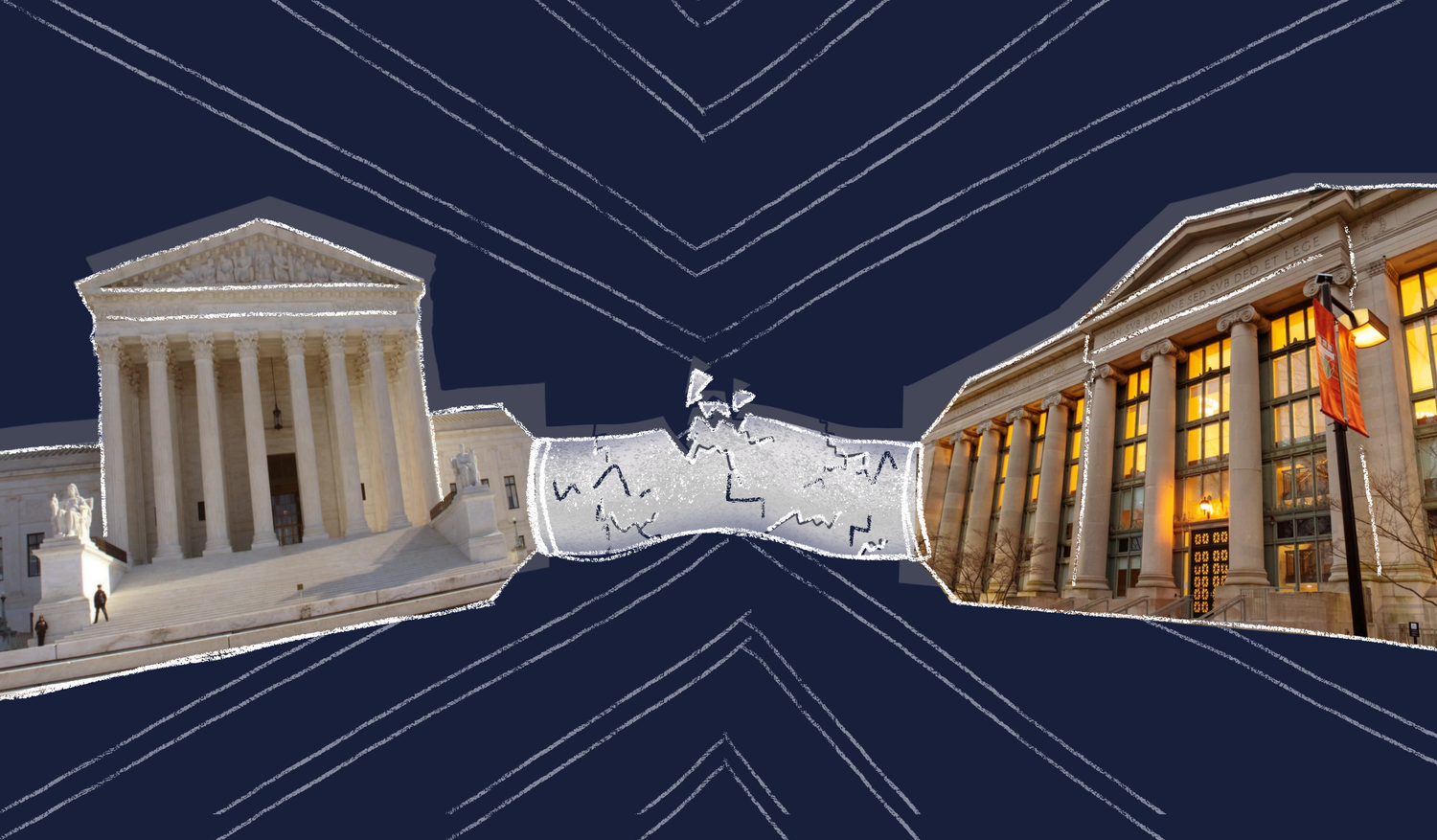
At Harvard Law School, the Federalist Society remains a powerful pipeline to conservative legal careers — even as Trump’s White House increasingly looks beyond Harvard’s elite credentials.
When Mason R. Laney arrived at Harvard Law School in the fall of 2023, he showed up at the HLS Federalist Society’s Welcome Barbecue without much of a plan.
“I was like, ‘Hey guys, I’m conservative, what should I be doing here?’” Laney recalled.
The answer came quickly. “‘Oh, let me help you,’” he remembered members telling him, ushering him into a society that would come to define his three years at the law school.
“That meant a lot,” Laney said.
The Federalist Society has spent more than four decades building a national network of conservative and libertarian lawyers, judges, and students rooted in originalist and textualist judicial philosophies. The organization has chapters at virtually every major American law school, and its leaders — chief among them Leonard A. Leo, the society’s longtime power broker — helped vet and recommend the nominees who would remake the federal bench during President Donald Trump’s first term.
That alliance has since unraveled in public. After a federal trade court struck down key Trump tariffs in May 2025, the president attacked Leo and the Federalist Society in a Truth Social post, accusing the organization of giving him “bad advice” on judicial nominations and calling Leo a “sleazebag” who “probably hates America.”
In his second term, Trump has steered nominations away from the elite law school pipeline the society spent decades building. He has instead favored graduates of state schools and rising institutions with conservative legal reputations like George Mason University’s Antonin Scalia Law School.
But at HLS, the Fed Soc chapter has only grown. Membership has increased, alumni return to recruit students for clerkships, and the chapter’s calendar of debates, symposia, and alumni dinners is as full as ever. For many of its current members, the chapter is less a debating society than a professional network — a pipeline into clerkships, law firms, congressional offices, and Republican administrations.
A Network Built From Scratch
The HLS chapter started with about seven members, filling what several founders called a void in conservative legal debate at the law school.
Get The Crimson in your inbox.
“Not surprisingly in the beginning, leaders of society really came out of the Yale Political Unions,” said Northwestern law professor John O. McGinnis ’79, a founding member of the HLS chapter. “What they were interested in was having more debate than they thought was going on at law schools because of the generally monochromatic or the ideologically homogeneous faculties.”
The HLS Republicans was founded after the Federalist Society chapter, according to co-founder Saied Kashani ’86. For years, the society functioned as the primary institutional home for conservative students at HLS, while liberal students could choose among affinity groups and organizations rooted in progressive legal values, such as the American Constitution Society.
May Mailman, a former White House senior advisor who graduated from HLS in 2015 and served as chapter president, said the absence of conservative faculty forced students to build the institution themselves.
“That was one of the premises of the Federalist Societies,” she said. “There was no faculty for these students — so they had to bring in speakers, they had to bring in the debates. You were not being taught about natural law at all in classes — ever.”
“The success of Fed Soc had absolutely nothing to do with conservative faculty members supporting it, but that’s not a knock. That’s the point,” Mailman added. “The point of Fed Soc is that that environment doesn’t exist.”
She credits the network for her first White House job, which came after a former classmate recommended her to their boss.
“I felt very indebted to Fed Soc for giving me the connection that someone from the middle of nowhere, Kansas, who never knew anybody, could ultimately work in the White House,” Mailman said. “People perceive politics and White House jobs, and just the world in general, to be a little bit of an old boys club. But Fed Soc, you can make your own connections.”
Over time, the chapter’s invited speakers and visiting judges began to form the outline of an alumni network. Members who graduated into clerkships and Republican administrations returned to recruit, recommend, and mentor — turning the society’s programming into a feeder system for the conservative legal world.
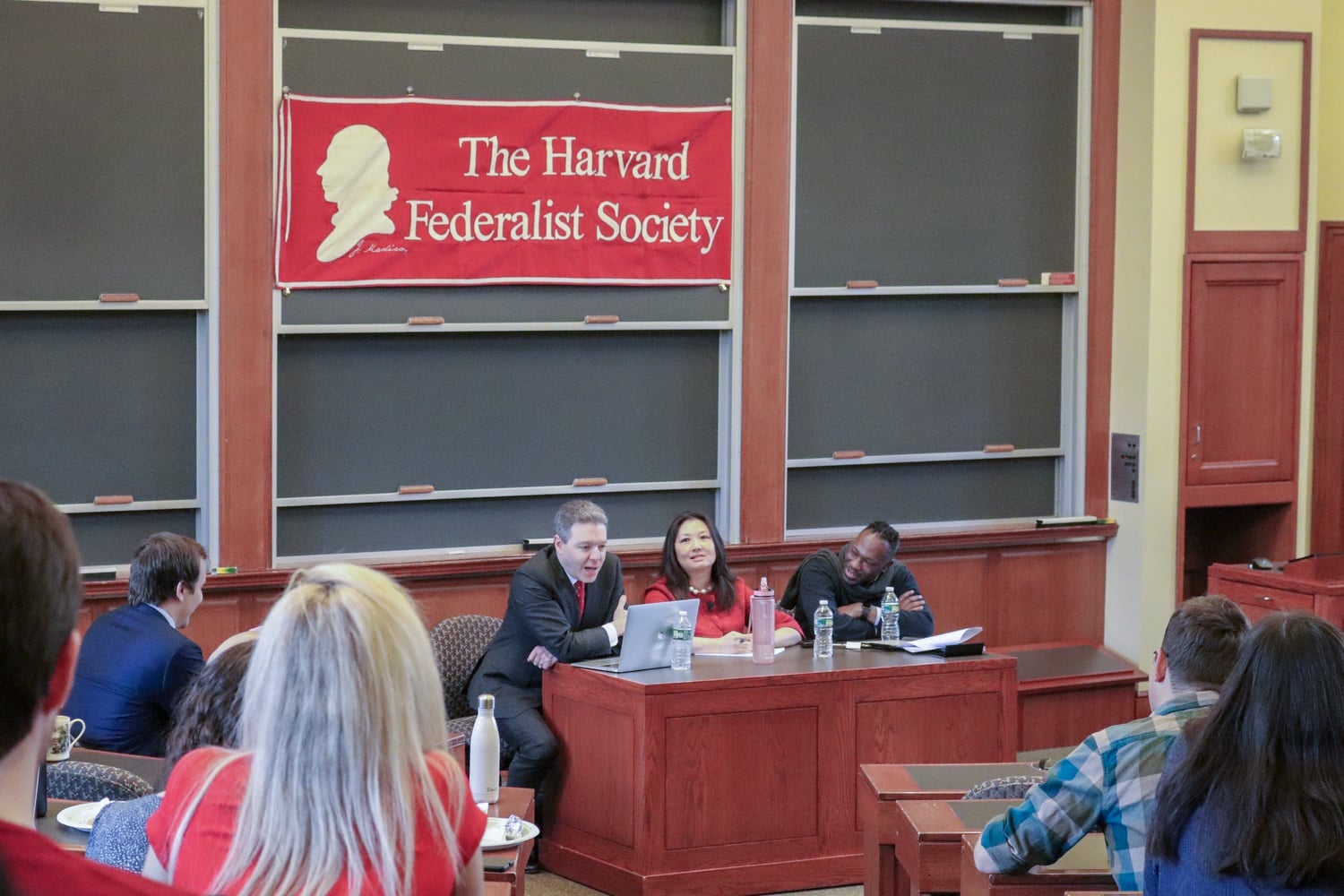
HLS alumnus Gabriel J. Krimm, who works in the Tennessee Attorney General’s office, said he meets students at alumni events and often helps place them in internships, either at his own office or through other contacts in his network.
“Sometimes because I’m now a practicing attorney, it turns into somebody’s going to come do an internship with me, right into the Tennessee AG’s office. And sometimes people will get such an internship independent of me,” Krimm said.
“You’ll have the school experience in common, and so then you’ll spend some time developing a relationship,” he added. “I try to keep in touch with a bunch of those people, because people did that for me and continue to do that for me.”
Clerkship Season
The chapter still hosts the lunchtime debates that gave the society its founding purpose, with federal judges, law professors, and senior government officials in conversation on religious liberty, executive authority, and contested legal doctrines. Some events are designed to feature a counterpoint, often a liberal faculty member.
But several of the events also center on the personal lives of the professionals onstage: balancing a judicial career with family, the inside of the Department of Justice, the practice of law and faith. In addition to the formal event, society members are often invited to a smaller dinner with the guest at a local restaurant.
The chapter’s most consequential work happens around clerkship applications, where a tight system of mentorship runs between current students, recent graduates, and judges themselves.
Second- and third-year members advise first-years, current clerks help vet applicants for the judges they work under, and some federal and state judges email recruitment notices directly to HLS students. The chapter also passes down institutional knowledge about which firms and which judges weigh ideological alignment in their hiring decisions.
“The Federalist Society was able to help me understand the mechanics of how to apply, as well as the underlying reasons to apply for a clerkship, and then, most concretely, how to assemble my list of judges and courts, and to think strategically about where I’d be most competitive and where I’d be the best fit,” said HLS alum Cameron J.E. Pritchett, who clerked for Supreme Court Justice Brett M. Kavanaugh.
HLS alum David J. Benger said he received mentorship from alumni for his own clerkship applications and now advises current students.
“A lot of it is done through networking and through knowing people, and Fed Soc kind of democratized that and facilitated that for people who did not come into HLS already having family relationships, or otherwise did not know any federal judges,” Benger said. “Fed Soc helped put everyone in an even playing field in that regard.”
The chapter also keeps its alumni close. Its annual symposium draws back graduates alongside legal scholars and guest speakers, culminating in an alumni banquet. An end-of-year boat cruise sends off third-years, with recent alumni often in attendance.
Harvard Kennedy School professor Maya Sen ’00, who researches federal courts, said the affiliation has become close to a credential.
“It would be hard to be a conservative law student, who’s really interested in a career in the federal judiciary, to not have a Federalist Society affiliation,” she said.
“Law students who are looking to signal that they’re conservative, and they have the conservative credentials, having the Federalist Society on your resume — it can be a really good way to signal that,” Sen added.
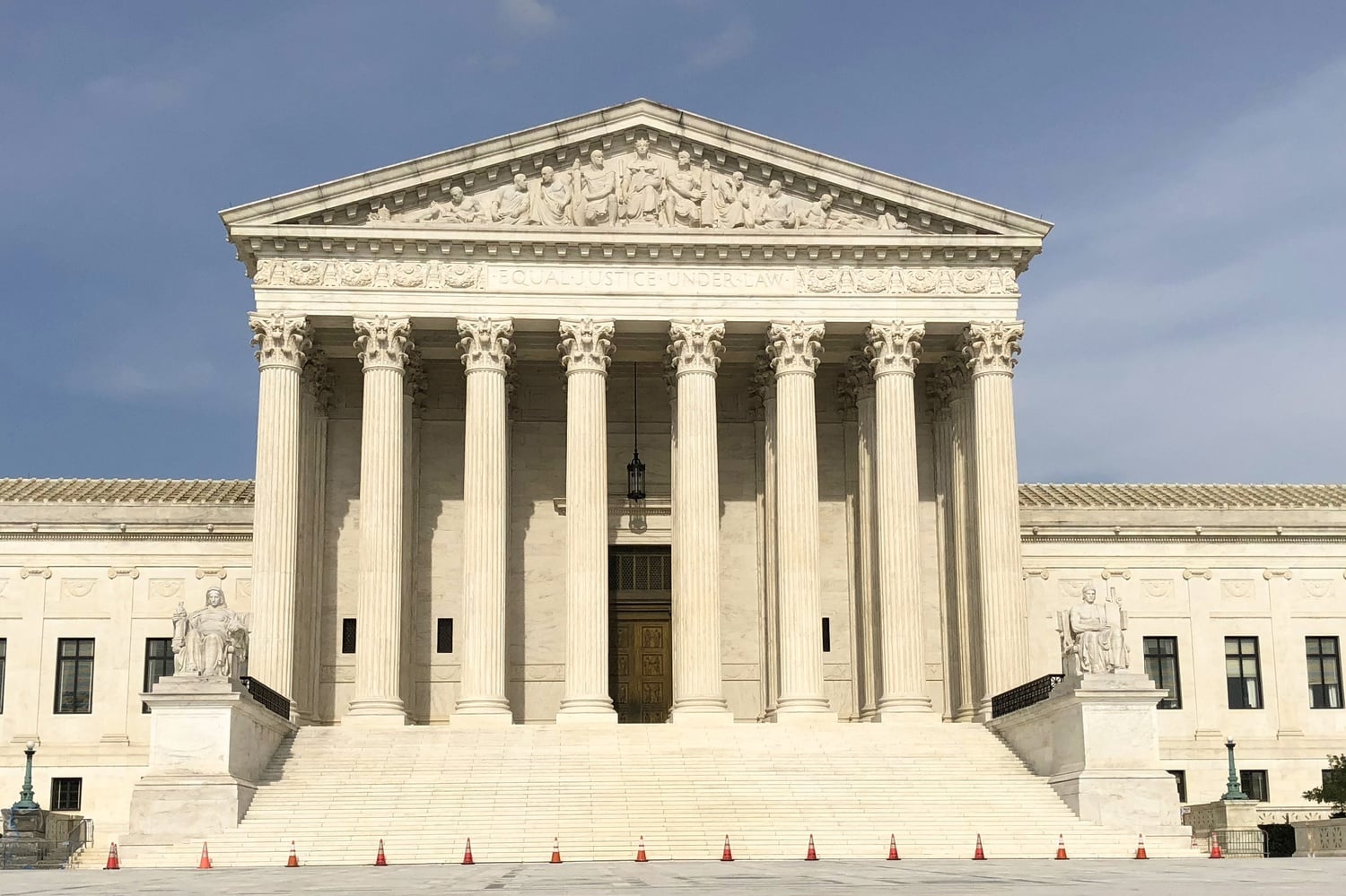
Five current U.S. Supreme Court justices are current or former members of the organization; a sixth, Chief Justice John Roberts ’76, has been described as affiliated with the society, though he has denied being a member. At least 50 percent of Trump’s first-term judicial appointees identified as current or former members on their confirmation questionnaires. In his second term, despite his public break with Leo, at least 70 percent of his judicial nominations still come from the same network.
In both terms, at least 80 percent of appellate court nominees were current or former members of the Federalist Society, while the rate of district courts rose from over 43 percent to 68 percent.
“They go for clerkships. They want big law jobs, they go for big law jobs. They want to work in the government, they go for work in the government,” Laney said of his fellow members. “If anything, the biggest difference is that we have more opportunity.”
Looking Past Harvard
In Trump’s first term, 20 of over 220 district and appellate level judicial appointees held Harvard degrees. So far in his second term, Harvard’s representation has fallen sharply: among the more than 50 judicial nominees Trump has named, only one attended Harvard.
Yale has seen a similar decline, from 15 appointees to four; the University of Chicago, from 11 appointees to three; and Stanford, from six appointees to zero.
The school now leading the list of appointee alma maters is George Mason University’s Scalia Law School, whose representation has grown from two to five appointees in the current term.
In Trump’s first term, out of nearly 100 nominations, he appointed six U.S. attorneys who graduated from HLS. This term, he has appointed one out of nearly 100 from Harvard.
Sen said the shift reflects what the administration is selecting for.
“You’re not necessarily wanting to prioritize qualifications or merit or attending an elite law school,” she said. “You want to prioritize getting judges on the courts who are going to uphold the President’s agenda.”
The White House did not respond to a request for comment.
Krimm, who graduated from HLS in 2017, said Trump’s rise raised new questions for conservative law students about how loyalty to the president fit with their own ambitions in government — a tension he said has persisted into his second term.
“When you’re a bunch of law students sitting around thinking, what does this look like for me if I’m still interested in working in government?” Krimm said. “It raised questions that people hadn’t really had to answer before.”
George Mason professor Eric R. Claeys said the school’s recent prominence reflects a deliberate move away from elite legal credentials.
“In his second term, Trump has been looking for people who don’t have the normal credentials. They’re in the conservative movement, but they don’t have the most conventional credentials,” Claeys said. “He’s looking for people who think outside the box, and there are more Mason alums who fit that pattern. There are more Mason alums who are willing to be populist conservatives than establishment conservatives.”
Robert Luther III, a George Mason professor who co-managed judicial selection in Trump’s first term, said proximity to Washington and faculty experience across all three branches of government give the school an edge during a Republican trifecta.
“Because our student body is reasonably small, at about 140 per class, we get to know every student, and think about our students when a lawyer or judge or person on the Hill says, ‘Hey, I’ve got an opening,’” Luther said. (Since 2019, he said he has helped more than 200 students obtain clerkships.)
Harvard, by contrast, has no publicly listed former Trump administration officials on its full-time law faculty — a gap Luther argued the school cannot afford.
“Why would a top-five law school like Harvard, with the resources that it has, not have, as far as I know, a single former Trump official at their law school?” he said.
“Over that period, there will be hundreds of federal judges, thousands of lawyers credentialed by service in this administration, and that network will build within that network, and historic institutions like Harvard will always do well,” Luther added. “The question is: are they missing an opportunity here? And I think they probably are.”
A HLS spokesperson declined to comment on the school’s faculty composition.
But the current dip in Harvard appointees may not last. A federal hiring freeze early in Trump’s second term briefly blocked HLS students from pursuing public service internships within the administration, though current students and recent alumni have since secured positions, according to Laney.
Michael R. Dimino Jr., a Widener University law professor and former HLS Federalist Society member, said students should not overweight the current administration when planning their careers.
“I don’t know that I would make many choices based on an expectation about what’s going to set me up well in a Trump administration that’s either going to be gone or about to be gone by the time I graduate,” Dimino said.
—Staff writer Caroline G. Hennigan can be reached at [email protected] or on Signal at carolinegh.53. Follow her on X @cghennigan.
—Staff writer Uy B. Pham can be reached at [email protected] or on Signal at ubp.88. Follow him on X @uybpham.
Want to keep up with breaking news? Subscribe to our email newsletter
Have a tip for The Crimson? Share it confidentially