From Cannes: ‘The End of It’ Is Morbid, Existential, and Comedic
Dir. Maria Martinez Bayona — 3 Stars
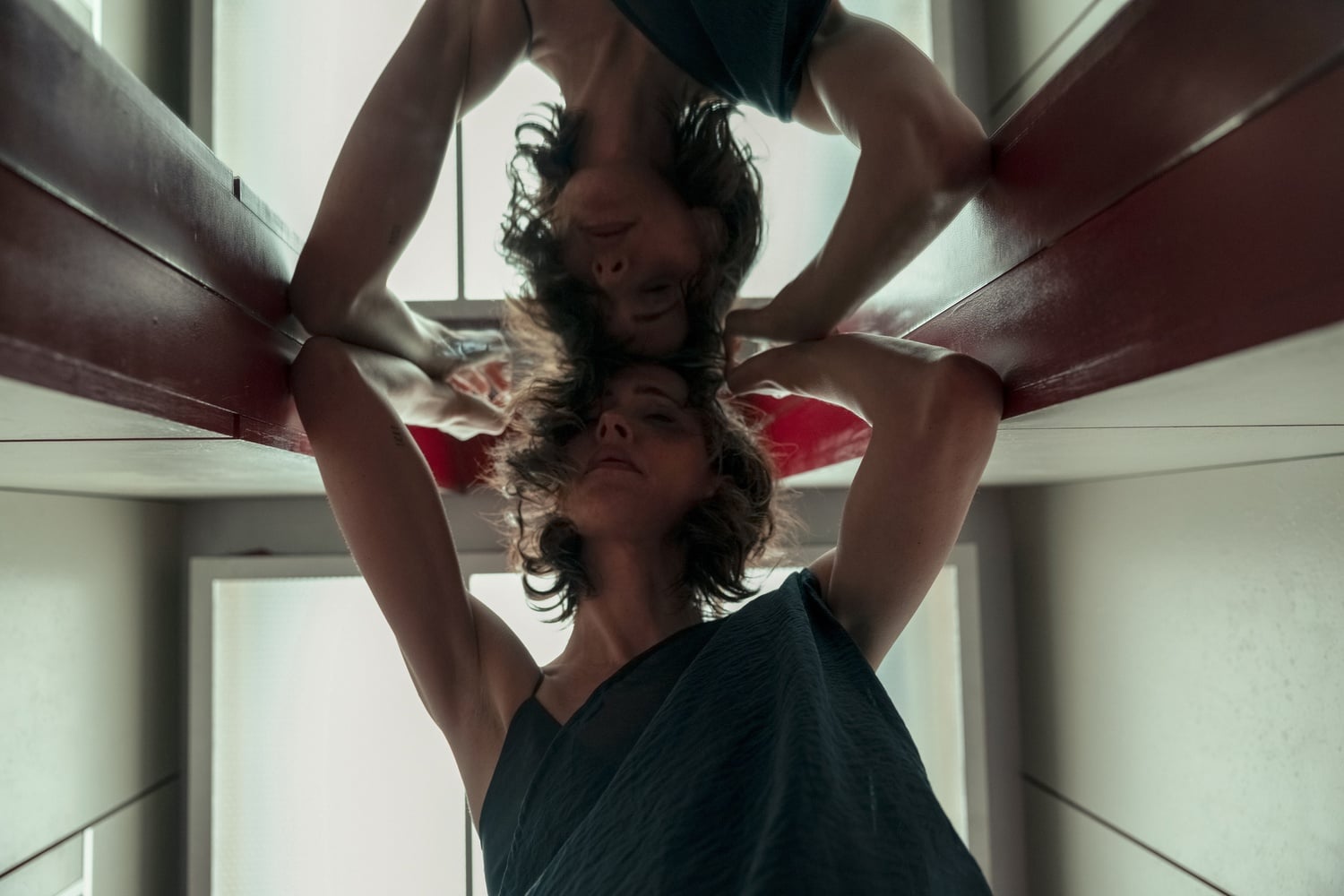
Set in a future timeline where modern technology has unlocked the secret to eternal youth, “The End of It” contemplates how the human condition evolves without the threat of death, and whether life retains any meaning once that threat is removed. The film delivers gorgeous visuals, humorous writing, and a strong performance from lead actress Rebecca Hall, but is ultimately held back by its weak supporting characters.
When renowned visual artist Claire (Hall) violently trips while running on a treadmill, she breaks a rib. At the doctor’s office, the bone is replaced, and she is told it was her last remaining real one. At her birthday party, now 250 years old, she grows existential: If none of her original parts remain, is she still herself? In this way, the premise brings the Ship of Theseus thought experiment to life.
Surrounded by shallow, artificially beautiful friends, Claire arrives at a morbid conclusion: She wants to die. Her journey toward that goal becomes the film’s central arc as she simultaneously explores what her final artwork should be. The arrival of her daughter (Noomi Rapace) adds another layer: In this world of fixed population, a death creates a vacancy, and her daughter — hoping to give birth — comes to claim it.
Philosophically, the film attempts to answer a genuinely interesting question: Do life’s joys still feel the same without the knowledge that they will end? Claire’s arc answers this question as the audience watches her run through the same daily routines — one as an immortal and one facing imminent death — in vastly different emotional states. Consequently, “The End of It” demonstrates that humanity is partially defined by its ephemerality.
However, “The End of It” struggles to perfect this message. The film’s greatest weakness is that no one besides Claire feels real. Her husband (Gael García Bernal) and daughter are the most glaring omissions. Both have lived for centuries and spent decades with Claire; their relationships should feel even more emotionally complex than those typically depicted on screen. Instead, they are reduced to familiar archetypes: the neglected spouse and child, victims of an artist’s dedication.
As a result, “The End of It” falls almost entirely on Hall’s shoulders. Her performance is deeply felt, grounding the film’s philosophical ambitions. Her performance is matched by only one other: Sarah (Beanie Feldstein), Claire’s AI assistant. Sarah looks human, but behaves robotically, providing Claire with medical and career support while also acting as Claire’s confidant. Feldstein takes on the difficult task of transforming a purposefully stiff, mechanical character into the emotional and comedic heart of the film. Through her performance, she brings both depth and entertainment to every scene she is in.
Another successful facet of “The End of It” is its simultaneously futuristic and timeless production design. Food arrives in precise shapes and robotic humans are attached to wires. Scenes are filmed with a cool, corporate color grade. And yet, the furniture is wooden, the clothes are ordinary, and characters play famous classical pieces on the piano such as Bach’s “Prelude in C Major.” The future here looks remarkably like the present. This familiarity makes the film’s existentialism feel immediate rather than abstract.
In its portrayal of aging, unlike films such as “The Substance” that rely on body horror to make their argument, Claire does not decay. Instead, she is captured beautifully, blurring the line between her and the artwork she creates. Her performance art comes alive through the film’s own lighting and camera work.
“The End of It” pairs an excellent concept with impressive production design and a strong lead performance. It attempts to answer an interesting philosophical question while remaining light and consistently entertaining. What it lacks, however, is the ability to make its secondary characters as complex as its themes demand. In turn, “The End of It” gestures at depth it never delivers. In a film about what makes us human, that absence is unfortunately hard to forgive.
—Staff writer Anat Goldstein can be reached at [email protected].
Want to keep up with breaking news? Subscribe to our email newsletter
Have a tip for The Crimson? Share it confidentially