Harvard Choruses New Music Initiative Feature: Compelling, Creative, and Captivating
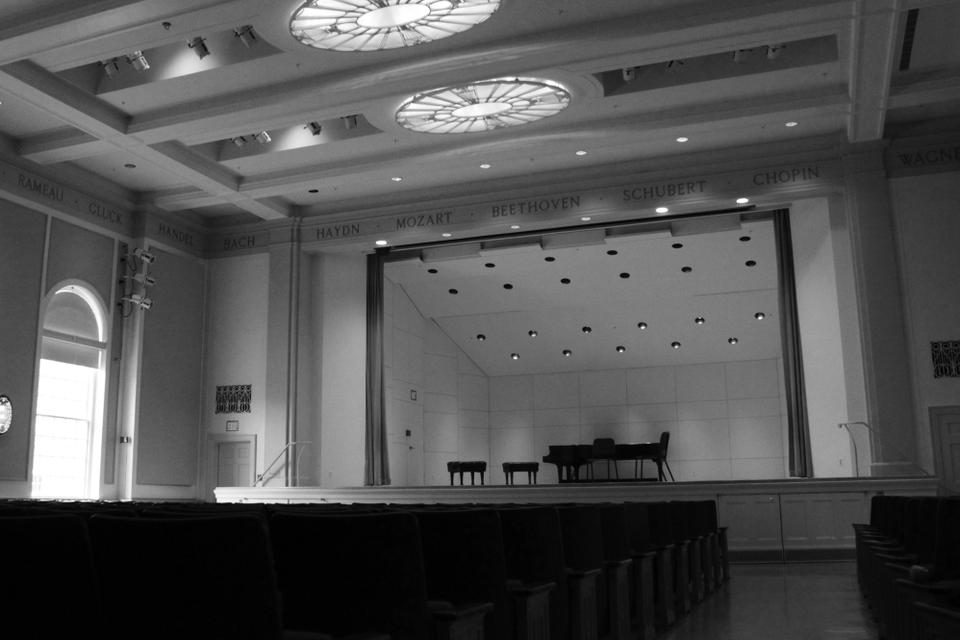
On the evening of April 29, the sounds of choral music filled the vaulted space of Paine Hall. In the Harvard Choruses New Music Initiative’s annual concert, six original works by undergraduate composers — Anika L. Christensen ’26, Grant S. C. Shueh ’27, Jack R. Damon ’28, Herman X. Y. Leong ’26, Linda Wnetrzewska ’26, and Christian A. Yom ’27 — were heard for the very first time.
Performed by Harvard’s Ensemble Veritas — the professional vocal ensemble in residence at Harvard University — under the direction of conductor Dr. Andrew Clark and manager Stephen Sands, the HCNMI’s annual concert was a captivating evening celebrating the dawn of a new generation of choral music composers.
HCNMI is a program dedicated to fostering new choral music creations by undergraduate student composers. Arriving at Harvard in 2010, Andrew Clark, Director of Choral Activities at Harvard, realized after just a few semesters that student creativity and an impulse to compose and arrange for vocal ensembles have always been a big part of the artistic culture on campus.
Clark recalled students asking about having their pieces or arrangements performed. Thus, pieces composed by students began to be performed by the Harvard Glee Club and the Radcliffe Choral Society. In 2016, thanks to some external support from initial stage funders Betsey and Alan Harris, HCNMI was launched.
“It’s a chance for students over the course of about nine or ten months to create a piece for performance here at Harvard,” said Clark in an interview with the Crimson.
Under the guidance of Robert H. Kyr ’89 and current professor of Composition at the University of Oregon, students are able to attend private lessons, group workshops, and critical feedback sessions tailored toward developing each student’s unique compositional voice while learning practical techniques of choral music writing.
“Every one of them is a remarkable human being,” said Kyr in an interview with the Crimson. “They’re doing so much already at Harvard. Many of them are double and even triple majors, yet they’re all musicians, performers, as well as composers.”
The process for HCNMI starts at the end of the spring semester, when students interested in the program apply. Then, over the summer, the selected students begin working with Kyr.
“I’ll meet with them, and then we’ll start working with the text,” said Kyr. “Some of them will want to write their own text, and then some of them will really be excited about bringing different texts together, several lines. Maybe make composite text and maybe even add some of their own original material to it to shape it the way that they want to set it to music.”
The program itself is unique in its explicit focus on choral composition.
“We wanted to create a program that would be quite different, and give them a real experience of what it means to sing in chorus, to compose for chorus, and then to be able to hear it sung by the very best singers, either the Harvard Choruses or professional chorus,” said Kyr.
In the past ten years, over 75 new compositions have been born out of HCNMI.
“We started a tradition about five or six years ago where student compositions are performed during graduation,” said Clark.
In addition, student pieces have been performed by visiting professional ensembles, three Harvard chorus groups, and the University Choir.
Anika L. Christensen ’26 applied to HCNMI at the end of her freshman year and has been a part of the Radcliffe Choral Society since her first year at Harvard. During her time in HCNMI, she has written four choral pieces. The idea for her featured piece in the concert, “Panopticon” came to her when she was in Harvard’s Government 1090: “Biotech Ethics” class, taught by Sergio Imparato. Christensen’s inspiration emerged to her in fragments that she pieced together.
“I just build up what I call my garage of ideas,” said Christensen in an interview with the Crimson. “Every so often I’ll be like, ‘Oh, this is what I want this to come to.’”
Christensen’s second piece that she has composed this year through the program, “Light and Particles,” will be performed at the Class of 2026 commencement ceremony in May. After graduation, Christensen will be at the Max Planck Institute for Evolutionary Anthropology in Leipzig, Germany, as a Fulbright Scholar.
Linda Wnetrzewska ’26, a double physics and music concentrator, came into the program with no prior composition experience.
“I’m a senior, and I was like, ‘Wow, Harvard has this program where you can compose a piece and a choir will perform it.’ Like, why would I not go just to challenge myself?” said Wnetrzewska.
Wnetrzewska, who is Polish, will be returning to Europe after graduation and hopes to continue singing. She described her experience in HCNMI as a fantastic way to round up her senior year.
More than a concert, this evening with HCNMI was a reminder that at Harvard, one can truly do it all — science, art, and composition.
“Our basic foundation is: create the music you truly believe in,” said Kyr.
Want to keep up with breaking news? Subscribe to our email newsletter
Have a tip for The Crimson? Share it confidentially