Harvard College to Require Senior Theses for Joint Concentrators, Tightening Longstanding Policy
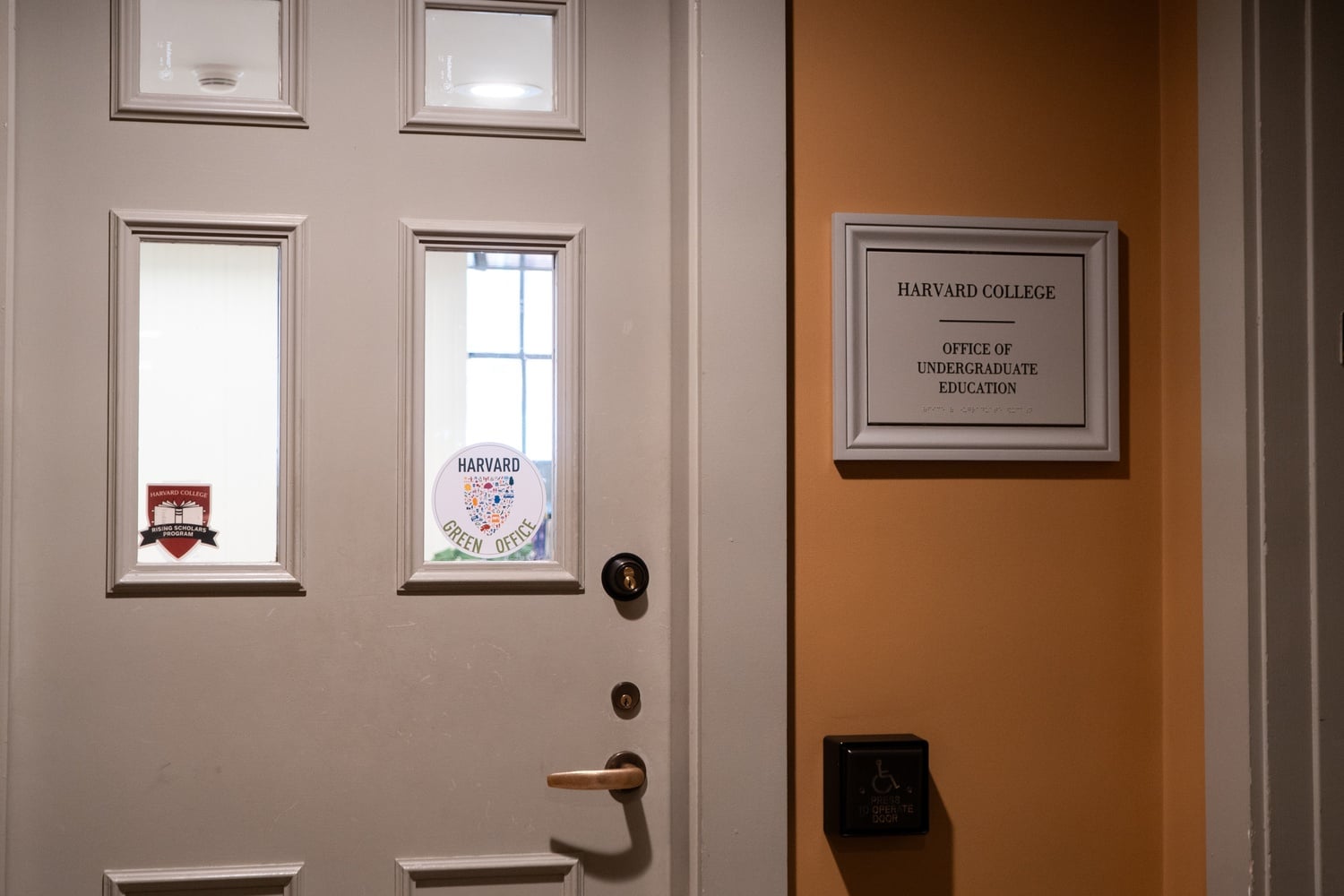
Harvard College’s Office of Undergraduate Education will begin strictly enforcing a thesis requirement for joint concentrators starting next year, Dean of Undergraduate Education Amanda Claybaugh confirmed Monday — a shift that will primarily affect Physics concentrators.
The requirement itself is not new, but past iterations of the Student Handbook stated that joint concentrations “ordinarily” culminated in theses, a hedge that left some students, particularly in Physics, treating the prerequisite as optional. Other departments have historically enforced the requirement more strictly.
This year’s handbook dropped the word “ordinarily.” In a Friday email to department affiliates, Anna Klales, the physics department’s associate director of undergraduate studies, wrote that the OUE had confirmed it would not approve joint degrees without a senior thesis beginning next year. The change will not affect members of the Class of 2026, who graduate in under a month.
Claybaugh said in a Monday interview that tighter enforcement of the rule will ensure that all departments are complying equally with the requirement — which, she added, was set by faculty rather than the OUE itself.
“This has always been the policy,” she said. “This has always been the rule, and to be clear, it’s not my rule, but it is my responsibility to make sure that all departments are following it equally.”
Faculty will have a chance to review both the joint and double concentration guidelines next academic year and can recommend changes to either program then, Claybaugh said.
More than half of the senior class typically writes a thesis, according to The Crimson’s annual survey of graduating seniors, though that number is far lower in the Physics department.
The department’s website indicates that roughly five to 10 students concentrating in Physics or Chemistry and Physics, which is supervised by the Physics department, choose to write a thesis each year. There were 185 concentrators across the two departments as of December 2025.
Klales’ email, sent to the Physics department’s mailing list, is the only instance of the shift being publicly announced to students that The Crimson has identified. Many Physics concentrators said they were caught off guard by the change.
“I definitely didn’t know this was going to happen,” said Steven Su ’27, a Physics and Math joint concentrator.
Get The Crimson in your inbox.
Su said he was not planning to write a thesis and that the change was making him second guess his plan of study. He is now considering switching to a double concentration in Physics and Math, though he said the transition would be difficult.
“The math concentration has a lot more requirements than the math joint,” Su said.
The double concentration, introduced in 2022, allows students to receive degrees in two fields without a combined thesis. Unlike the joint, it requires students to fulfill the standard course requirements of both concentrations, leaving less room for electives.
Students who stay with the joint will now have to plan on writing a thesis — an intensive and sometimes stressful process. Several said they had intended to write one anyway.
Gandab Mammadova ’28 said the thesis requirement was the reason she chose a joint over a double concentration in the first place.
“I think it’s actually more an advantage than disadvantage, because I think it forces you to experience academia,” she said. “I will probably be on the side of the people who actually think that this is a really important aspect of a college degree.”
But not all students feel the same way.
Evangelos B. “Evan” Tsingos ’27, who is also planning on writing a thesis, said other Physics concentrators were “scrambling” after Klales’ email.
“There might be a lack of understanding of what an undergrad thesis should look like in Physics for a lot of these Physics students,” Tsingos said. “So maybe that’s a factor.”
Klales wrote in her email that Physics students can generally expect to write a thesis based on research conducted the summer before or during the fall of their senior year. She added that there are no “strict requirements” for the length or format of a Physics thesis, and that the department would publish more guidance in the fall.
Miller MacDonald ’26, a joint Physics and Math concentrator, said he supported the requirement but pointed to a structural gap in how the department prepares students to meet it.
“There’s basically no formal infrastructure,” he said. “There could definitely be a learning curve on the departmental side and on the student side.”
A FAS spokesperson did not respond to a request for comment.
—Staff writer Sebastian B. Connolly can be reached at [email protected] or on Signal at sbc.23. Follow him on X @SebastianC4784.
—Staff writer Summer E. Rose can be reached at [email protected] or on Signal at ser.85. Follow her on X @summerellenrose.
Want to keep up with breaking news? Subscribe to our email newsletter
Have a tip for The Crimson? Share it confidentially