Doomscrolling and the Death of Attention Spans
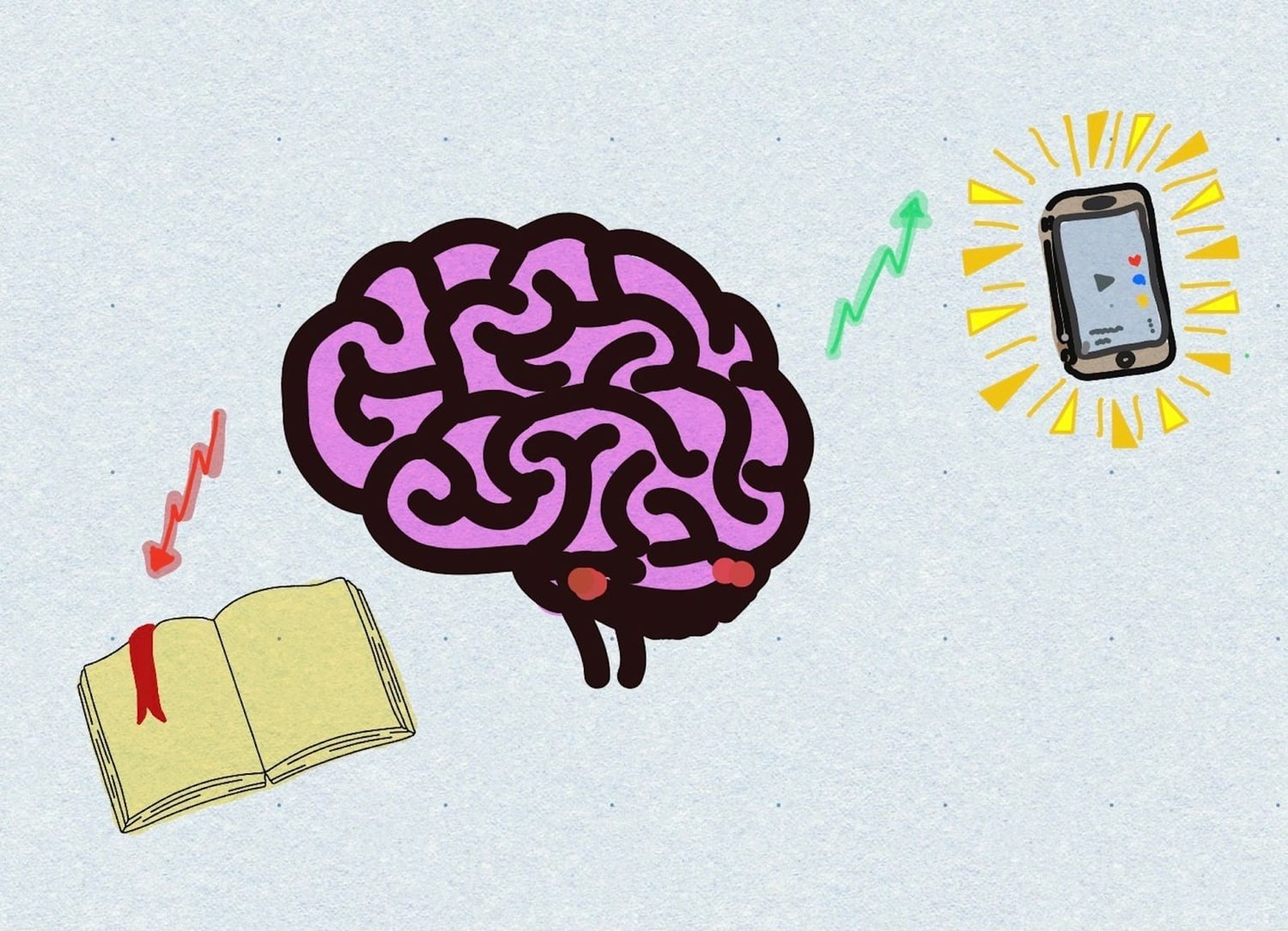
Whether it’s Tung Tung Tung Sahur, Ash Trevino, or read-alouds of Reddit stories above Minecraft parkour, social media offers a plethora of subjects for users to explore. The average young person is no stranger to the vice of doomscrolling — the compulsive habit of scrolling online media content. However, endless variety has a cost. When everything is available, nothing requires your full attention. The capacity to read the news or a 400-page novel decreases. If we’ve trained ourselves to consume the world in 15-second intervals, what are we losing in the space we no longer allow ourselves to sit in?
Shorter attention spans mean we forfeit not only the capacity to carefully read longer books but also the kind of critical thinking that can only be built by engaging with long-form media. We lose our tolerance for ambiguity and the willingness to ponder a question without immediately swiping to the next video, no longer interested in an answer.
Social media platforms are deliberately designed with features like autoplay, pull-to-refresh, and user-specific algorithms that keep users locked in a continuous loop of consumption. Each scroll releases a small dose of dopamine, so doomscrolling becomes a habit before we realize it. In 2020, over 3.8 billion people spent an average of two hours and 24 minutes a day scrolling through social media alone.
The result is a creeping intolerance for the novel’s natural texture. Long descriptions feel indulgent and slow-building plots feel boring. Websites like SparkNotes, designed as a last resort for professional procrastinators or a quick brush-up 5 minutes before a test, are now the first choice readily utilized by students. With the rise of AI, fast summaries that flatten meaning become even more irresistible.
For students and young minds especially, the stakes become clear immediately. College courses have students reading hundreds of pages a week, from advanced, specialized courses to broader, general ones required for students across all majors (or, in Harvard’s case, concentrations). Often, these classes make students work through difficult ideas and produce original arguments. Many academic programs — including undergraduate ones — also offer students the opportunity to write a thesis, which is the ultimate test of attention span due to all the work and perseverance that goes into it.
Students need the kind of sustained attention that doomscrolling quietly erodes. Many may find themselves re-reading the same paragraph without fully understanding it or abandoning a chapter halfway through — not because they aren’t capable of absorbing the material, but because their brains have been trained to expect a new rush of dopamine every few seconds, rather than sustain focus. Laziness is not inherent. It is the entirely predictable result of spending years in an economy that profits from your inability to focus.
There is something worth taking seriously in this critique. The idea that longer media is tied to more complex themes — while shorter media is seen as superficial — has long been a social prejudice. However, depth has never depended on length. Oral storytelling can stretch for hours, and poems can be expanded, while forms like flash fiction show how brevity can still carry weight and complexity.
The issue facing attention spans isn’t brevity itself; rather, it is the algorithmic replacement of choice with compulsion. Short-form content is not the problem. The problem is a platform ecosystem that trains you to constantly need it, punishing the pause and rewarding the reflex.
What we are losing, then, is not just the ability to read long books or watch a full-length movie without pausing. It is the ability to choose slowness as well as the awareness that deliberation is even an option. In a society where convenience and productivity are prioritized, the slowness of life, which is essential to reflection and understanding, is often forgone. Social media isn’t necessarily the “villain,” but it isn’t neutral either, as these platforms prioritize short-form over long-form content.
Long-term reading has an effect that a fifteen-second clip can’t replicate. It instills the capacity to follow a complex argument across many pages, to hold a character’s dialogue from chapter one to the end, and to embody a perspective that isn’t one’s own long enough to learn something new. More than just scholastic skills, these are the habits a mind needs to think empathetically and engage in activities like civic life, which need more attention than ever in the current world.
A person with the ability to finish a book is not just someone who can technically read more. These individuals are equipped to understand everyday documents, follow a sustained argument, and process complex emotions like grief without immediately reaching for a convenient distraction. Our attention spans are an active resource in everyday life. Attention is a muscle, and like any muscle, it atrophies when unused.
Want to keep up with breaking news? Subscribe to our email newsletter
Have a tip for The Crimson? Share it confidentially