The Neighbourhood Concert Review: The Art of Immersion and Return
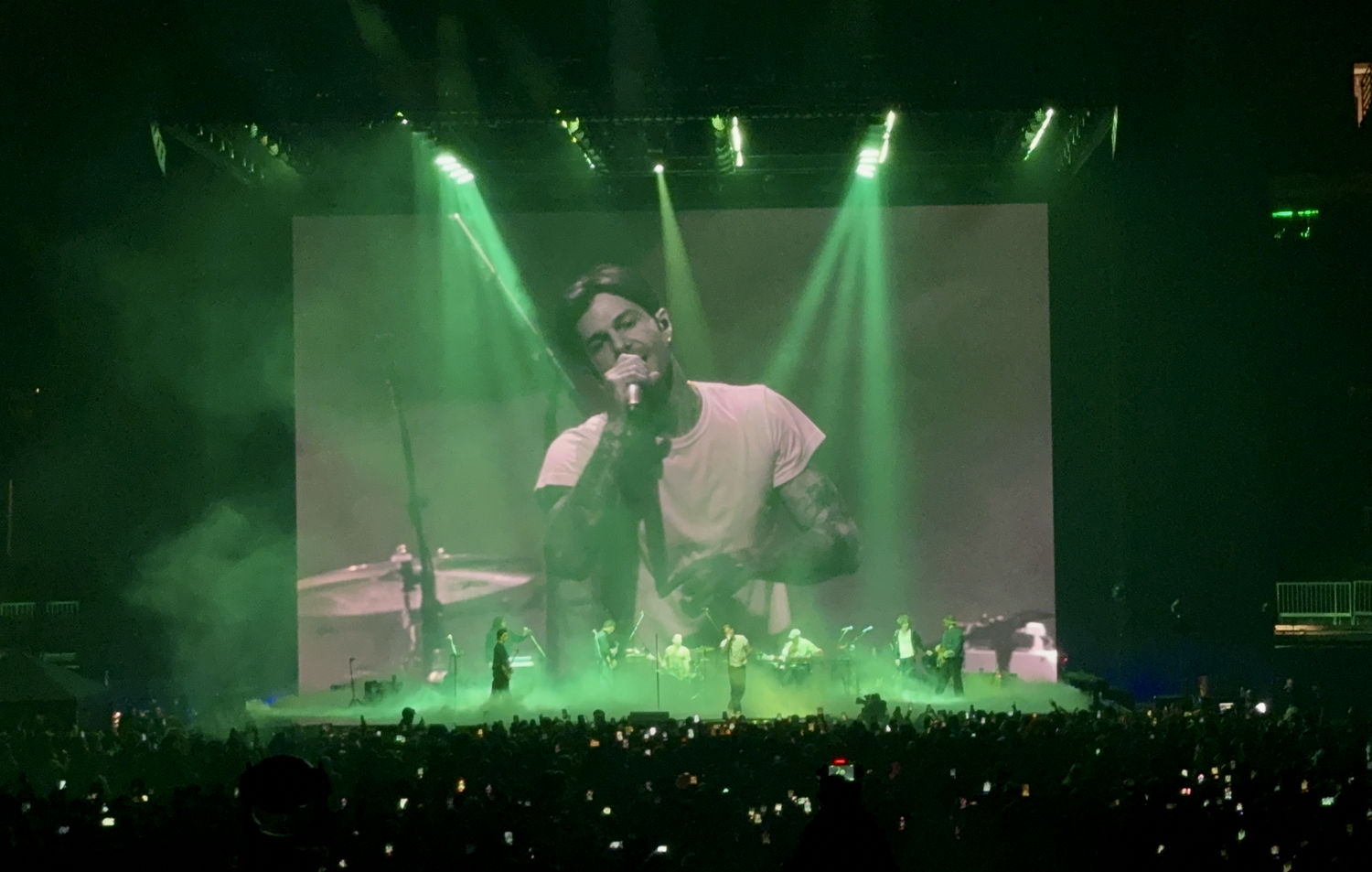
Rutherford’s voice carried cleanly across the venue, contrasting with the hazy atmosphere surrounding him.
“I hate the beach, but I stand, in Boston with my toes in the sand.” As the Boston-tailored “Sweater Weather” rang out across TD Garden, the crowd shouted it back, knowing every lyric from the band’s lead single off their debut album, “I Love You.”
On April 8, The Neighbourhood returned to Boston for the first time in years with their 2026 “THE WOURLD TOUR.” After an indefinite hiatus announced in 2021, the California-based band’s reemergence featured the release of their album “(((((ultraSOUND)))))” on Nov. 14, 2025, telling a story about heartbreak, nostalgia, and love.
Fans — dressed almost uniformly in black — filled the venue, transforming the crowd into an extension of the band’s signature monochrome palette. The evening kicked off with opener Neggy Gemmy, whose synth-driven, electronic pop sound provided a fitting prelude.
As the band took to the stage, the “Hula Girl” intro bled seamlessly into “OMG,” immediately establishing the performance’s visual language with slow, hypnotic lighting cues. The stage was cast in a dim glow — a hallmark of the band’s longtime aesthetic — with lead vocalist Jesse Rutherford emerging almost as a silhouette. Encaptured by shadowy projections and grainy textures, the stage mirrored the shift in tempo and intensity of the songs.
The transition into “Cry Baby” marked one of the first clear expansions of energy. Strobing lights pulsed in sync with the song’s melody, sharpening the performance. Rutherford’s voice carried cleanly across the venue, contrasting with the hazy atmosphere surrounding him. Tambourine in hand, he leaned into the rhythm and amplified the crowd’s lively energy.
That momentum carried into “Reflections,” shifting from performance to shared experience as the audience joined in on the singing. The venue’s large screen turned outward, displaying fans packed into the general admission floor with many already singing before the microphone reached them.
Structurally, the setlist unfolded with a purposeful sense of progression. Early tracks such as “Prey” and “R.I.P. 2 My Youth” leaned into The Neighbourhood’s darker, more brooding tone. Heavy bass and loud drums reverberated throughout, while green-tinted lighting and misty fog covered the stage.
As the performance continued, the energy grew in both sound and spectacle. “You Get Me So High” and “Nervous” introduced warmer tones and more kinetic staging, signaling a shift from isolation toward connection. Sweeping laser effects cut across the crowd, leading to one of the night’s most dynamic performances: “Devil’s Advocate.” A roaming camera tracked Rutherford as he moved across the stage, injecting a sense of spontaneity and dance into the production. Shedding his shirt partway through the performance, Rutherford leaned fully into the song’s fun energy. The crowd responded, shouting the chorus with intensity as his ad-libs layered over their voices.
A brief intermission introduced the final act and reframed the tone of the evening. As the stage dimmed, a message appeared in stark text: “We are about to enter the ballad section of the evening. Yearning is encouraged. If you plan on crying, please make sure your tissues are accessible now.” The directive drew laughter from the crowd, but it also signaled a clear emotional pivot. When Rutherford reemerged with a guitar in hand for “Baby Came Home 2 / Valentines,” the atmosphere had softened entirely — the lighting warmer, the pacing slower, and the performance more vulnerable.
The transition into “Private” further emphasized intimacy; before beginning, he reflected on having imagined the song performed live with the crowd humming along. The audience obliged almost immediately, their voices filling the space in a low — a unified chorus that dissolved the boundary between performer and crowd. In that moment, the venue felt less like a concert hall and more like a shared pulse — a space come to life.
“Lovebomb” marked a final surge in energy, built on anticipation. Words flitted across the main screen once again: “I don’t want to come on too strong, but there are only really a few words that I can use to describe it.” As the stage lingered in near-silence, Rutherford shouted, “I love you! I love you!” into the crowd, triggering an eruption of screams that collided with the song’s opening. Virtual fireworks burst overhead as lasers cut through a soft pink glow, shifting the performance from introspection back into liveliness.
The closing sequence culminated in “Softcore,” where the balance between artist and audience fully dissolved. The crowd’s collective voice nearly overtook the band, transforming the experience entirely. What followed felt like a recognition of the song’s lasting cultural resonance and the role it continues to play in shaping The Neighbourhood’s identity.
Contextually, The Neighbourhood’s return carries a broader weight. Composed of Jesse Rutherford, Zach Abels, Brandon Fried, Jeremy Freeman, and Mikey Margott, the band’s revival does not attempt to erase the time that has passed, but rather integrates it into the performance itself. The united atmosphere, visual storytelling, and emotional continuity reframe familiar songs as part of an evolving narrative for the fanbase. What emerges is a performance that feels retrospective, nostalgic, and evolving.
Want to keep up with breaking news? Subscribe to our email newsletter
Have a tip for The Crimson? Share it confidentially