How Undergraduate Course Assistants Weigh Joining the Picket Line
Undergraduate course assistants do the same work as graduate teaching fellows. Why are they less involved in the union?
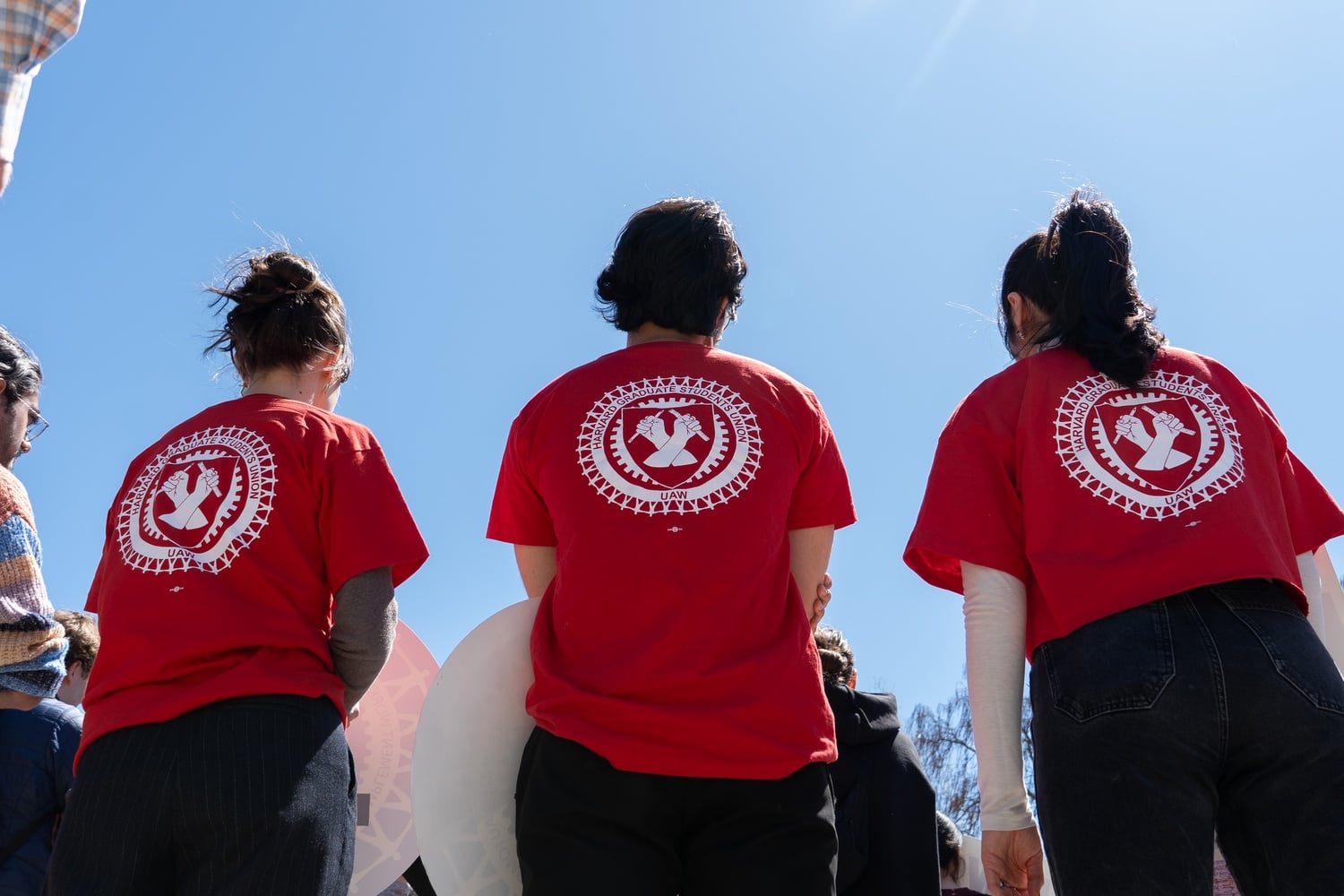
hen Lilian C. MacArthur ’28 became a course assistant for Mathematics 55, she did not think much about the fact that her job placed her in the same union as thousands of Harvard graduate student workers.
MacArthur, who is a CA this year for both semesters of Math 55 — “Studies in Algebra and Group Theory” and “Studies in Real and Complex Analysis” — says she was reminded shortly before the Harvard Graduate Student Union-United Auto Workers strike began that undergraduate course assistants were eligible to join the union.
But it was not an email that ultimately convinced her to sign a union card and go on strike. It was a conversation she had with graduate student teaching fellows in the Math Lounge.
“They explained that CAs and TFs — we do the same thing, and we’re vital to the running of classes,” MacArthur says. “If you have CAs doing the things that TFs would have done, that doesn’t put the pressure on the University.”
MacArthur is one of hundreds of undergraduate course assistants employed by Harvard College, often in departments such as mathematics, statistics, economics, and the sciences. Depending on the course, undergraduate CAs hold office hours, grade assignments, and, in some classes, lead their own sections.
They are also part of a bargaining unit whose public face is overwhelmingly graduate student workers.
Harvard’s graduate student workers have been on strike since April 21, after more than a year of bargaining with the University failed to produce a new contract. HGSU-UAW has demanded higher wages, stronger protections for non-citizen workers, safeguards against academic retaliation, and changes to the process for handling harassment and discrimination complaints.
The University maintains that it is bargaining in good faith. Last week, Harvard raised its wage offer and proposed a new benefits package, including an 11 percent increase in salaried student worker compensation over four years, expanded legal services, fully subsidized preventative dental insurance for Ph.D. students, and a new parental benefit stipend for Ph.D. student parents.
But the offer does not resolve several of the union’s central demands, including non-citizen worker protections and independent arbitration in harassment and discrimination cases.
For undergraduate CAs, the strike poses a more complicated question than whether they support HGSU’s demands in principle. Many are covered by the union but have limited contact with it. Some say they only learned of their eligibility shortly before the strike began. Others say their working conditions as undergraduates differ significantly from those of graduate students.
Undergraduates make up approximately 14 percent of the workers eligible to be represented by the union — roughly 650 of the union’s 4,486 eligible workers. But undergraduate involvement in the union remains comparatively low. According to HGSU representative Jacob Wolf, only about 150, or about 23 percent, of the eligible undergraduates are currently union members.
“We believe this imbalance is due to union-busting tendencies from the University, particularly regarding issues with appointment letters that are supposed to inform workers they are union-eligible, and the lack of access HGSU has to provide them union orientations,” Wolf wrote in a statement to The Crimson. He added that delayed appointment letters and inaccurate workers’ lists contributed to a broader lack of awareness and subsequently low undergraduate participation.
A University spokesperson wrote in a statement to The Crimson that “the union gets a weekly list of members, and they are able to communicate with anyone who may have missed an orientation.”
The low participation is visible in the union’s internal structure. HGSU’s website lists no current Harvard College stewards, a representative role filled at Harvard’s other graduate schools and divisions to serve as a bridge between workers and the union. Wolf says the Union believes that their proposals on union access and security will help remedy the gap between workers and union members.
In the meantime, the limited undergraduate presence has translated into uneven participation in the strike.
MacArthur says that she initially doubted whether the five to 10 hours she works each week as a CA would matter in the broader strike effort. After speaking with graduate student workers in her department, she decided it would.
She spent two hours on the picket line on April 22. Though workers who picket for at least eight hours per week are eligible for a $500 weekly payment from the union’s strike fund, MacArthur says she does not expect to meet that threshold, adding that she is not especially concerned about the lost pay, citing another math teaching job and additional grading hours she completed ahead of the anticipated strike.
Avinashi A. L. Bhandari ’26, a CA for Physics 15B: “Introductory Electromagnetism,” has been a union member for two years and also chose to strike. Of the 14 CAs in her course, she says that at least six have decided to strike.
For Hugo L. M. Hinze ’26, a CA for Statistics 100, the decision to strike is driven less by his own working conditions than by solidarity with graduate student workers.
“I think I’ve had relatively positive work experiences here at Harvard,” Hinze says, referring to dormitory housing and the undergraduate meal plan. “But I know that for a lot of the grad students, that’s not the case.”
“My participation in the strike is primarily motivated out of solidarity with the grad students and grad student teaching fellows,” he adds.
Hinze, an international student from Germany, says that the union’s demands for stronger protections for non-citizen workers especially resonated with him.
Still, Hinze says undergraduate participation on the picket line has appeared limited. At several pickets he attended, he recalls that he was often one of only two or three undergraduates present.
“I know that from the class that I’m teaching, one other TF, who’s also an undergrad, is on strike, and the rest of the teaching team is not,” Hinze says. “I think that the proportion of undergrad striking versus not striking is also something that I think is reflected in the picket lines that I’ve been a part of.”
Other undergraduate CAs say they understand the union’s demands but do not see their own position as equivalent to that of graduate student workers.
Tino G. Karakousis ’28, a course assistant for Statistics 102: “Introduction to Statistics for Life Sciences,” believes undergraduate workers face different circumstances.
“I think, relative to the work I do, my pay is adequate. I think in general, college students have a lot of different ways that they can reach out to their administration,” he says. “I think it is really different when you’re a grad student.”
Wolf acknowledged that not all union members will be “immediately” affected by HGSU-UAW’s proposals, but says the entire slate of proposals will eventually “improve the well-being of every one of our members.”
“While compensation is an essential issue, we have multiple additional proposals that we believe will ensure the well-being of all of our members, as well as the entire Harvard community,” Wolf writes.
Karakousis emphasizes that graduate students perform labor critical to the University’s academic operations. But he says he does not feel compelled to strike on his own behalf.
“Personally, the reason I’m not going on strike is because I feel as though the pay I receive is adequate, and it would be unfair for me to go on strike demanding better conditions for myself, relative to not being able to host office hours for the people that come,” he says.
Johnny H. Perkins ’28, a CA for Statistics 100 and a Crimson Magazine editor, also decided not to strike.
“I didn’t really consider the question of whether or not to join until the strike was upon us, where I was reminded by the emails and the chatter around campus that undergraduate CAs are included in this as well,” Perkins says.
Because he had not joined the union, Perkins says he “felt it was the right thing to try to keep working.” But he was reluctant to physically cross the picket line to teach his section in the Science Center, and students in the class raised similar concerns.
“I had received some questions from people asking, ‘Is section still on?’ And we had a lot of kids in the class who said, ‘We’re not really that enthusiastic about crossing the picket line and going into the Science Center. That was really something I had to debate about,” he adds.
Perkins ultimately decided not to cancel his April 23 section. Instead, like some other instructors across campus, he offered a Zoom option to help students prepare for their final exam without requiring them to enter the Science Center.
The divide among undergraduate CAs reflects a broader tension in the strike. HGSU’s contract covers both graduate and undergraduate student workers, but several undergraduate CAs say that some of the strike’s central demands can feel more immediately applicable to the graduate students.
HGSU is currently bargaining for a $25 minimum wage for graduate and undergraduate CAs and TFs who are paid hourly rates. The union is also seeking a provision that would increase that hourly rate each year by either 5 percent or the rate of inflation, whichever is greater.
Perkins says a direct appeal to undergraduate CAs might come through proposals focused on students who balance teaching with an undergraduate courseload, such as clearer separation for teaching responsibilities undertaken by CAs during reading period, when they are also studying for their own final exams.
“Not to say that the graduate student docket, those items aren’t important — I think that they should be the central part of the platform, given the population breakdown of the Union,” Perkins says. “Undergrads, I think, will be more enthusiastic if they’re thrown a bone on a couple topics of ‘this is kind of designed for you guys.’”
“The things that they already do are designed for undergrads, just to be able to emphasize those in the email, so that people who may be in my position really see them and feel this need to join,” he adds.
Wolf writes that the union strives to “make sure our demands are maximally impactful for all of our hourly workers, with significant input from a wide range of worker experiences.”
For MacArthur, even demands that may not affect her directly still matter. She says her own access to College resources — including the Title IX Office in cases of sexual harassment — has made her more aware of the importance of protections for graduate student workers.
“First of all, very directly, I know they’re asking for a lot of things, and I don’t know how much they impact me,” MacArthur says. “For example, one of the things that they’re trying to campaign for is recourse for sexual harassment and pathways to report that and get that handled.”
One of HGSU’s central demands is access to arbitration in harassment and discrimination cases outside Harvard’s internal process. In an email sent to undergraduates on April 17, the union called the University’s current Title IX procedures “woefully inadequate,” claiming the policies can be amended by Harvard at any time.
The union says its data indicates that one in five student workers experience harassment, discrimination, or bullying during their time at Harvard. Its demands include allowing student workers to choose between University procedures and an external grievance process, as well as access to a legal fund to pay for representation.
Harvard has pushed back on the union’s proposals around harassment and discrimination procedures. A spokesperson for the University points to policies and guidelines adopted in 2023 that Harvard says apply consistently across the University and were developed with input from faculty, staff and student input.
HGSU says that workers will continue withholding labor until Harvard moves on the union’s core demands. As the strike extends into reading period, the union has warned that TFs may be unable to support undergraduates as they prepare for finals or complete grading work they would ordinarily perform.
That possibility has left some undergraduates uncertain how to respond — especially those who sympathize with the union but worry about the strike’s impact on students late in the semester.
“This is something that most students probably never dealt with in high school — a large-scale strike of teaching staff. Whether you’re just a student or you’re a CA or whatever your role may be, I feel like there’s a certain degree of — it’s okay to not have it all figured out and to not really know what to do or how to feel in this type of situation,” Perkins says.
“Even if they make one decision or the other,” he adds, “people are conflicted.”
—Staff writer Uy B. Pham can be reached at [email protected] or on Signal at ubp.88. Follow him on X @uybpham.
—Staff writer Thamini Vijeyasingam can be reached at [email protected]. Follow her on X @vijeyasingam.
Want to keep up with breaking news? Subscribe to our email newsletter
Have a tip for The Crimson? Share it confidentially