The BSO Finds Defiant Conviction in Beethoven and Adams
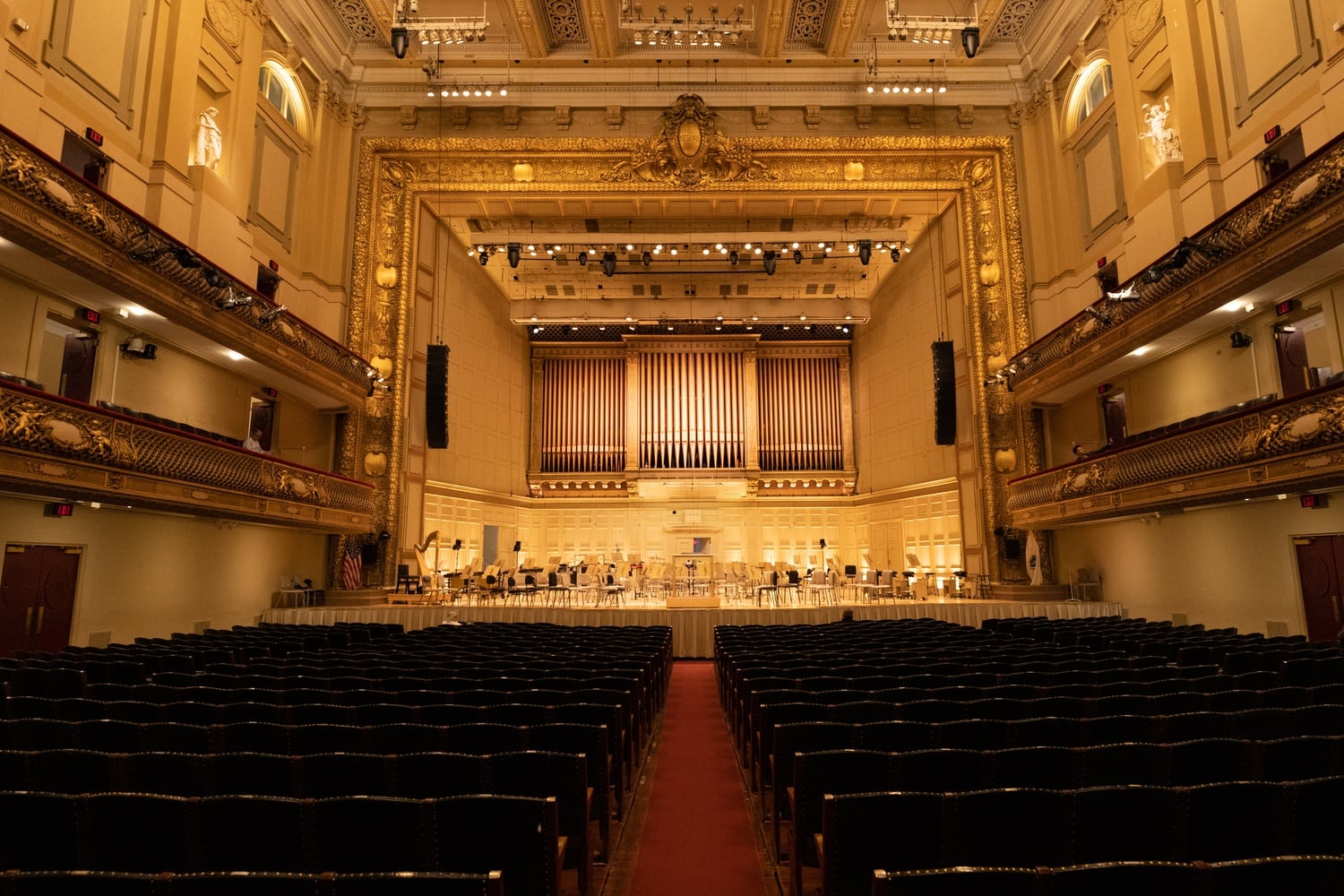
Set against the backdrop of a deeply tumultuous period for the Boston Symphony Orchestra, the final concerts of the 2025-26 season carried unusual emotional weight. The sudden termination of Andris Nelsons’ contract — due to a misalignment in his “future vision” with the BSO’s board — has given rise to considerable angst throughout Boston’s classical music community, casting a bleak shadow over the season’s closing concerts. Each orchestra member wore a red rose to signal their solidarity.
Yet, audiences still flooded Symphony Hall from April 30 to May 3 to hear one of America’s preeminent orchestras, led by guest conductor Dima Slobodeniouk and choral conductor Jean-Sébastien Vallée, perform two monumental works from drastically different eras: Beethoven’s Symphony No. 9 in D minor and John C. Adams’ ’69 Harmonium.
Adams, a Harvard College graduate and Pulitzer Prize-winning composer, has seen particular prominence this season, with works such as Nixon in China and his Violin Concerto appearing across BSO programming. Harmonium, Adams’ first major orchestral work, offered a minimalist counterpoint to Beethoven’s expansive symphonic masterpiece, balancing the program from both a historical and stylistic standpoint. Initially commissioned by the San Francisco Symphony and premiered on April 15 1981, Harmonium is based on poetry by John Donne and Emily Dickinson and is scored for orchestra and chorus.
The concert opened with a single drone played by the flute and the Tanglewood Festival Chorus slowly emerging from this texture. The gradual build in tension during the opening passages of the first movement was handled with patience and restraint, with Slobodeniouk allowing the music’s harmonic weight to accumulate organically. As the piece progressed, each section began to unfurl out of the initial drone into a flurry of extended chords and gliding semiquaver sections.
Indeed, although the brass stabs during this movement were clean and confident, the chorus lacked both clarity and force. At times, the chorus was swallowed by the sheer density of Adams’ orchestration, leaving the choral writing more atmospheric than incisive.
The second movement began in a distinctly ethereal and suspended manner, with the string parts remaining largely static in comparison to the previous movement. It was during this movement that Slobodeniouk occasionally struggled to sustain energy and tension in the work’s more restrained passages, with subtle timekeeping slips and an overall loss of cohesion between the upper and lower voices of the chorus momentarily weakening the movement’s otherwise hypnotic and delicate affect.
However, the final movement of the work was particularly well-executed and compelling, with the ascent to the climax feeling inevitable and exhilarating. The brass section was commanding during this build, cutting through the orchestral texture with brilliance.
Despite helping to highlight the highly motivic, repetition-based writing that has come to define the composer’s mature style, Slobodeniouk’s lack of experience with this kind of contemporary American classical music was occasionally apparent. Indeed, while this rendition of Harmonium contained moments of striking grandeur and brilliance, its choral writing felt subsumed into the orchestral mass rather than fully integrated as a distinct force.
After a brief intermission, the orchestra returned to perform arguably the most iconic orchestral work of all time: Beethoven’s 9th Symphony. Not only does the symphony hold immense influence and symbolic weight, but it is also a work that demands a unique set of interpretive and technical challenges with each performance. Slobodeniouk approached this complex, innovative work with considerable care and nuance by balancing the structural and emotional dimensions of the symphony. The opening gestures were played with austere, heroic, and decisive force, and the D major recapitulation was equally triumphant and exclamatory. Here, Slobodeniouk showed impressive expressive range, shifting fluidly between the movement’s distinct modes of expression.
Following the first movement’s ominous ending, the orchestra exploded into a fiery, propulsive scherzo. Described by composer Jan Swafford in the program as a “manic counterpoint dancing through dazzling changes of key,” Slobodeniouk led the orchestra through this mania with confidence and command. Despite the overall bite of the strings, the viola section was somewhat underwhelming, lacking the restless energy that this movement demands.
Perhaps the weakest movement of the work was the third, with the yearning, lyrical string lines feeling more dutiful than transcendent. Furthermore, the orchestra occasionally lost momentum as the movement unfolded, leaving some of Beethoven’s most intimate writing without the sense of tenderness and introspection it requires.
The fourth and final movement of the symphony, commonly known as “Ode to Joy,”opened with startling force. The tranquillity of the third movement was immediately disrupted by the powerful and commanding lower strings. Here, the original theme from the first movement was brought back in a fragmented form, albeit under an entirely different setting. Indeed, Slobodeniouk handled the movement’s sense of drama with conviction, capturing the sheer joy and jubilation that characterizes Beethoven’s climactic vision of human fellowship.
The triumphant, ‘joy’ theme of the movement was backed by a beautiful, flowing accompaniment, carried by the string section with warmth and impressive clarity. In stark contrast to the Harmonium, the chorus was overwhelmingly cohesive, heightening the frantic, joyful energy of the finale upon their entrance. The soloists were particularly impressive, bringing a sense of urgency and virtuosity to Beethoven’s grand, almost operatic final statement. The conclusion of the piece was met with immediate ovation from the audience, a fitting response to a finale that felt triumphant and cathartic.
Ultimately, despite the turmoil surrounding the concert, the BSO delivered a performance that reminded us that, even in times of uncertainty, there is still room for profound joy. Although he occasionally struggled to fully capture the expansiveness and tension of Adams’ Harmonium, guest conductor Dima Slobodeniouk’s overall command of the program was assured and expressive, marked by a memorable and stirring rendition of Beethoven’s 9th Symphon
—Staff writer Alexander J. S. Chieng can be reached at [email protected].
Want to keep up with breaking news? Subscribe to our email newsletter
Have a tip for The Crimson? Share it confidentially