As Harvard Square Becomes a Public Drinking Zone, Bars Move Quickly
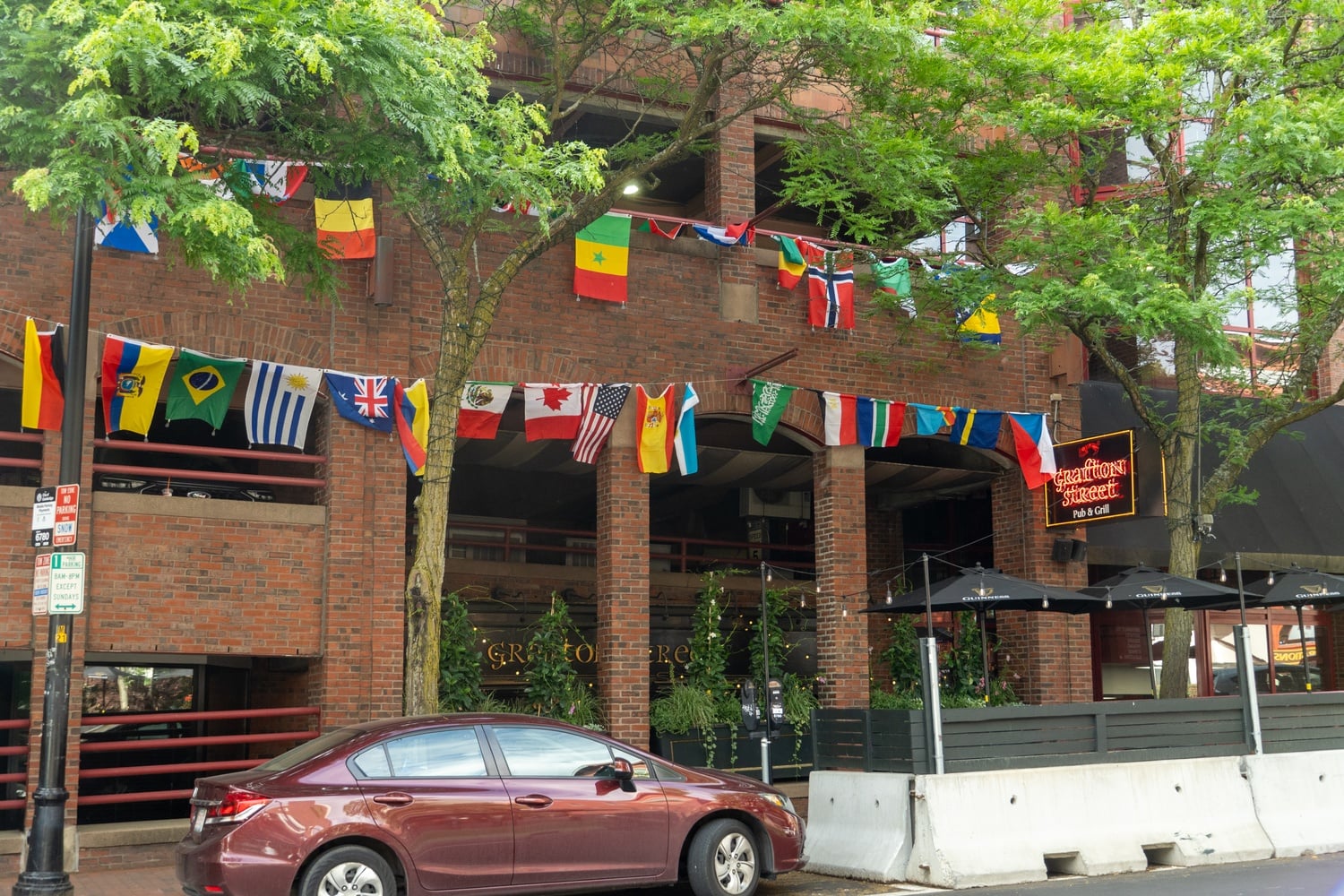
Harvard Square bars and restaurants are moving quickly to take advantage of a new summer alcohol policy after Cambridge officials last week authorized to-go drink sales in mapped public consumption zones and allowed some businesses to sell alcohol for an extra hour, as late as 3 a.m.
Made possible by a state law signed June 8, the program runs through July 31 as Massachusetts prepares for the 2026 FIFA World Cup and America’s 250th anniversary celebrations. Approved establishments in Harvard Square and five other Cambridge districts can sell to-go alcoholic drinks for consumption in those zones from 11 a.m. to 11 p.m., with last to-go service at 10:45 p.m.
Cambridge City Manager Yi-An Huang ’05 wrote in a statement that the measures would help “showcase Cambridge as a welcoming, world-class destination while supporting local businesses during one of our busiest periods of the year.”
Kari Kuelzer, who owns Grendel’s Den and Sea Hag, said she expects alcohol-to-go sales to bring in more customers during what is typically a slower season for local restaurants.
“We would normally expect just a lag, but we’re going to expect to see max capacity business throughout June, the rest of June, and into July,” she said.
Jason Doo, owner of Wusong Road Tiki Bar, said his business plans to participate in the alcohol-to-go program, saying it could encourage customers to try offerings from different restaurants in a single night.
“Rising tides raise all ships,” he said.
Though Doo does not expect to apply for a 3 a.m. license, he said other businesses should be free to decide whether extended hours make sense for them.
“Myself nor my staff believe in the benefits of drinking after 12 o’clock, and the resulting things that may occur thereafter,” he said. “That being said, it’s a free market. If a restaurant wants to do it, go with God.”
Patrick Lee — owner of Grafton Street Pub & Grill, Russell House Tavern, and The Hourly Oyster House — wrote in a statement that all his restaurants applied to participate in both the extended-hours and alcohol-to-go programs.
Get The Crimson in your inbox.
“We are looking forward to seeing how the extended hours and to go drinks can help elevate guest experiences in Harvard Square this summer and perhaps beyond,” Lee wrote.
But the pilot’s rapid rollout has also left some business owners weighing the benefits of expanded alcohol policies against concerns about enforcement and safety.
Juan Carlos Herrera, manager of Felipe’s Taqueria on Brattle Street — one of the few Harvard Square spots that already has a 2 a.m. liquor license — said Felipe’s would “play it by ear” before committing to a 3 a.m. closing.
“There’s a lot of safety protocols that we just want to make sure that we’re nailing out 100 percent before we even make the next step forward,” he said, adding that staff safety is the top priority.
Rosaline Kovacs, owner of Shay’s Pub & Wine Bar, said she has already amended her license to allow a 2 a.m. closing time but remains wary of the alcohol-to-go program.
”I’m a little concerned about the consequences of people taking our cups outside of the zone, about people filling our cups with their own alcohol,” she said.
Under city rules, participating businesses must serve drinks in approved cups, issue wristbands, and provide maps of the designated districts.
The pilot comes as city officials have discussed whether nightlife can help Cambridge retain young workers and compete with neighboring cities. At an Economic Development Committee meeting the day before the city approved the program, Councilor Marc C. McGovern said measures like the pilot could help the city remain competitive.
“We are a city that kind of oftentimes acts as if we’re some sleepy little suburban town,” he said. “Young people want to have fun.”
State Rep. Marjorie C. Decker, who voted for the legislation authorizing the program, said the changes could boost local businesses while urging residents and visitors to remain mindful of the city’s residential character.
“It has the potential to give a little extra boom to our local small businesses,” she said. “Be mindful and have fun.”
—Staff writer Alexa M. Schmitt can be reached at [email protected] or Signal at alexaschmitt.15. Follow her on X @alexa_m15_s.
—Staff writer Risha Sinha can be reached at [email protected] and on Signal at rishas.13.
Want to keep up with breaking news? Subscribe to our email newsletter
Have a tip for The Crimson? Share it confidentially