‘Obsession’ Review: Curiosity Killed the Cat, in More Ways Than One
Dir. Curry Barker — 3.5 Stars
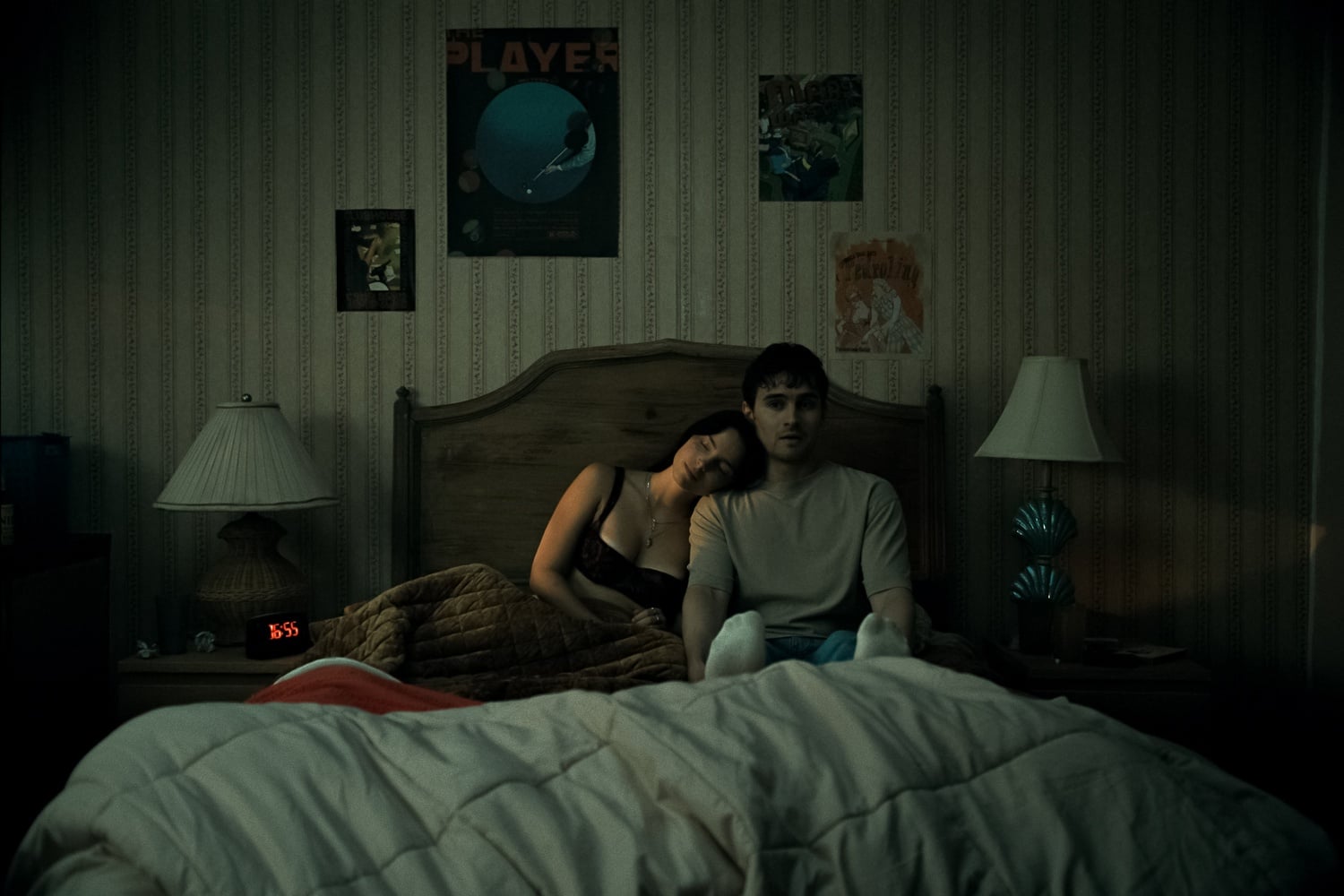
If it looks like love, sounds like love, and feels like love, then it probably is love.
What may seem like a simple case of abductive reasoning is shamelessly weaponized by the lead in “Obsession” — a selfish attempt to maintain his fantasy, even if it’s at the expense of the one he claims to love.
Curry Barker’s studio debut follows Bear (Michael Johnston) and his escalating relationship with his crush Nikki (Inde Navarrette). Scared of rejection, he forfeits many opportunities to confess his feelings to her, opting instead to plead upon a One Wish Willow for her to love him “more than anyone in the world.” This proves to be a fatal move because, in an instant, Nikki reappears nonsensical and entirely fixated on Bear — exhibiting only a fraction of the torment that is soon to come.
As her bizarre behavior intensifies, Nikki oscillates from overly flattering to terrifyingly and grossly needy. Watching Bear sleep, feeding him a sandwich made out of his deceased cat, and purposely bashing her head at a party are acts eerie enough on their own, but paired with her erraticism, they appear far more sinister. What’s unusual, though, is that this is not the most unsettling aspect of the film. Rather, it is how Bear’s insecurity turns him into a predator, instrumentalizing Nikki as a means for love to the point of her and her personhood’s detriment.
For example, when Bear starts to fear Nikki and regret his wish, he calls the number on the One Wish Willow packaging for help. Prompted with the option to cancel the wish, Bear is quick to clarify that he is only looking to alter it — as in, he wants Nikki fixed, not freed. Fortunately, the operator allows Bear to speak to the ‘real’ Nikki, who is screaming in anguish on the other line; unfortunately, he just ends the call.
Such details — fleeting to Bear yet revealing to the audience — constitute one of Barker’s greatest strengths as a filmmaker. They disclose how it is not Nikki’s selflessness, creativity, or passion that draw Bear to her, but the way she makes Bear feel about himself. And if she makes him feel important, then she has served her purpose, regardless of whether her true self survives it or not.
At the same time, however, this skill is used past sufficiency and ‘big’ moments oversaturate what is an already subtle yet extremely compelling narrative. This is most apparent in the spectacle that Nikki causes during a drinking game, in which she recites a poem about an incestuous relationship between Hansel and Gretel — a direct reference to how the ‘real’ Nikki only sees Bear as a brother. On its own, the moment is impressively effective and uncomfortable, but sandwiched between two other peculiarities — a fit of cringe-worthy jealousy and a bottle to the head — it reads as though Barker is too desperate to prove that he can make his horror bleed meaning. It’s true that Barker may be hungry, but he does not need an overwhelm of evidence to show it.
A similar imbalance is demonstrated by the discrepancy between the actors’ performances. Without a doubt, the best thing to come out of “Obsession” is Inde Navarrette. Sometimes the script teeters on using Nikki as a vehicle for shock factor and materialized male fears of women being ‘too much.’ Yet by clearly delineating between the ‘real’ Nikki and the entity that overtakes her, Navarrette showcases her range and delivers a remarkable amount of depth to the character; she is unashamed to commit, and it pays off in a huge way. The same cannot be said for the rest of the cast. Cooper Tomlinson’s Ian and Megan Lawless’ Sarah are forgettable side characters, and Michael Johnston as Bear presents only a perpetual state of bewilderment, communicating little beyond the notion that Nikki is ‘so weird’ — an unfortunate one-sidedness that only elevates Navarrette more.
A fascinating subversion of the common unrequited love trope, “Obsession” flips expectations on their head and offers an incredibly clever critique of male insecurity and how its lack of resolve comes at the expense of female autonomy. Had its indulgences not dulled its edge, Barker would have delivered a near-perfect theatrical debut. Still, “Obsession” resonates all the same with surprising intelligence.
—Staff writer Melina Fonseca can be reached at [email protected].
Want to keep up with breaking news? Subscribe to our email newsletter
Have a tip for The Crimson? Share it confidentially