‘Nothing Stops Her’: Jill Abramson ’76 Kept Digging From Harvard to The New York Times
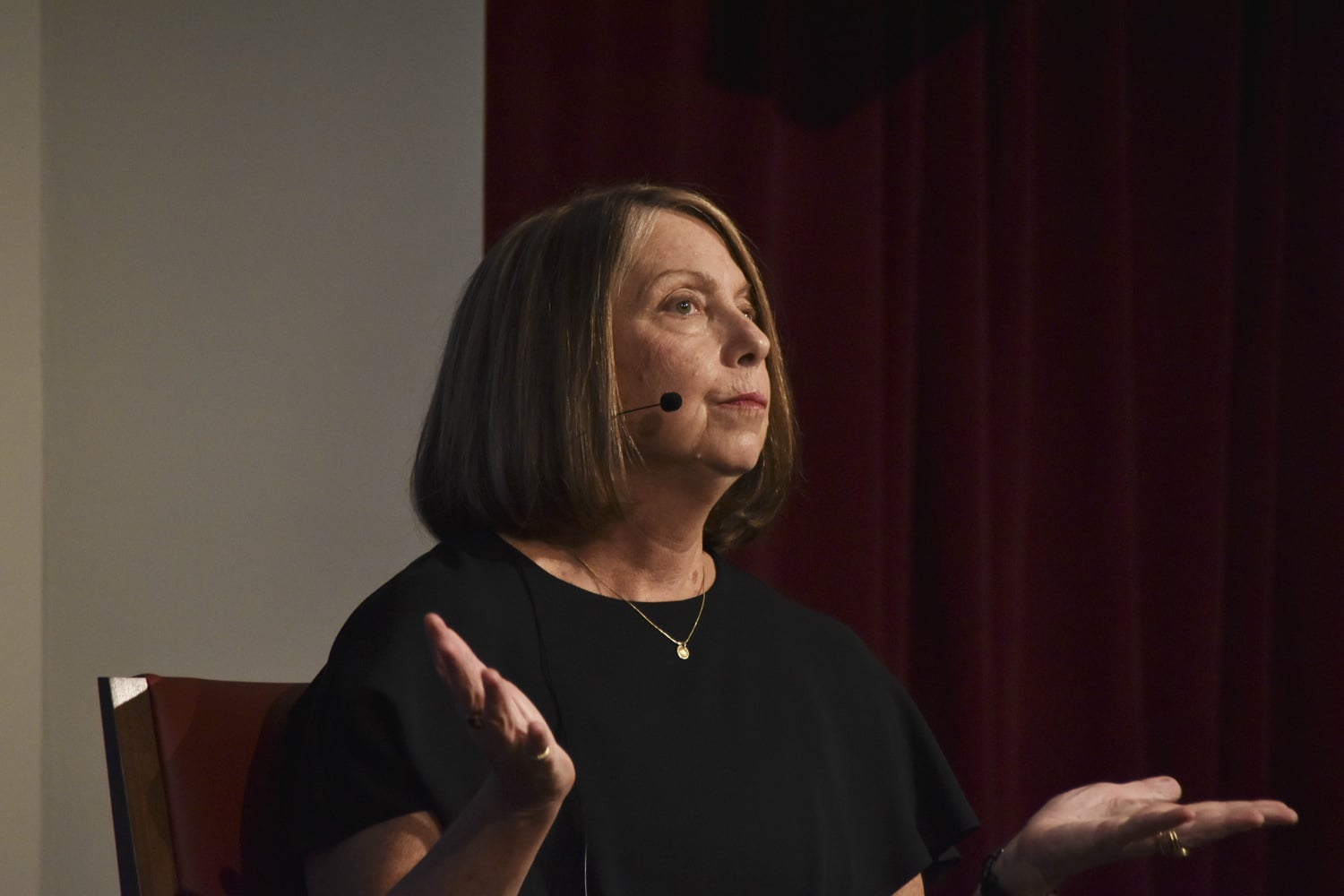
Jill E. Abramson ’76 learned to chase a story in Harvard Square.
As Watergate unfolded in Washington, Abramson — then a Radcliffe student more drawn to theaters than newspapers — would go to a news kiosk near campus and buy old issues so she could read Bob Woodward and Carl Bernstein.
“I was addicted to the Watergate story,” Abramson wrote in a statement. “They were my inspiration for pursuing a career in investigative reporting.”
Nearly four decades later, Abramson would become the first woman to lead the newsroom of The New York Times. But at Harvard, she had not yet set out to become a journalist.
A New York native who arrived at Radcliffe from the Ethical Culture Fieldston School, Abramson concentrated in History and Literature and wrote her thesis on unemployment in Britain during the Great Depression. She edited the Radcliffe Union of Students newsletter and worked as a stringer for Time magazine throughout college.
She also tried her hand on stage.
“I hadn’t done any journalism before college and I was very interested in theater, film and television,” she wrote.
Her entry into journalism ran through The Harvard Independent, where she started out reviewing theater and eventually became arts editor.
The choice, Abramson said, had less to do with a journalistic calling than with what she cared about at the time.
“The Independent had strong arts coverage,” she wrote. “It was a weekly, which appealed to me as I did not want to take too much time away from courses and reading for them.”
Get The Crimson in your inbox.
To those who knew her then, the choice fit.
Amy Wilentz ’76, a journalist who first met Abramson in high school, said Abramson was drawn to the Independent precisely because of who she was.
“She didn’t go the old Crimson route and instead chose the Independent,” Wilentz wrote in a statement, “because she is independent, as a thinker and doer.”
Wilentz said Abramson already stood apart.
“She was always a smart, intuitive, and curious person, all ideal characteristics for a journalist,” she wrote.
Abramson, she added, was “both funny and tough, but with a tender side most people don’t know.”
After graduating in 1976, Abramson covered that year’s presidential race for Time and the 1980 election for NBC News. She spent nearly a decade as a senior staff reporter at The American Lawyer before becoming editor in chief of Legal Times in Washington in 1986.
Two years later, she joined The Wall Street Journal’s Washington bureau, where she covered money and politics and rose to deputy bureau chief.
Around that time, Abramson and Jane Mayer co-wrote “Strange Justice: The Selling of Clarence Thomas,” a finalist for the 1994 National Book Award. The book examined the battle over Thomas’ confirmation to the Supreme Court and the sexual harassment allegations made against him by Anita Hill.
It is the achievement Abramson holds dearest.
“Strange Justice is the work I am proudest of,” she wrote. “Working on the book taught me that if you dig and dig and never give up you can get to the truth.”
It left her with a harder lesson, too.
“Sources will often lie to you,” she wrote.
Mayer, who said she has known Abramson since middle school and worked alongside her as a stringer for Time in college, said Abramson’s instincts made her the ideal partner.
“She doesn’t pull punches,” Mayer wrote. “She plays it straight and she’s tough on all sides.”
Abramson joined the Times in 1997 and became its Washington bureau chief in 2000 — the first woman in the job.
The paper had loomed large in her life. Abramson recalled growing up in a New York household with two home-delivery subscriptions to the Times, and, by her account, the paper recruited her only after she beat its own reporters on a major Washington scandal in 1996.
In 2003, she was named managing editor, again the first woman to hold the post. Eight years later, she succeeded Bill Keller as executive editor, becoming the first woman to lead the paper in its then-160-year history.
Abramson was clear-eyed about what those firsts cost.
“Yes, I was conscious of being the first woman to hold these jobs,” she wrote. “As Executive Editor I believe I was unfairly criticized for flaws in my ‘management style’ and behavior that was considered perfectly normal for my male predecessors.”
Her tenure ended abruptly in May 2014, when the Times dismissed her and replaced her with managing editor Dean Baquet, the first Black journalist to hold the post.
The paper cited her management style. Abramson’s questions about pay disparities with her predecessor became part of the story, and her firing turned into a national flashpoint in debates over gender and power in the workplace.
Looking back, Abramson framed her own rise and fall as part of a larger shift in American newsrooms.
“The conversation moved faster than the institutions,” she wrote, “although a few great women did ascend to the top jobs in some newsrooms.”
Then, she added, “some of them were abruptly fired!”
Mayer said women of their generation entered journalism at a moment when newsrooms were deeply hostile to women.
“Journalism was still incredibly sexist when we came along in the 1980s,” she wrote, “but we at least had a few role models.”
That fall, Abramson returned to Harvard as a lecturer in the English department, teaching narrative nonfiction.
The homecoming, she said, felt almost cinematic.
“There were shades of Back to the Future when I returned to teach at Harvard,” Abramson wrote.
After her firing, she recalled, then-University President Drew G. Faust called with a warning: “Don’t do anything before you talk to me.” Faust then helped create a place for her in English Department’s creative writing program alongside Helen Vendler, Jorie Graham and Claire Messud.
For Mayer, the return was no surprise.
“Jill is more resilient than anyone I know,” Mayer wrote. “She’s literally been run over by a truck. Instead of flattening her, after she re-learned how to walk, she went on to run the New York Times.”
“Nothing stops her,” Mayer added.
—Staff writer Jen L. Phan can be reached at [email protected] and Signal at jenphan.74. Follow her on X at @jenllphan.
Want to keep up with breaking news? Subscribe to our email newsletter
Have a tip for The Crimson? Share it confidentially