Only Advocacy Can Bring Accountability
When Larry Summers walked into the General Education course he co-taught last fall, the University made its position clear.
Last November, a House committee released hundreds of emails detailing the close relationship between Former Harvard President Lawrence H. Summers and convicted child sex offender Jeffrey E. Epstein. The two frequently corresponded, discussing topics including Summers’s suggestion that women are cognitively inferior to men and how to pursue a romantic relationship with a mentee.
In response, Summers resigned from nearly all of his leadership posts — from the board of OpenAI to the Yale Budget Lab. But instead of following suit and immediately holding Summers accountable, Harvard allowed him to walk into a lecture hall full of young women.
I was in that lecture hall. I was one of the students who recorded what happened next.
Summers offered a brief, 30-second statement of regret. He then proceeded with the lesson as normal. But there was nothing normal about Harvard silently allowing Summers — who solicited donations from Jeffrey Epstein, flew on Epstein’s private jet, and visited his island during his tenure as Harvard president — to continue teaching young students.
Students refused to let any survivor of sexual violence in that lecture hall, across our university, or beyond our campus believe Harvard’s apparent message: that an Epstein affiliate deserved the institution’s protection more than they did.
So we posted the video of his “apology” to social media, and it went viral. Within two days, Summers publicly stepped back from teaching for the semester. Several months later, he resigned from all faculty and academic appointments.
Students prompted in two days what Harvard failed to do for years. Harvard has long known about Summers’ sexism and connection to Epstein. But it wasn’t until the November email cache and students publicly demanding Summers’ resignation that change took place.
This is but one instance of many. For the Class of 2026, our four years have been defined by devastating attacks on women and queer students — and feminists and survivors stepping up where Harvard has failed.
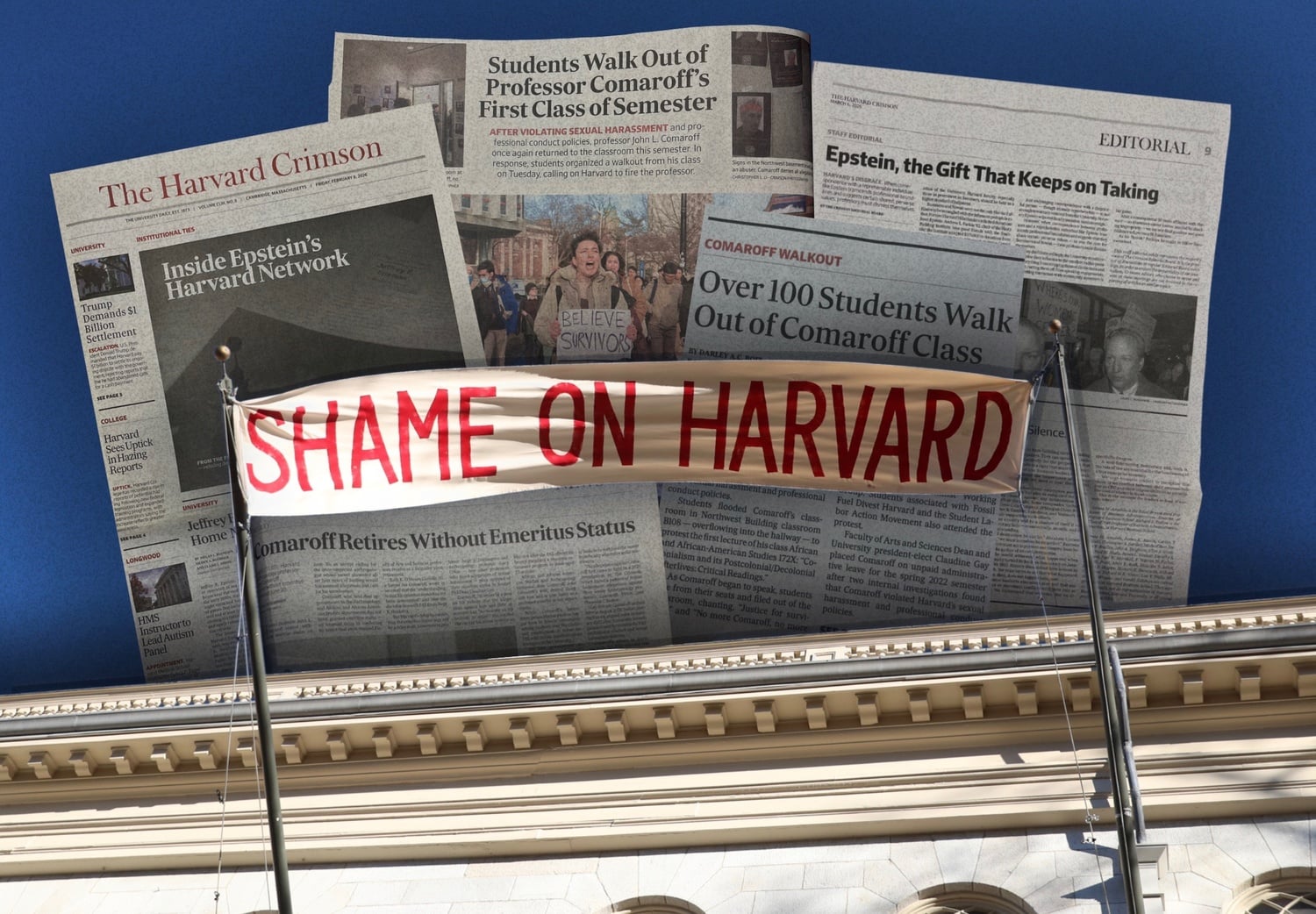
As freshmen, we walked out of alleged predator John L. Comaroff’s classroom and occupied University Hall to demand that Harvard address the sexual violence crisis on campus, which at the time saw nearly one in three undergraduate women experience sexual assault. As sophomores, we recalled a student body president facing allegations of misconduct and established a Gaza solidarity encampment to demand Harvard divest from a genocide in which sexual violence has been systematically weaponized against Palestinians, according to a United Nations report.
As juniors, we resisted Harvard’s adoption of Trump-era Title IX rollbacks — the University relegated protections against sexual misconduct on the basis of gender identity and sexual orientation to a separate policy, creating a messy two-policy structure that risks leaving queer and transgender students vulnerable. As seniors, we fought to cut Harvard’s ties to Epstein and demand real recourse for grad student workers who experience sexual harassment in the workplace.
Yet Harvard’s failure to invest in women and queer students runs deeper than sexual violence prevention and response. It is a divestment from gender equity itself.
In the last year alone, Harvard closed the Women’s Center and the Office for BGLTQ Student Life at the College, let funding cuts imperil the Studies of Women, Gender, and Sexuality, and denied tenure to the committee’s first full-time faculty member, Durba Mitra.
These are not separate decisions. They sum to a destruction of the infrastructure that women and queer students rely on to support and advocate for themselves. Women’s Center programming and WGS classes aren’t just for learning in the abstract — they are how students understand their identity, build community, and organize for their rights.
Harvard systematically dismantled the structures made to protect and empower women and queer students, while simultaneously failing to cut ties with the Epstein class.
The attacks on women and queer students have come alongside the diminished funding of our studies, the gutting of identity-specific resources, and the rollback of affirmative action and DEI. Harvard has also made it harder for us to advocate for ourselves, sanitizing social justice programs and disciplining students for protest.
Harvard placed me on disciplinary probation after I recorded Summers’s non-apology — effectively disqualifying me, a student activist, from public service fellowships — yet it could not bring itself to strip the Epstein affiliate himself of tenure.
These changes all stem from Donald Trump’s coordinated effort to push Black and brown students, immigrant students, and poor and working-class students out of university life. Harvard is capitulating to Trump’s fascist agenda — and kneecapping students’ ability to fight back.
But students have always organized anyway. Our predecessors occupied University Hall to demand an Afro-American Studies department, struck from work and class for days to protest war efforts, and took over a Harvard building to establish a makeshift women’s center. And they won.
Because organizing is how we keep each other safe when Harvard fails to do so. It is how we build accountability, justice, and community that Harvard refuses to build. It is how we hold Harvard accountable for the violence they legitimize and fund beyond our campus.
We must continue that legacy today.
As the Class of 2026 graduates, Harvard must heed our calls from the past four years for justice for survivors. That starts with reinvesting every dollar of the $9.1 million Jeffrey Epstein donated to the University into survivor support and sexual violence prevention, including re-establishing a women’s center. Every Epstein affiliate must resign or be removed from faculty and leadership, and buildings that carry on their legacy must be renamed.
This is where justice for survivors begins. Students must not stop fighting for it.
Rosalie “Rosie” P. Couture ’26 was a Social Studies and Women, Gender, and Sexuality Studies double concentrator in Pforzheimer House.
Want to keep up with breaking news? Subscribe to our email newsletter
Have a tip for The Crimson? Share it confidentially