The A.R.T.’s ‘Black Swan’: Truth Told Through Smoke and Mirrors
5 Stars
Mirror, mirror, on the wall, who’s the fairest of them all?
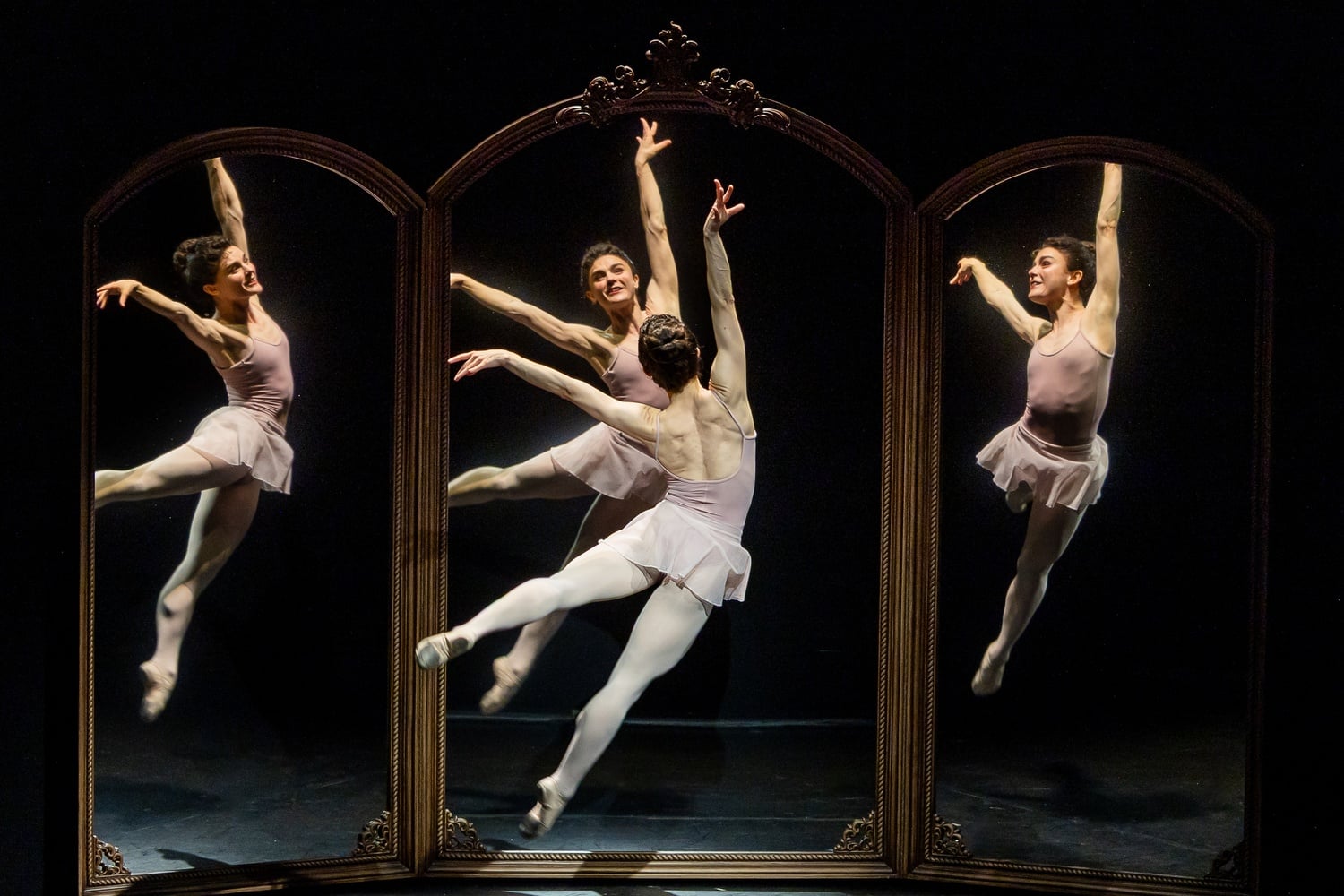
A young woman flees from — or dances with — demons in the twisted woods. Her mother stands behind her in a mirror, positioning her head on top of her daughter’s, as if she could suck the youth from the girl’s body like marrow from a bone.
“Snow White” is the bedrock onto which the aesthetics and themes of the American Repertory Theater’s 2026 production of “Black Swan” are pinned: An older woman, desperately trying to relive her youth, drives her daughter into the dangerous “forest” of the ballet world in an attempt to salvage her own beauty.
“Black Swan” is a technical powerhouse, taking its effects to the extreme. Lighting design by Isabella Byrd show the psychedelic effects of drugs, isolate principal characters, and alternately villanize and humanize a dancer. The set, designed by scenographers AMP and Marissa Todd, is a masterpiece that integrates smoke and mirrors at every turn — in the practice rooms, in private homes, in hospital rooms, in glittering gala halls. Illusion designers Chris Fisher and Skylar Fox worked overtime: Ghostly echoes of dancers whirl across the stage after their real-life counterparts, while fantastical figures emerge from the smoky darkness in the glass.
Most impressively, the “Black Swan” cast belted Broadway-level musical numbers and danced like company members at New York City Ballet throughout the production. The difficulty of the performance was mind-bogglingly absurd, and the “Black Swan” cast bursts with talent.
Melanie Moore played the protagonist Nina with shocking duality, alternating between the fragile voice of a teenaged girl and the wild authoritativeness induced by her psychosis. Her dancing perfectly mirrored the shift in her voice: Tentative in the beginning, there were moments where her dancing was just behind the others, as if she was checking to see whether she was doing the right thing. By the end of the performance, Moore’s movements were as fluid as her rival ballerina Lily’s (Jada Simone Clark), diving across the stage like an acrobat. Her transition from white swan to black swan is utterly believable through her mannerisms, voice, and dance.
The motif of Nina scratching at her back grows darker as the musical progresses and Nina descends into madness, culminating with the eerie “Scratch” number. Orchestrally, the “Swan Lake” theme grows ever more jagged, and the voices of the dancers wilder. The electric instruments paired with ever-changing lighting and curtain shifts are more reminiscent of a magic show than an ordinary musical performance.
Nina’s rival and lover Lily was immediately noticeable due to her beautiful extensions and electric energy. Impossible to ignore onstage, and with a voice like moonshine, Clark’s portrayal of Lily made Nina’s enthrallment inevitable. However, her competitiveness masqueraded as coolness left the audience uneasy from the start as they wondered what she might do to succeed.
The ensemble reinforced Clark’s performance of Lily by echoing her movements: Their eerie smiles and jolting heads mirrored Clark’s like clockwork. Other times, they perfectly embodied a crowd of people that don’t like each other but have to work together to survive an eat-or-be-eaten industry. The ensemble’s ability to act as a terrifying organism and as a cluster of disgruntled dancers reinforces the strong contrasts of mundanity and madness throughout the show.
Understudy Mehry Eslaminia played Nina’s mother on the night The Crimson reviewed “Black Swan.” Casting directors Stephen Kopel and Jillian Cimini did an extraordinary job — Eslaminia and Moore look astonishingly similar, a visual parallel that perfectly reflects the mirror theme. Although Eslaminia initially tapped into the same sweet nervousness as Nina, her annoying tendencies soon grew obsessive, and her belting voice filled the theater with rage and grief.
Director and choreographer Sonya Tayeh masterfully created scenes where Eslaminia stepped forward as her daughter steps away, while the corps de ballet bickered among themselves, deciding to help her or spurn her. Standing in front of a triptych of mirrors, Eslaminia’s body seemed to blend with Moore’s as they danced and uncomfortable questions emerged: What does the ballet owe to the patrons who pay? What does Nina owe to her mother? What does she owe to the dark dancer that inspires her?
The mirrors in “Black Swan” force the audience to see itself as part of the musical. It must watch itself consuming Nina’s story, pressing a hand to its mouth while leaning forward to catch a glimpse of her heart fluttering beneath her leotard, her hands trembling, her eyes nearly rolling back with exhaustion.
Alternately ethereal and horrific like “Swan Lake” itself, A.R.T.’s “Black Swan” is a spectacle that will haunt and inspire audiences long after the final curtain is drawn.
—Staff writer Laura B. Martens can be reached at [email protected].
Want to keep up with breaking news? Subscribe to our email newsletter
Have a tip for The Crimson? Share it confidentially