Harvard Weighs Automatically Converting A’s to A-’s to Enforce Grade Cap
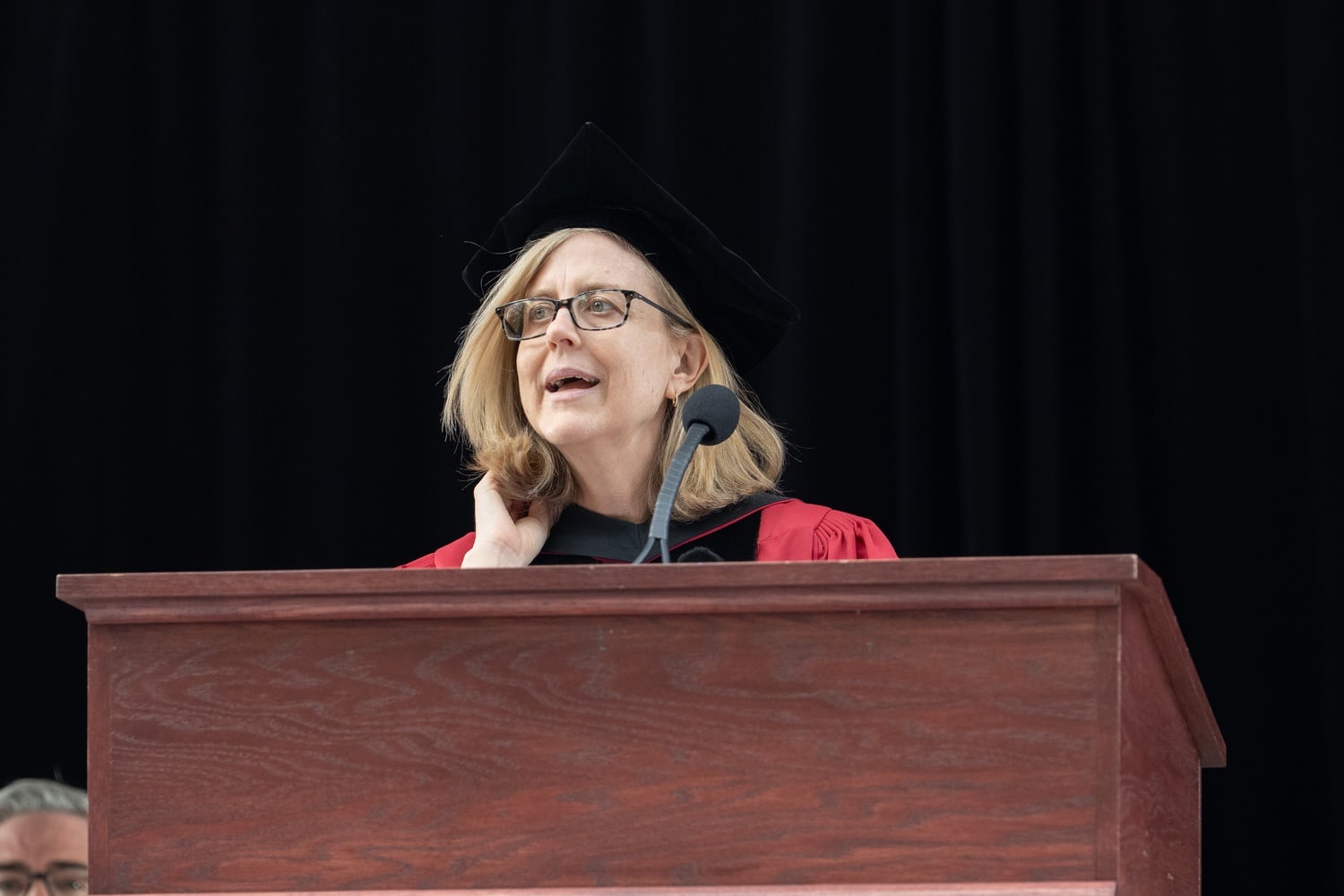
Dean of Undergraduate Education Amanda Claybaugh told PAFs Monday that Harvard “will” automatically turn all of a course’s A’s into A-’s if professors refuse to comply with the new grade cap, but backtracked in an interview Thursday, saying the mechanism remains only a proposal.

Dean of Undergraduate Education Amanda Claybaugh told Peer Advising Fellows on Monday that Harvard plans to enforce its new cap on A grades by automatically converting all of a course’s A’s to A-’s if professors refuse to bring their grades under the limit — but backtracked in an interview Thursday, saying the mechanism remains only a proposal.
Claybaugh told PAFs that professors who entered too many A grades would first receive an alert instructing them to bring their course into compliance. If they nevertheless submitted grades above the limit, she said, all of the course’s A grades would automatically become A-’s, according to four students in attendance and a recording of the event obtained by The Crimson.
“We will have an enforcement mechanism which will say if a professor puts in too many A’s, a little screen will pop up and say that’s too many A’s, and so we need to cut down those A’s, or we will turn all of the A’s into A-’s,” Claybaugh said.
The comments, made during a fireside chat that attendees had been told was off the record, offer the clearest indication yet of how Harvard could enforce the controversial cap once it becomes mandatory, answering a question that has loomed over the policy since faculty approved it in May.
But in an interview on Thursday, Claybaugh backed away from the certainty of her Monday remarks, saying the automatic conversion mechanism was only one option under consideration. She said a committee is still considering how to enforce the cap.
While she said the mechanism “seems like the easiest enforcement option,” she added that she was unsure whether it was “physically possible in our system.”
“It sounds mean to hold a gun to the student’s head, but the thing about our faculty is they really care about our students,” Claybaugh said.
“They do not want our students to be hurt, and so that’s why you have to kind of do that,” she added.
The enforcement question has taken on added urgency as some professors have publicly said they may refuse to follow the cap.
Mathematics professor Clifford H. Taubes, one of the policy’s most vocal faculty critics, wrote in a February Crimson op-ed that he planned to “ignore” the cap and award A grades as he saw fit. If the Registrar rejected his grade sheet for containing too many A’s, Taubes wrote, he would leave it to administrators to determine which students received A’s.
Get The Crimson in your inbox.
Claybaugh said Thursday that the committee wants to weigh possible enforcement options before reaching a final decision, though she added that no other suggestions have surfaced yet. The decision will depend in part on the cost and the time required to add a mechanism to my.Harvard, she said.
“It’s very complicated — complicated and boring — and I don’t understand it,” Claybaugh said.
Faculty voted in May to cap flat A grades in undergraduate courses at 20 percent of undergraduate enrollment, with flexibility for up to four additional A’s. The policy will formally take effect in the 2027-28 academic year, though administrators have encouraged faculty to begin following it this fall.
Claybaugh also told PAFs Monday that professors are being encouraged to award A grades to less than 20 percent of students, leaving a cushion beneath the 20-percent-plus-four ceiling. She did not specify a lower percentage professors should aim for.
The guidance builds on instructions Claybaugh gave faculty in June, when she emphasized that the 20-percent-plus-four allowance was an absolute maximum rather than a target.
In Thursday’s interview, Claybaugh said administrators are deliberately not asking professors to meet any particular lower target.
“We’re encouraging them not to set a particular lower target because that would be equally arbitrary,” Claybaugh said. “We’re encouraging them to define for themselves what extraordinary work would be and what thorough mastery is, so that it feels natural to draw a break there.”
Claybaugh said faculty should aim for grading distributions that do not force professors to draw arbitrary distinctions between students whose performance is nearly identical — a concern she said contributed to the decision to delay formal implementation of the cap until 2027.
In June, Claybaugh also urged faculty to change their assessments to better differentiate student performance, including through final exams and other forms of evaluation rather than relying primarily on effort-based assignments.
The grading reforms followed an October 2025 report that found that flat A grades made up roughly 60 percent of all undergraduate grades and argued that grade compression was harming the College’s academic culture.
Faculty approved the cap after months of objections from students and professors who warned that the policy could increase competition among students and undermine faculty autonomy.
The share of A grades had already begun falling before faculty formally approved the cap. In fall 2025, flat A grades accounted for roughly 53 percent of undergraduate grades, down nearly seven percentage points from the 2024-25 academic year.
As Harvard prepares to implement its cap, Claybaugh has also pointed to Princeton University’s former grading policy as a cautionary example.
Princeton adopted a policy in 2004 asking departments to keep A-range grades below 35 percent across their undergraduate courses. Unlike Harvard’s policy, Princeton’s standard applied across departments rather than imposing a numerical cap within each individual course. Princeton abandoned the numerical target a decade later.
Claybaugh told PAFs Monday that people at Princeton had told her directly that the policy suffered from inconsistent adherence and disparities in how much say professors had in the allocation of A’s. She also suggested that those shortcomings received less attention when Princeton rolled back its policy than concerns about student mental health.
Claybaugh said Thursday that she was not criticizing Princeton’s attempt at grade reform, calling the school “very brave to go first and to hold out for as long as they did when nobody else followed them.”
Claybaugh also predicted that other peer universities would pursue their own efforts to address grade inflation. She told PAFs that she presented Harvard’s work on grading to other Ivy Plus deans and came away with the impression that peer schools were grappling with similar concerns.
“Everyone was like, ‘Oh, that seems very interesting,’ like kind of blinking with their eyes, like ‘Us too,’” Claybaugh told PAFs.
On Thursday, Claybaugh clarified that the Ivy Plus administrators cannot coordinate specific grading policies because doing so would raise antitrust concerns, but said officials at peer institutions broadly acknowledged problems with grade inflation.
Claybaugh said she also plans to communicate Harvard’s changing grading standards to employers and graduate schools as flat A’s become less common.
She told PAFs Monday that she planned to personally write to some employers and graduate schools to explain that an A-minus should continue to indicate academic excellence.
Claybaugh said Thursday that her current plan is to send an email to “every single institution or company that has interacted with the Mignone Center.”
PAFs raised concerns Monday about the potential mental health effects of stricter grading. Claybaugh said she would suggest reviewing wait times for student appointments with Counseling and Mental Health Services.
But Claybaugh also told PAFs that simply graduating from Harvard was “not that hard,” arguing that much of students’ academic stress comes from ambitions beyond earning a degree.
“It’s actually not stressful to graduate from Harvard, right? You need to take 21 courses for a C or better. You can do that. It’s not that hard,” Claybaugh said. “What is stressful about Harvard is the fact that you guys all want more than just graduating from Harvard. You have set very high goals for yourself.”
In Thursday’s interview, Claybaugh said the College is also trying to give students more information about how much grades actually matter for the postgraduate paths they hope to pursue.
She said freshmen will participate in a new entryway meeting about grades this semester.
“The other thing we’re trying to do about stress is to give students information about how important grades actually are for the path they’ve chosen for themselves,” Claybaugh said. “I think in many cases, they’re much less important than students think they are.”
In response to a question about students taking General Education courses this year to avoid potentially stricter grading next year, Claybaugh told PAFs that the Gen Ed program would soon tell its faculty to “be like EC10,” one of several introductory courses that has committed to follow the cap early.
Claybaugh backed away from that description on Thursday, saying she had heard that the Gen Ed program may encourage faculty to follow the cap early but was unsure how it ultimately planned to proceed.
—Staff writer Megan L. Blonigen can be reached at [email protected] and on Signal at mblon.50. Follow her on X at @MeganBlonigen.
—Staff writer Alexa M. Schmitt can be reached at [email protected] or Signal at alexaschmitt.15. Follow her on X @alexa_m15_s.
Want to keep up with breaking news? Subscribe to our email newsletter
Have a tip for The Crimson? Share it confidentially