Deming Defends Five-Day In-Office Mandate as Essential to College’s Residential Mission
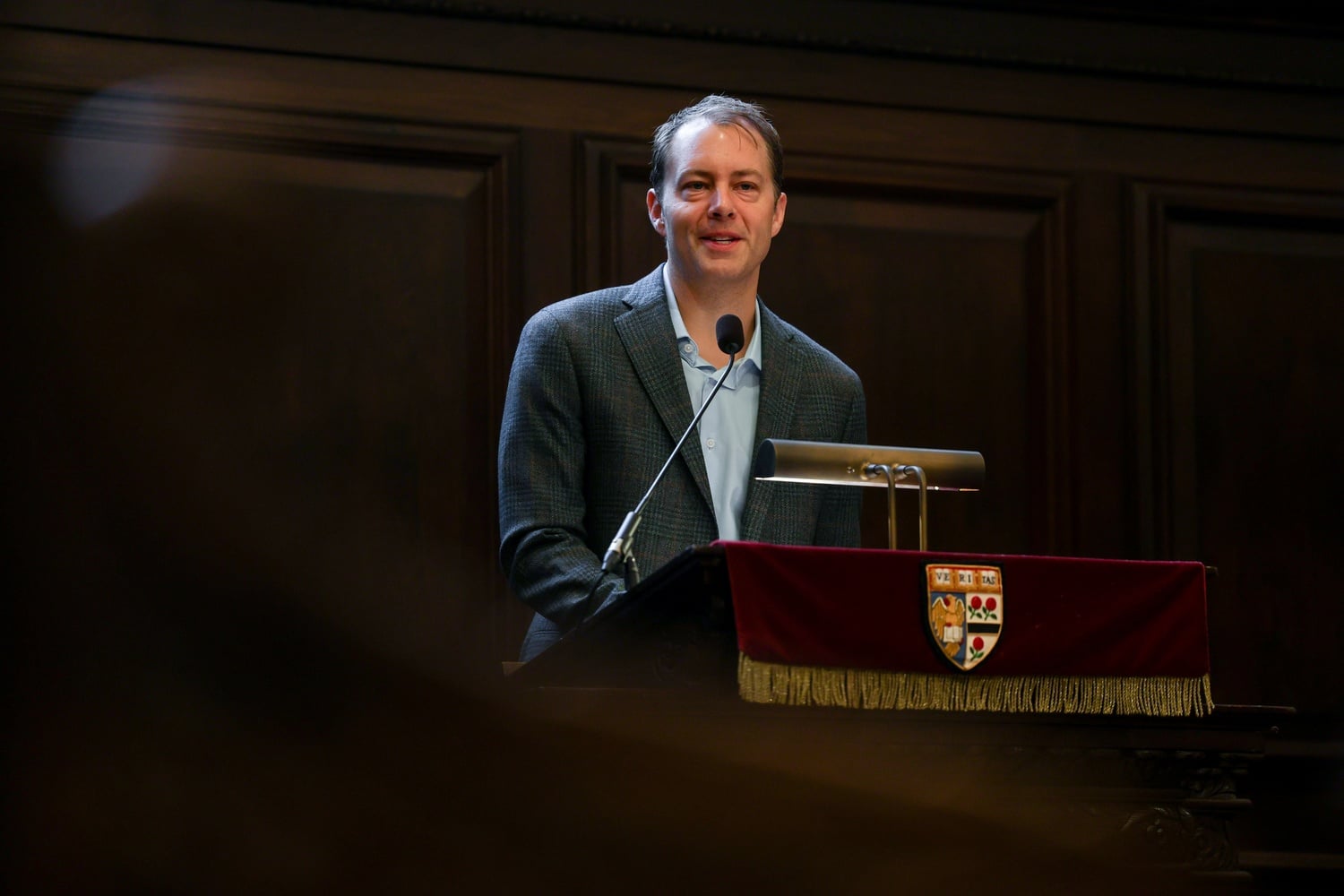
Harvard College Dean David J. Deming defended the College’s new five-day in-office mandate for staff at a Wednesday open forum, saying the policy was essential to delivering the “high-touch, intensive” experience Harvard promises its students.
Deming said that “upwards of 95 percent” of College staff work in student-facing roles — jobs he argued cannot be done well remotely.
“If you’re in a directly student-facing role, you actually can’t really do the job well from home,” he said. “It’s essential to the job.”
The mandate, which took effect for most staff last week, requires College staff to be on campus five days a week while classes are in session. It was rolled out this summer as part of a sweeping administrative restructuring across the Faculty of Arts and Sciences.
The policy was unpopular among many College leaders — but Deming remained “adamant” about pushing it through, one of the College’s senior administrators told staff at a private meeting in July.
At Wednesday’s forum, Deming acknowledged that restructuring-related changes like the mandate would create difficulties for some staff, particularly those with caregiving responsibilities. He said the policy’s effective date had been delayed to January for some employees to give them time to make new arrangements, including for childcare.
But Deming remained resolute about the policy’s importance to staff fully performing their roles — noting that students, Harvard University Dining Services staff, and custodial staff are already required to be on campus for their academic or employment obligations.
“If we’re asking the students to be here all the time, and we’re building our infrastructure around them being here together all the time, and our dining hall staff are here whenever they’re working, and our custodial staff are here when they’re working, then I think our Harvard College staff should be here when they’re working because they are just as essential to the mission as those other staff and the students,” he said.
“If I didn’t think they were essential, they could be home,” Deming said. “I know that not everyone experiences it this way, but I actually think of it as honoring the importance of what our staff are doing and recognizing it’s best done in person.”
Deming added that the policy was designed to offer staff “maximum flexibility” within the in-person requirement, pointing out that the five-day rule applies only while classes are in session and not during summer or term-time breaks.
Get The Crimson in your inbox.
He said his decision was shaped by the nature of the services the College provides, and that he would not impose a similar requirement at a different kind of organization.
“The business that we’re in is in-person intensive residential education,” Deming said. “If I were running a software company or a consulting firm, I wouldn’t insist on five days a week. That’s not what we’re doing here.”
“Students are here 24 hours a day, seven days a week during session,” he added. “We have built into our structure a lot of redundancy based on that.”
He pointed to the House system’s dining halls as an example — an arrangement he called economically wasteful but socially valuable.
“It’s incredibly inefficient in an economic sense to have all these dining halls,” Deming said. “It’s inefficient in a way to serve food, but it’s an incredibly efficient way to build community.”
In conversations with staff, Deming said, he had framed the mandate around his “overall priorities on community.”
“I wasn’t just asking something of staff, I was also asking something of students: to not have so many meetings on Zoom, meet in person, be together,” he said. “Part of it was just helping them understand a broader vision and explain why I thought it was important.”
Individual FAS staff first learned of the change in June, through informal conversations with their managers. Harvard’s previous policy left flex-work decisions to individual schools, departments, and units, many of which permitted partially or fully remote work.
The Harvard Union of Clerical and Technical Workers’ contract also includes protections for flex work. HUCTW organizer Carrie Barbash said in June that the union would resist the mandate, including by encouraging union members who were impacted to file grievances.
Several College leaders opposed the policy as well, including Associate Dean of Academic Engagement Manny Contomanolis, Dean of Undergraduate Education Amanda Claybaugh, Associate Dean for Undergraduate Education Gillian Pierce, and OUE Executive Director for Administration and Finance Ruth Wilson, Contomanolis told OUE staff at a July meeting, according to one staff member present.
—Staff writer Sebastian B. Connolly can be reached at [email protected] or on Signal at sbc.23. Follow him on X @SebastianC4784.
—Staff writer Summer E. Rose can be reached at [email protected] or on Signal at ser.85. Follow her on X @summerellenrose.
Want to keep up with breaking news? Subscribe to our email newsletter
Have a tip for The Crimson? Share it confidentially