Harvard’s Mittal Institute Helped Book a Nine-Day Hindu Recitation at Sanders. Then Its Own Faculty Revolted.
For nine days in August, roughly 1,000 people a day filled Sanders Theatre for a Hindu devotional recitation that Indian outlets hailed as a landmark moment for Harvard. Behind the scenes, the Mittal Institute had spent weeks trying to get Harvard's name off it.
For nine days in August, roughly 1,000 people a day filled Sanders Theatre to hear an Indian spiritual leader recite the life of Ram, a Hindu god — a devotional marathon that Indian outlets covered as a landmark moment for Harvard.
Harvard had spent weeks trying to get its name off it.
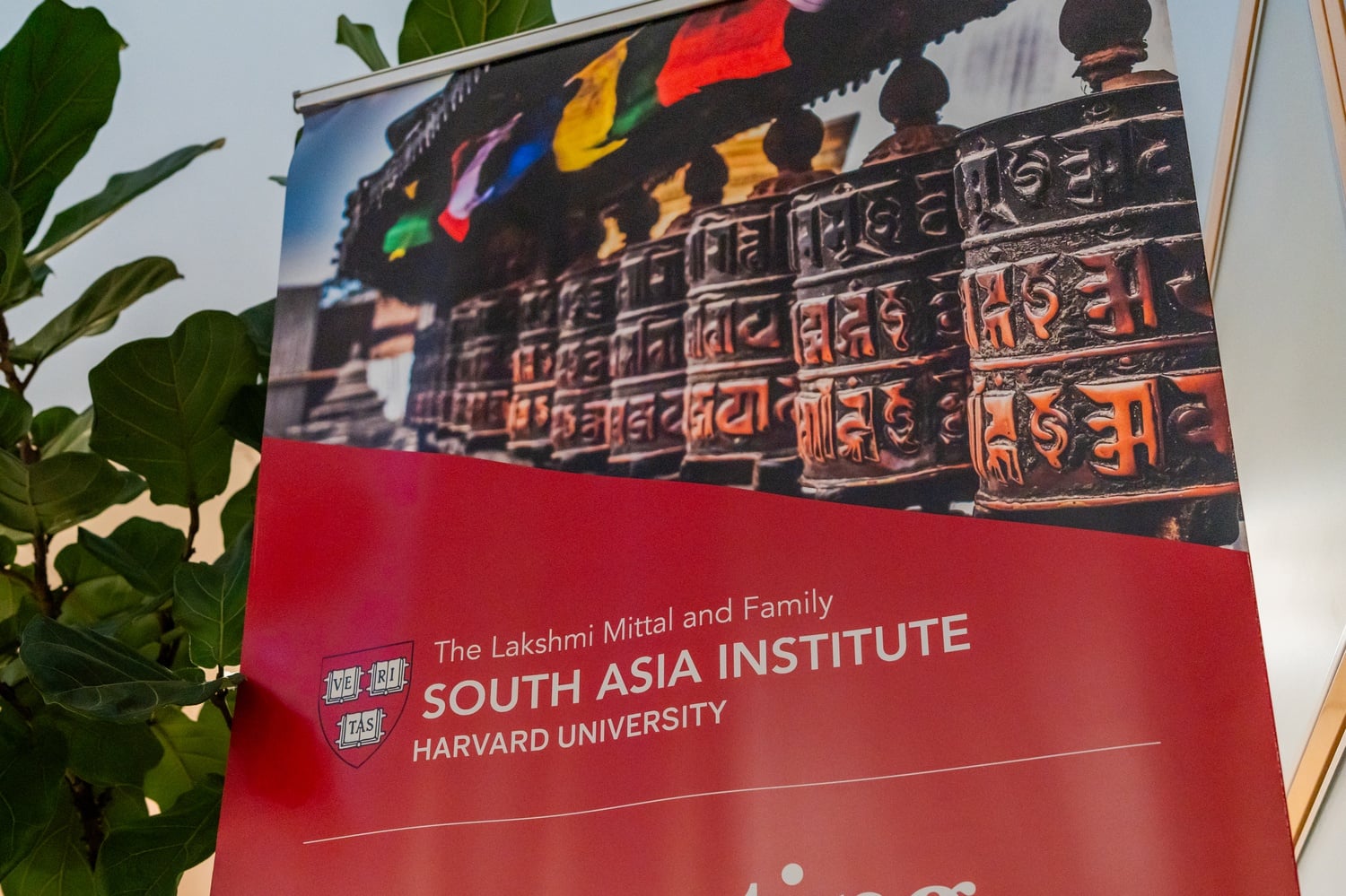
The “Ram Katha,” which ran from Aug. 15 to Aug. 23, was led by Indian spiritual leader Morari Bapu and funded by a British charity run by the son of a Conservative member of the House of Lords. Attached to it was an academic conference on the Ramayana, an ancient epic, that Harvard’s South Asia Institute — founded in 2003 and renamed in 2017 after a $25 million gift from steel magnate Lakshmi N. Mittal — had helped assemble, publicize, and book into Sanders.
But over the summer, Harvard faculty — including those on the Institute’s own steering committee — argued an academic unit was lending its name to a nine-day devotional event seemingly aimed largely at a non-Harvard audience, one with political stakes in India that Harvard had no business taking on.
The dispute wound its way to Harvard’s top lawyers and its public affairs office. By the end of July, the Institute had decided to pull out entirely, taking the conference page off its website and stripping its name from the Sanders booking. After a professor flagged that a website advertising the katha still included “atharvard” in its URL, that was scrubbed too.
“After extensive consultations with all stakeholders, it was agreed that the whole event should proceed as planned, independently of the Institute,” Hitesh Hathi, executive director of the Institute, wrote in a statement to The Crimson.
Planning the Katha
When entrepreneur Paavan Popat — the son of Lord Dolar Popat, a Conservative member of the House of Lords who calls Morari Bapu his guru — began courting Harvard faculty in 2024, he quickly ran into roadblocks.
He contacted at least 10 to 15 professors and administrators across Harvard, he said in an interview, including those at the Harvard Divinity School, the Mittal Institute, and the president’s office. Many were receptive, he said, but told him the event was too large to take on alongside their day jobs.
Capacity might not have been the only issue. Divinity School professor Francis X. Clooney wrote in a statement that when he corresponded with organizers, he told them that a katha might be better suited to a temple than an academic institution and that August would be a difficult month for students and faculty to attend. He added that he did not object to the religious event itself, which he said was “wonderful.”
Get The Crimson in your inbox.
Swayam Bagaria, an assistant professor of Hindu studies at the Divinity School, wrote in a statement that when he was approached by Paavan Popat in late 2024, he said Harvard — including the Divinity School — would not host a cultural event, so he could not facilitate it.
Paavan Popat disputed both accounts. He wrote in a statement that Clooney never suggested a temple as an alternative location or raised timing concerns with him — and that Clooney spoke at one of the event’s evening sessions. Bagaria, he wrote, stayed involved through the Institute until a few weeks before the event.
The Institute, though, was interested in an academic conference. Hathi remained the main point of contact, according to Paavan Popat. Bagaria compiled a speaker list, and Diana Eck — who became the Institute’s interim faculty director in July 2025 — joined later.
Institute affiliates warned Paavan Popat that the scholars’ perspectives on the Ramayana might not be welcomed by all katha attendees. He said he told them that any scholar engaging in good faith would be welcome, whatever their views.
Paavan Popat had wanted 2025. He got August of this year, he said, after Harvard scrapped construction on Sanders Theatre and left the month open. Before the booking was finalized, Hathi met him and Morari Bapu in India to discuss the conference.
That did not mean organizers could use the Harvard brand. Hathi warned them from the start that they could not advertise the katha as a Harvard event, a principle Paavan Popat said they readily accepted.
And while the Institute helped secure the booking, it did not foot the bill. Paavan Popat’s U.K.-registered charity, TRUDANA — working with U.S.-based nonprofit Truth Love and Compassion — was already covering the katha, and he offered funds for the academic conference as well. Lord Dolar Popat, a TRUDANA trustee, contributed no money, his son said. Paavan Popat declined to comment on the total cost, and Lord Dolar Popat did not respond to a request for comment.
‘Fundamentally a Religious Event’
The Institute publicized the katha and conference to faculty in an email that projected more than 1,000 attendees and presented the two as a package: “an academic conference on the Ramayana with some of the world’s leading scholars in tandem with a full traditional recitation of the Ramacharitmanas.” The email made no mention of the Popat family.
Questions followed quickly. History professor Maya R. Jasanoff ’96 said she immediately wrote to Eck asking for more information but received few details in response. The email, she said, “seemed to me to be describing what was preeminently a devotional event.”
The katha had come up at the steering committee’s last meeting before the event, early in the spring, but drew no discussion, according to a member in attendance.
Faculty argued that the Institute could not be involved in a devotional event aimed at a non-Harvard audience. Inviting a prominent religious figure to campus for a speaker event would be a different matter, Jasanoff said.
“I don’t think anyone would bat an eye at inviting Pope Leo or the Dalai Lama or other major religious figures to come speak at Harvard,” she said.
“I think that’s all completely in keeping with our principles and our mission. I think that that is very different from hosting, say, nine days of Latin Mass for the followers of a particular cleric within the church,” she added.
History professor Anurabh Ghosh, another faculty member concerned by the event, said the “basic concern that I think I have, and I share with many other people, is that this is fundamentally a religious event, and and a sectarian one as a result, and something that an institution like Harvard should not be in any way involved with.”
Jasanoff and a few other faculty outlined those concerns in a July 16 letter to Vice Provost of International Affairs Mark C. Elliott, copied to FAS Dean Hopi E. Hoekstra and Harvard Provost John F. Manning ’82. That letter invoked Harvard’s institutional voice policy, adopted in May 2024, which discourages University leaders from issuing official statements on public matters that fall outside Harvard’s core academic function. A few months after rolling out the policy, the University issued guidance broadening the principles to Harvard’s department and center leadership.
Ram’s worship has sat at the center of Indian politics for more than three decades. Many Hindus believe he was born in Ayodhya, on the ground where a 16th-century mosque stood, and some believe a temple was destroyed to build it. A mob of Hindu extremists tore the mosque down in December 1992, touching off riots that killed roughly 2,000 people across India.
The country’s Supreme Court awarded the site to Hindu petitioners in 2019, and Prime Minister Narendra Modi inaugurated a temple to Ram there in January 2024. Morari Bapu gave at least 11.3 crore rupees toward its construction, reported in the Indian press as among the largest individual donations to the project.
Given the “hotly contested matter of the worship of Ram in India today,” Jasanoff wrote in a text message, she “feared that this event would place the Mittal Institute, and by extension Harvard, on one ‘side’ of the defining political issue in the region.”
It was not the first time the Institute had been pressed over Indian politics.
In 2021, Harvard’s student government passed legislation in favor of a petition asking the Mittal Institute to “denounce the detention and repression” of protesters under Modi’s administration in India.
As questions mounted, roughly a dozen faculty members gathered with Eck and Hathi over Zoom on July 19 to discuss the issue. Over the course of an “intense discussion,” per a follow-up email Hathi sent to some faculty the same day, attendees agreed to physically separate the katha and conference and make the division clear in further communications.
Faculty also asked about funding. They had been told through the process that a line separated the katha, sponsored by donors, from the conference, run by the Institute, according to two faculty members familiar with the matter. When they pressed on the conference’s finances on July 19, they learned the donor was covering the academic speakers too.
In that email, Hathi wrote that Elliott had asked him to “check in” with Harvard’s Office of the General Counsel and Harvard Public Affairs and Communications. Both stayed involved as he considered next steps: on July 24, he told involved faculty he had a follow-up with OGC that day and would also speak to HPAC.
The resolution did not follow the July 19 recommendation. Instead, Hathi informed the Institute’s cabinet — a 12-person subset of the steering committee — in a July 29 email that the Institute was removing its name and affiliation from the event altogether.
“We are making clear that the Mittal Institute is not hosting any part of the event, including the academic conference,” Hathi wrote in the email, adding that the invited speakers would be told of the change and the Institute’s listing taken down from its events page.
Paavan Popat’s organization then contracted directly with Sanders Theatre for every element of the program, at a steeper rate.
“In removing our name from the booking, the foundation had to pay substantially more for the venue, as per Sanders policy,” Eck wrote in a statement.
‘History-Making’
In the weeks before the katha, Institute leaders scrambled to erase all traces of Harvard from the event’s promotion.
In an Aug. 7 email to some involved faculty, Hathi wrote that a website with a URL including “atHarvard” had been taken down after Comparative Literature and English professor Homi K. Bhabha raised concerns about the Harvard branding. Paavan Popat wrote in a statement that the page was published by the organizers’ IT team in error as an internal pitch and was “taken down within minutes of our becoming aware of it.”
The organizers, Hathi wrote in the same email, had also “re-confirmed” their commitment to “vetting principles” agreed on earlier — no political speakers, no officials of any political party, no officials from highly political social or cultural organizations, and no one who might compromise the academic speakers.
Hathi and Eck still spoke at the katha’s opening session, where Hathi welcomed Morari Bapu and Eck gave remarks on the geography of the Ramayana. Bagaria, who had compiled the speaker list, withdrew from the proceedings and attended only the academic portion.
The venue loomed over the nine days anyway — in the press coverage and in the speakers’ remarks. Indian outlets named Lord Dolar Popat and his family and splashed Harvard across headlines. And taking the stage on the first day, Lord Dolar Popat went straight to the setting, calling the katha at Sanders “history-making” and “a dream come true.”
On Aug. 21, the Casteless Caucus — a Kennedy School student group aiming to promote caste sensitivity amid burgeoning anti-casteism efforts at U.S. universities — emailed two OGC lawyers and a staff member at the Provost’s Office with concerns about the event. It followed up the next week with the Institute’s steering committee, questioning the event and Institute leaders’ presence at it.
“What happens when a globally prestigious institution lends its spaces, reputation, and legitimacy to the celebration of a cultural text that explicitly reinforces hierarchies of caste and gender?” the Caucus wrote to the OGC lawyers.
Eck responded on Aug. 31 email, writing that neither the Institute nor Harvard had sponsored or hosted the event and that she and other faculty attended “out of personal academic interest.”
“Issues of gender, discrimination, and hierarchy are part of many texts, including the Valmiki Ramayana (which I often teach in class), the Bhagavad-Gita, the Torah, the Christian Bible, and so on,” she wrote. “Since these texts do not arrive verbatim from heaven to earth, the responsibility of interpretation by teachers and preachers falls to us.”
Morari Bapu made no such distinction. On the katha’s ninth and final day, he settled the question himself.
“I dedicate this whole Ram Katha to Harvard University,” he declared.
—Staff writer Amann S. Mahajan can be reached at [email protected] and on Signal at amannsm.38. Follow her on X @amannmahajan.
Want to keep up with breaking news? Subscribe to our email newsletter
Have a tip for The Crimson? Share it confidentially