Harvard Medical School Dean Outlines Strategic Plan Amid ‘Destabilizing’ Federal Funding Cuts in School Address
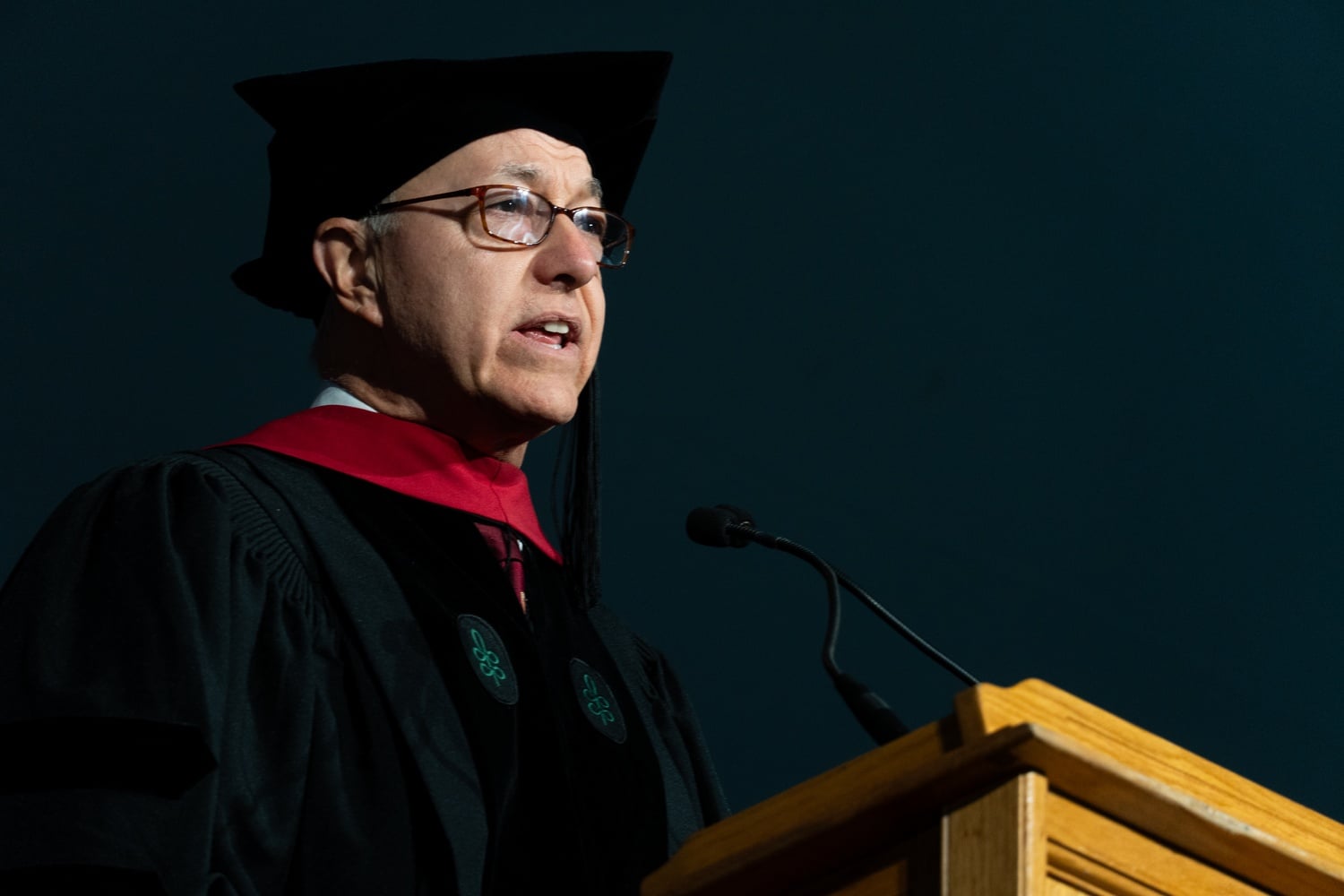
Harvard Medical School Dean George Q. Daley ’82 described an updated strategic plan on Wednesday that would include leaning into artificial intelligence, improving industry partnerships, and recentering academics in light of “destabilizing” federal funding cuts and “tumultuous” outside pressures faced by the school this year.
The school’s federal revenue was down by 17 percent in fiscal year 2026 after four years of continuous growth. Even so, the school closed its $8 million budget shortfall with strategic reserves — far short of the nearly $200 million operating loss it had forecast a year earlier.
“Now this is a success story, but it is a painful one. Every unit across the quad reduced their budget in FY 26, which necessitated some difficult choices about positions and people,” Daley said. “I want to commend all of you for acting selflessly at a time of financial strain.”
The financial strain has coincided with a series of federal battles. Harvard prevailed in district court last September after the federal government terminated research funding. The withheld funds have since been restored.
In the face of uncertain federal funding and the proposed revisions to federal grantmaking rules that would require senior political appointees to approve research awards, Daley called for increased focus on industry partnerships and philanthropy, which he described as a “lifeline.”
Daley said Harvard would use a congressional delay of the proposed revisions, now pushed to Dec. 11, to press lawmakers on the value of federally funded research.
“Now we will use this temporary reprieve to ensure members of Congress that they understand that discovery science for the benefit of humanity should not be dictated by partisan policies, and that’s a notion with bipartisan support,” he said.
Daley also pointed to several large philanthropic gifts made this year, including an anonymous $6 million donation to fund Ph.D. students, and a $6 million gift from HMS Board of Fellows member Mark Schwartz and his wife that added five fully funded slots to the MD-Ph.D. program, growing this year’s class by 33 percent.
In the realm of industry partnerships, Daley previewed a collaboration between the Medical School and Roche Genentech, set to be announced shortly, while also pointing to the recent Bristol Myers Squibb partnership that created a joint training pathway for HMS and company scientists.
“Because we have such an extraordinarily large faculty to draw from across all our institutions, a team of academic scientists to partner with industry scientists to address industries is a win-win partnership,” Daley said.
Get The Crimson in your inbox.
Earlier this year, the Medical School revised its mission statement and community values as a part of a broader shift in its strategic plan, outlined by the acronym BEACON. The plan prioritizes AI investments and academic excellence, alongside ideals such as belonging, collaboration, and resilience.
Daley said that the Medical School is transforming its infrastructure to create “an AI-enabled campus” that supports “our education, our research, and our service mission.”
“We are sprinting to keep up with the artificial intelligence revolution,” Daley said.
Among the Medical School’s “fleet-footed runners” in that sprint, Daley pointed to virtual patient avatars and an AI-agent-powered autonomous science. The HMS Core for Computational Biomedicine has also been working to acquire advanced graphics processing units and expand computing capacity to drive those tools, Daley said.
“These efforts are critical to maintaining our competitive advantage. We must stay at the leading edge, but we must also remain vigilant for potentially disruptive new technologies,” Daley said.
Last year, Daley established the Task Force on Open Inquiry group, whose findings, published in April, described students and faculty self-censoring out of fear of retaliation. To continue to prioritize viewpoint diversity, Daley announced that this year’s Daniel D. Fetterman Medical Education Awards will, for the first time, honor a faculty member who has excelled at promoting civil discourse.
“To be leaders in biomedicine, we must be able to listen with an open mind, especially when it feels uncomfortable, because that directly impacts our ability to navigate nuance and advocate for a healthier world,” Daley said.
Daley also said the school is working to renew its affiliation agreements with its 15 affiliated hospitals — originally written in 1948 — by the end of the calendar year.
“The state of Harvard Medical School is strong. It’s durable. It’s resilient,” Daley said. “We remain poised to tackle whatever that future brings. Bring it on.”
—Staff writer Riya S. Shah can be reached at [email protected] and on Signal at riyas.23. Follow her on X @RiyaShah233.
—Staff writer Juliana L. Yao can be reached at [email protected] and on Signal at jly.87. Follow her on X @JulianaYao298.
Want to keep up with breaking news? Subscribe to our email newsletter
Have a tip for The Crimson? Share it confidentially