Deming Tells Class of 2030 AI Will Bring About a New Age for American Universities
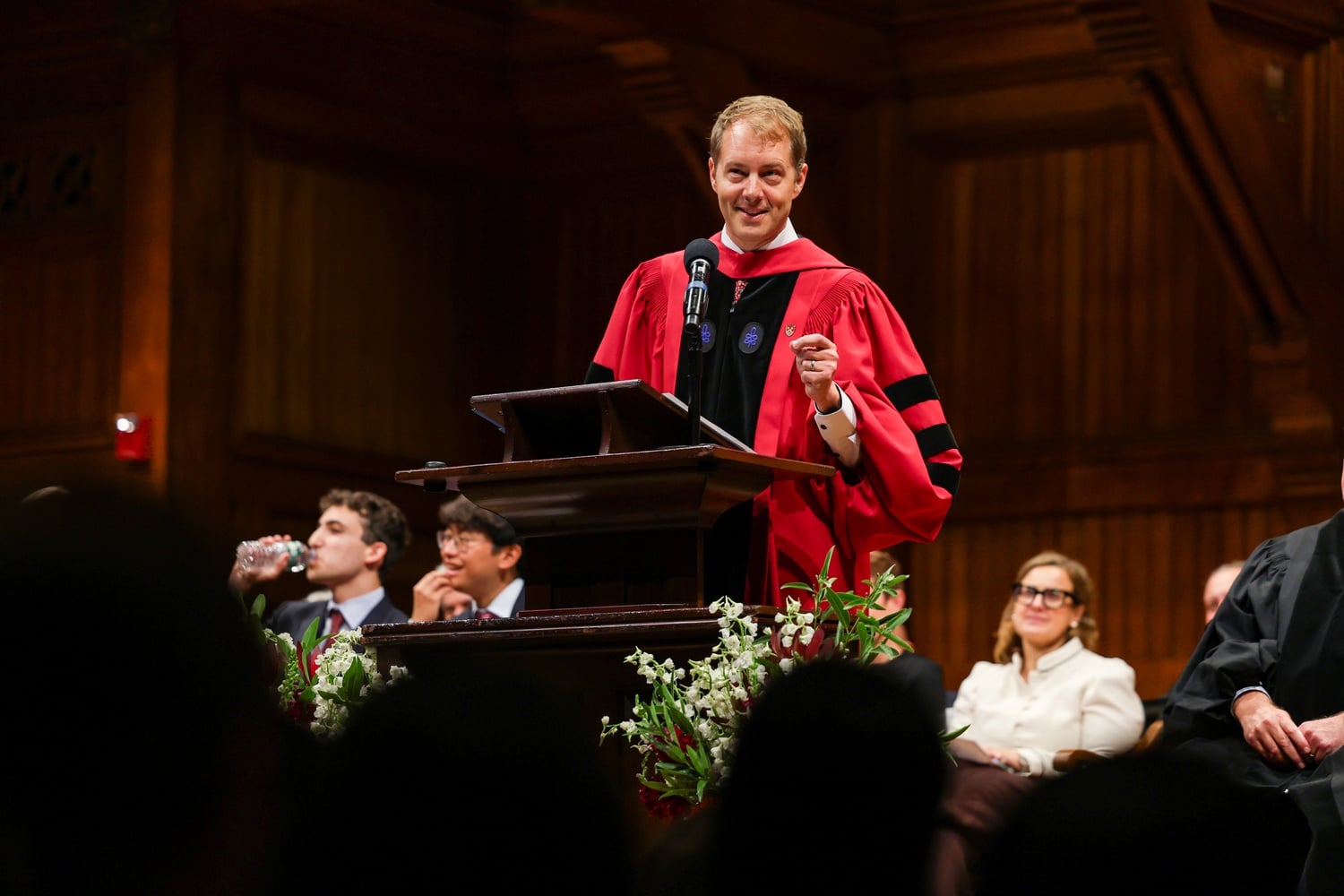
Harvard College Dean David J. Deming told members of the Class of 2030 that they were entering a “third era” of higher education in remarks at an abbreviated Convocation ceremony Tuesday afternoon — arguing that artificial intelligence would fundamentally change the role universities play in American society.
In his remarks, Deming divided the history of higher education into two eras. In the 1600s, he said, Harvard stood out because of the number of books it had accumulated — notable in an era where access to information was limited to a select few.
But as knowledge became more widely accessible and society increasingly specialized, Deming argued that universities have become places where expertise, rather than general knowledge, was cultivated — sometimes at the cost of a unified community.
“Specialization has great benefits, but also great costs because it divides us into separate realities and inhibits the formation of common firms. I believe this second era is coming to a close,” Deming said.
The rise of AI, he argued, is prompting another shift in the role of higher education, as technology makes expertise increasingly accessible and places greater value on collaborative and communal learning.
“The internet has made expert content available to anyone in the world,” Deming said. “That content doesn’t replace your education here because it isn’t personalized. Masterful lectures are part of your education, but not the only one. They don’t answer your questions or meet your individualized learning needs.”
“But artificial intelligence can be fully personalized,” he said.
Deming pointed to new tools — such as AI tutors that have already been shown to improve students’ learning outcomes — as evidence that individualized learning could occur through technology. He added that in the long-term, “expertise” itself would become widely available to the public, thanks to technological advancement.
“In the long run, AI and other technologies will commodify expertise, but expertise alone doesn’t make it for a great education or even a good one,” he said.
AI was also a focal point of Deming’s first Convocation address last year. Then, however, he focused on the technology’s impact on the workforce rather than undergraduate education, telling students that their Harvard educations would empower them to thrive in an AI-driven workforce.
Get The Crimson in your inbox.
This year’s ceremony was held indoors in Sanders Theatre due to expected rain, resulting in the class being split into two groups participating in two separate — though identical — ceremonies due to Sanders’ limited capacity. To accommodate the altered schedule, each event was abbreviated, with all musical performances cut.
In his remarks this year, Deming pushed back against the idea that technological advancement would make higher education obsolete.
“Tech leaders like Elon Musk encourage you to skip college, saying things like, ‘You don’t need to go to college to learn stuff; everything is available,’ basically. But this misunderstands what a university is for,” he said.
Instead, Deming argued that universities should increasingly become places where students develop skills best learned alongside others.
“I believe that in this new, third era of undergraduate education, we should lean into our strengths and become radically more communal, enabling other forms of learning in which technology is of little or no use,” he said.
Deming has previously argued on his personal podcast that social skills, including collaboration and effective communication, will become increasingly valuable in the workplace as AI is more widely adopted.
Some students said they appreciated Deming’s willingness to address AI.
“I think that Dean Deming’s speech did overall a good job of acknowledging it because it is the elephant in the room, but also figuring out a way to talk about Harvard and what Harvard has to offer outside of it,” Kabir S. Mahajan ’30 said.
As College dean, Deming made AI one of his priorities this past year. In remarks at an April open forum, he said he hoped to “push harder” on the technology moving forward — though he has consistently declined to encourage courses to adopt a blanket policy on AI use, instead advocating that limitations be set on a course-by-course basis.
—Staff writer Sebastian B. Connolly can be reached at [email protected] or on Signal at sbc.23. Follow him on X @SebastianC4784.
—Staff writer Summer E. Rose can be reached at [email protected] or on Signal at ser.85. Follow her on X @summerellenrose.
Want to keep up with breaking news? Subscribe to our email newsletter
Have a tip for The Crimson? Share it confidentially