Let’s Talk About Surveillance
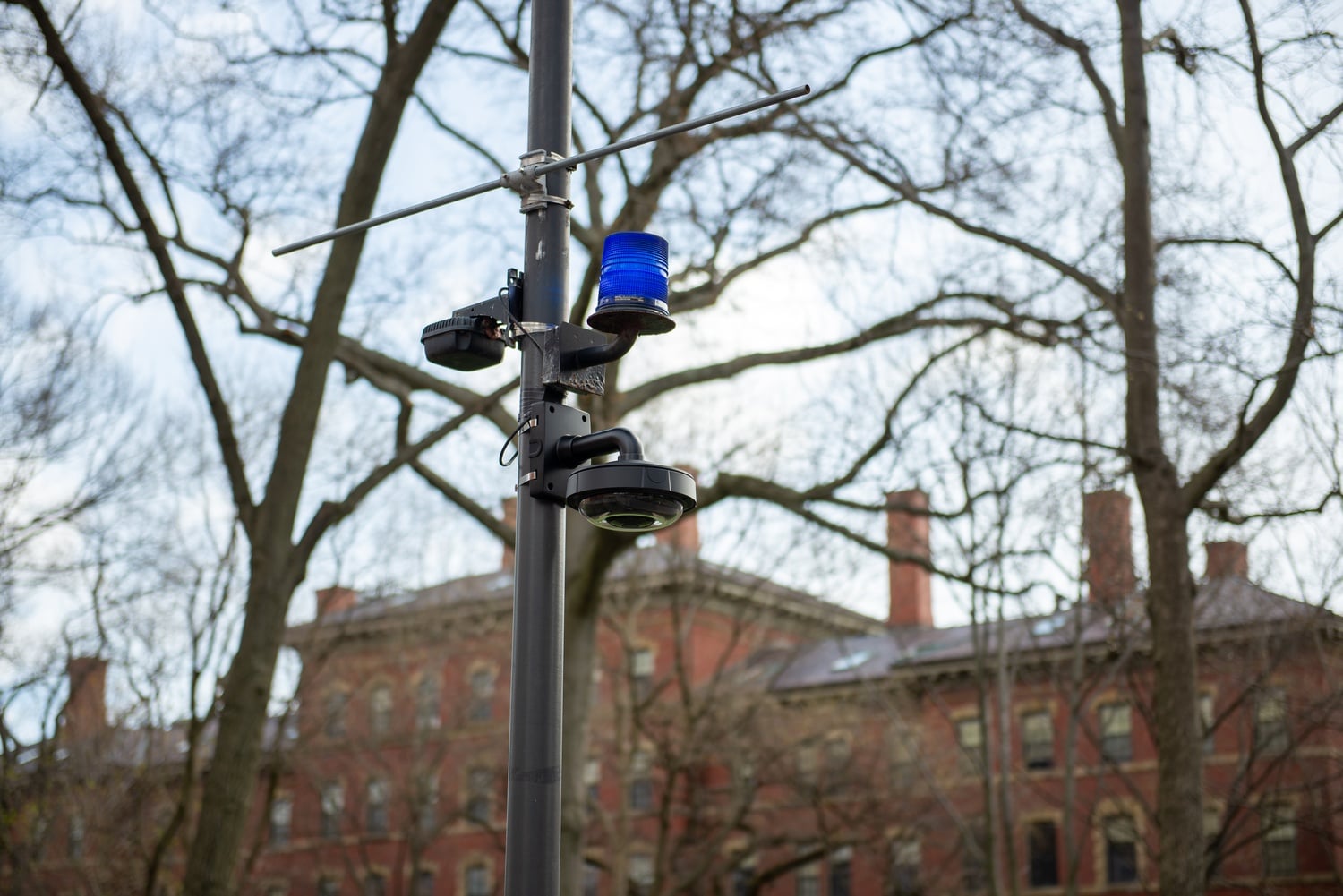
You should know that you’re being watched.
I’m not talking about relentless media coverage or the tourists milling in the yard — I’m referring to a kind of internal monitoring that seems to have flown under the radar on a campus that is so used to living and learning in a fishbowl.
In spring of 2025, Harvard installed 30 new security cameras in the Yard. Over the summer, they revealed plans to install additional cameras around academic buildings and residential Houses. An administrator privately tied the escalated surveillance to the fatal shooting at Brown University and possibly to better enforcement of campus protest rules.
Although Harvard seems to be putting guardrails in place to prevent abuse, we should remain on high alert. While some amount of surveillance can serve a legitimate public safety purpose, our campus community ought to carefully consider the unintended consequences of heightened monitoring.
The debate over privacy and public safety is not confined to Harvard. Americans of all political persuasions are growing increasingly wary of unbridled, hyperoptimized monitoring. There are a variety of concerns about the latest batch of AI-enhanced surveillance cameras in particular, from the potential for data sharing with federal immigration law enforcement to the tendency of facial recognition technology to disproportionately and unreliably police people of color. Student demonstrations nationwide have denounced universities’ investment in powerful surveillance technologies to observe campus activity.
At Harvard, however, I have been surprised by the ostensible lack of backlash or even discussion of the expanding surveillance on campus. Where are the impassioned op-eds invoking Foucauldian logic, or the heated dinnertime debates about the role of surveillance in mitigating gun violence?
The apparent disinterest may stem from a lack of information about these cameras, and from their portrayal as a standard update of existing security measures. Additionally, the University has made it clear that their use is significantly circumscribed. Faculty of Arts and Sciences spokesperson James M. Chisholm emphasized that the cameras were not “connected to ICE or law enforcement.”
But Harvard has not allayed concerns about one potential use: muting campus protest. According to Harvard’s video camera use policy, staff may review footage to investigate safety threats or misconduct.
If the past few years are any guide, it’s easy to see how an overbearing administrator might accuse students engaging in peaceful protest, an act that is disruptive and subversive by design, of “misconduct.” Even if not explicitly wielded against protesters, however, just the knowledge that one is being observed can be enough to deter assembly with like-minded peers.
Of course, not all campus monitoring should be dismissed offhand as illegitimate and harmful. I understand why administrators are on edge after the horrific shooting at Brown last year, given that the search for the suspect was complicated by a lack of usable surveillance camera footage. And it’s not as though Harvard is alone in ramping up security measures — just across town, the Massachusetts Institute of Technology announced that it would spend more than $3 million on over 500 AI-powered surveillance cameras across campus.
This is part of a tragic macro-trend that afflicts our country: Rather than amending permissive national gun laws, we sink billions of dollars each year into school safety technologies, applying extravagantly priced band-aids to a gaping structural wound.
Nationwide, the government’s inability or unwillingness to enact commonsense gun reform has pushed Americans to adopt increasingly expensive, invasive technologies — the Washington Post reported that several public schools are turning to pepper-spraying drones inspired by those used in the battlefields of Ukraine to attack assailants.
I view Harvard’s security escalation as the University’s well-intentioned attempt to prioritize student safety within the context of the society we live in. But we should at least acknowledge that when we turn to ubiquitous surveillance as a stopgap, we make a sacrifice — excessive monitoring undermines the ethic of a university as a place for expression and experimentation.
The tension between public safety and privacy is complicated and unresolved, and that is why administrators should not unilaterally dictate what constitutes acceptable versus unacceptable surveillance. While it is tempting to dismiss passive data collection as unproblematic, any data collected can become data abused.
The city of Cambridge recently announced that they would convene a resident assembly on surveillance technology. Harvard should do something similar. We need to have candid community conversations in which students, faculty, and administrators alike can share their input on a development that affects us all.
Rather than docile indifference, we ought to meet surveillance with equal parts curiosity, pragmatism, and healthy skepticism.
Monitoring only works when we monitor back.
Anniyah H. Rizvi ’29, a Crimson Editorial editor, lives in Dunster House.
Want to keep up with breaking news? Subscribe to our email newsletter
Have a tip for The Crimson? Share it confidentially