Stop the Slop
First they came for the take-home essays
And I did not speak out
Because I like presentations
Then they came for the research
And I did not speak out
Because I’m not in STEM
Then they came for the creative writing
And I did not speak out
Because contemporary authors are pretentious
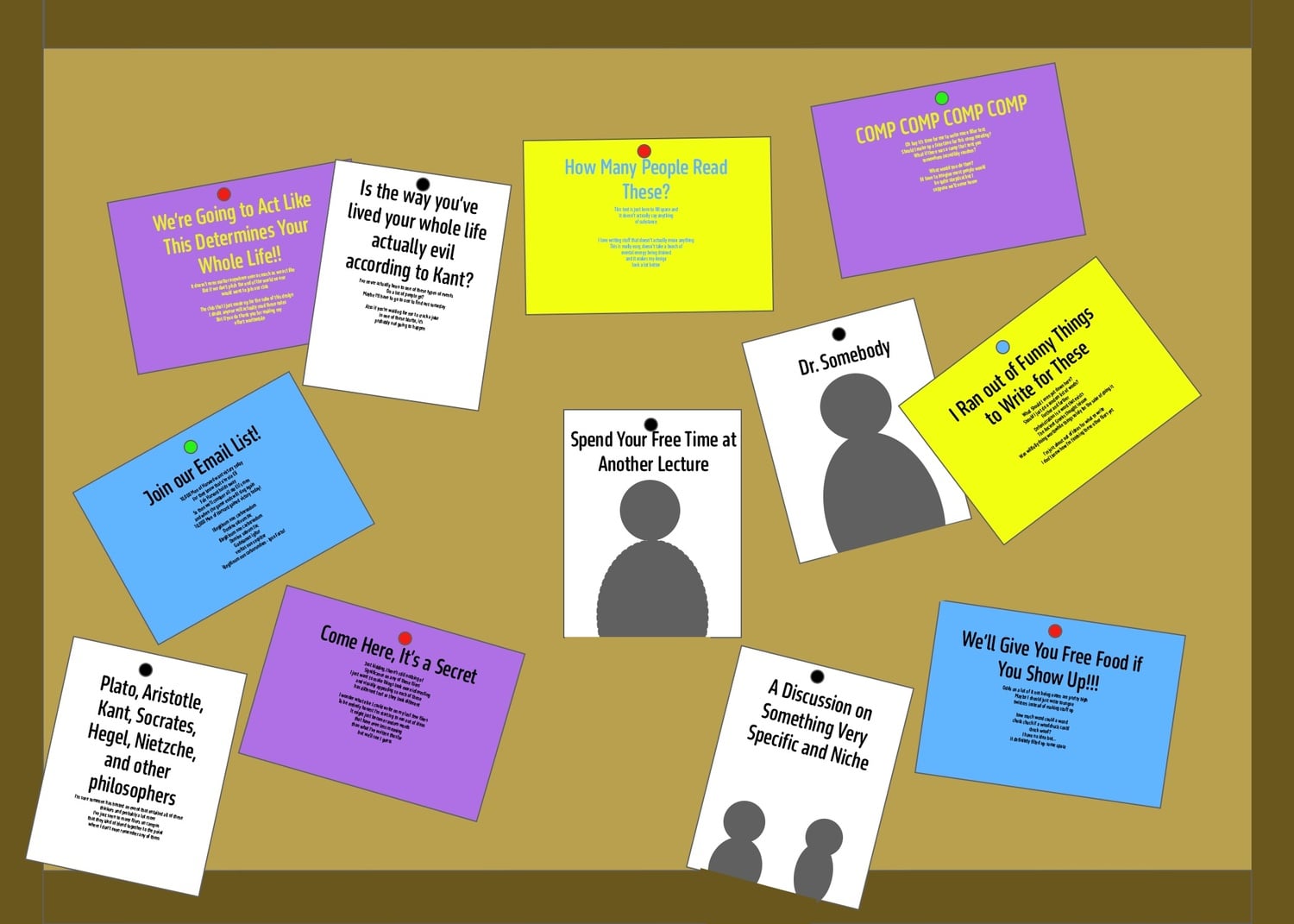
Then they came for the posters
And there was no one left
To speak out for me
Here at Harvard, we pride ourselves on being a self-selecting crowd of students concerned about rescuing liberal arts from the doldrums of an era defined by an intense attention economy. Indeed, The Crimson’s Editorial Board clamors for intellectual stimulation and genuine effort in every academic arena.
But even as Harvard’s brass has reiterated time and time again that artificial intelligence will fundamentally change the role of American universities, it came as a shock to me when the AI laziness epidemic claimed its next victim: graphic design.
Over the past few years, we’ve become remarkably quick to cut corners on research and other menial tasks, but posters? Seriously? What do we stand to gain by outsourcing the relatively straightforward task of event promotion to ChatGPT? About two minutes of freed-up time, and a lifetime of misery and regret.
Picture this: You open your email to find a message from your House Committee pubbing an event this weekend. Before impulsively pressing delete, your distracted self notices there’s an image attachment — and now you’re face-to-face with a .jpg of meaningless content: letters slightly misaligned in that uncannily loose sans-serif font, tinged a hazy yellow overtop an idealistic horizon. Don’t forget the three “what, where, when” boxes in that mahogany bar on the bottom.
You are nauseated. Sweaty, even. What’s going on? What’s become of traditional communication? Do they even care about you? What’s become of the West?
As you may expect, such a willingness to employ AI for menial tasks is part of a broader culture of “co-intelligence,” stemming from Wharton professor Ethan Mollick’s 2024 guide on using large language models as collaborative partners. While the Editorial Board and I alike support AI’s ability to facilitate menial tasks, we worry about what might become of an institution where students’ creative thinking — the essence of our humanity — is outsourced to a robot.
If we continue to elicit the “help” of external entities for such basic needs, all the while failing to assure some degree of aesthetic quality, we risk burying ourselves in a dumpster of uncreativity, where the coddled mind is the norm. It’s a slippery slope for the future of higher education.
The Canva revolution of recent years pitied the recipient, providing dates and times in an obnoxiously straightforward manner as a visual elevator pitch of sorts. At least templates require a degree of active design from the user, even if it’s as little as replacing “Lorem ipsum” with a catchy event title.
Now that some unsympathetic club head can jot a sentence or two onto ChatGPT and call it a day, the social contract has been compromised. If he’s not putting the same level of effort into his publicity, why should I attend his event? Is anything real anymore? When the club advertises drinks, should I expect a single can of lukewarm Spindrift?
I don’t demand that anyone possess the Illustrator prowess to design one’s own posters. In fact, the charm of Canva is its relative minimalism and low barrier to entry — but dare go even lower, and in my eyes, you’ve produced slop.
That’s right: “Time-saving” AI flyers are an eyesore. A recent image for a religious organization I belong to spelled the following across two separate columns: “Come as you are. You don’t need to know the prayers. You don’t need to stay for the entire service. You don’t need to have it all figured out.”
In this illustration, which was wholly unnecessary to begin with (at least from the perspective of providing dates and times), the horizontal separator lines didn’t even align — not to mention a weird gritty texture that blanketed the entire image in an off-putting haze. Hideous.
So retrieve the login to your Canva account and be prepared to devote an extra minute or two to meaningfully pubbing your events. Or better yet, learn Illustrator and take risks of your own. But don’t let your guard down.
If you hear reports of a sophomore in Adams internally combusting after opening an email, you only have yourself to blame.
Of course! Cyrus P. Sarfaty ‘29 — a Crimson Editorial editor — lives in Adams House.
Want to keep up with breaking news? Subscribe to our email newsletter
Have a tip for The Crimson? Share it confidentially