From NYFW: Max Esmail Combines Old Money with Individualism and Explores Audience Perspective
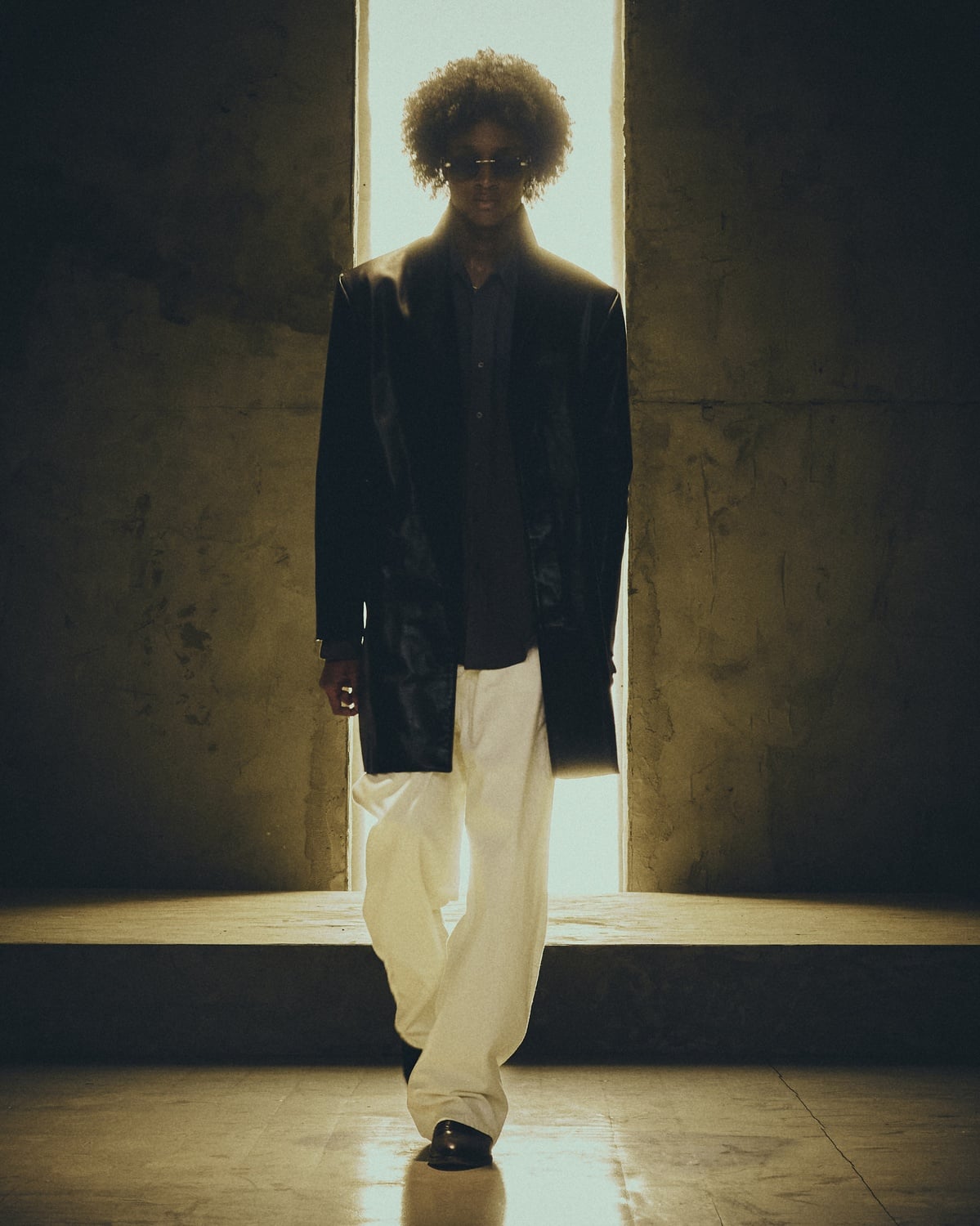
On Sept. 12, Max Esmail’s menswear collection reimagined Lower Manhattan’s 66 Greene Street for the brand’s Spring/Summer 2027 New York Fashion Week “God Would See It.” Taking advantage of the space’s distinctive atmosphere, up-and-coming designer Max Amadeus Kamal Coombs Esmail infused the presentation with his own personality through clever spatial manipulation and fashion design. Rather than treating the venue as a conventional runway, Esmail used it as an extension of his collection, allowing models, clothing, and architecture to interact as one composition.
From the very beginning, he established that this was no ordinary runway collection. Esmail had built a highly curated installation that put visitors in a cool, slightly unsettling space that could pass as a movie scene. The designs referenced the old-money aesthetic but simultaneously showcased the designer’s individualism, etching themselves deep in visitors’ memories.
With 12 looks in total, Esmail’s collection of luxury menswear spanned distinct personas, from the stoic businessman to the dapper academic. Upon walking through the exhibition doors, visitors were greeted by two models sitting silently, with watchful and almost intimidating looks on their faces. Their companions lingered close by or perched within alcoves along the coarse grey wall. From afar, they loomed in the shadows, resembling gargoyles with their slicked-back hair and unamused facial expressions. Esmail demonstrated through his casting and sophisticated styling that he was not just creating pieces of clothing but building a narrative and a fictional world.
Esmail’s presentation explored the idea of perception by encouraging visitors to look beyond the obvious and discover details that might otherwise go unnoticed. His jackets, in particular, had an adventurous quality that is rare in an industry so often driven by trends. He played around with different leather finishes, creating textural and tonal variation that was difficult to achieve in his cool-toned, monochromatic palettes. For example, the front-most model Jason Lee donned a black oversized bomber jacket made from suede and flat grain leather. This combination resulted in a dual-tone effect that elevated the jacket from a capsule wardrobe must-have to a bold statement piece. Standing directly behind him, curly-haired Mattic Meinhardt wore a funnel-neck zip-up with a glossy sheen. The patent leather caused natural crinkles which reflected light at unexpected angles and gave the piece its extraterrestrial appearance.
Esmail proved that he took into account every hem and every corner of his designs through their surprising back details. Unlike at a traditional runway show, visitors could move freely around the models, discovering design elements that would have otherwise remained hidden from a single viewpoint. Perhaps one of the most memorable images was the series of straps and buckles on the back of a short matte overcoat worn by Chris Kang. They spread out in an organized manner, tracing out the wearer’s spine. Paired with the model’s tiny silver-adorned rat tail — a thin length of hair extending from the nape of his neck — it conveyed a sense of mischief, setting it apart from contemporary designs with similar silhouettes.
Perhaps the aspect Esmail most wanted his visitors to ‘see’ was the dramatic tension between the “old money” aesthetic and his personal style. Initially, it seemed like all 12 looks could serve as costumes in the 1999 thriller “The Talented Mr. Ripley” — they equipped their wearers with a quiet yet assertive demeanour while paying homage to traditional silhouettes. One example was model Diogo Lapas’ outfit: It featured an elegant suit jacket on top of a light pink shirt, which provided a fresh twist to this familiar ensemble. On the other hand, Esmail included a taste of the otherworldly in terms of unconventional choices of material and accessories. He put model Enrico Bagnasco in a long black trench coat, yet still managed to grab visitors’ attention through the unusually shaped tweed collar: Two small mustard yellow flaps peeked out from underneath larger black ones, suggesting Esmail’s sense of humour and desire to surprise.
Ultimately, Max Esmail’s “God Would See It” was more than a presentation of contemporary menswear looks — it was an immersive study of audience perception and stylistic balance. By careful design, he placed his models within the space of 66 Greene Street and allowed visitors to comprehensively examine each garment. Esmail’s refined tailoring and allusion to what is vintage provided an appealing foundation, while his use of unexpected materials, playful details, and unconventional styling revealed his individual perspective. The result was a world that felt simultaneously timeless and ethereal, leaving visitors with the impression that every detail had been deliberately constructed to be discovered.
—Staff Writer Sophie Tung can be reached at [email protected].
Want to keep up with breaking news? Subscribe to our email newsletter
Have a tip for The Crimson? Share it confidentially