Harvard Grad Union Votes to Authorize Another Strike After 40-Day Walkout
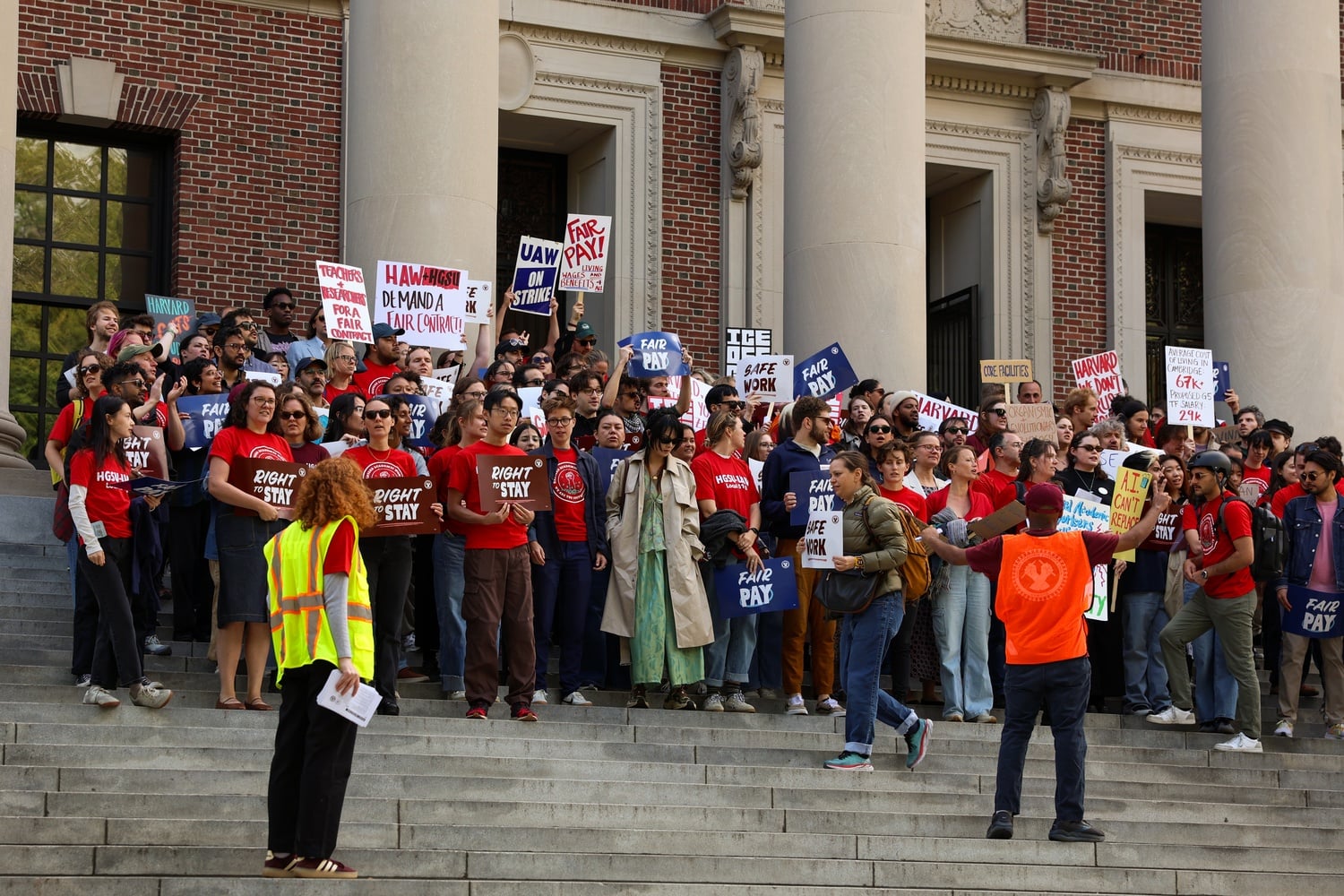
Harvard’s graduate student union voted to authorize another strike, setting the stage for a possible second work stoppage this year as contract negotiations with the University stretch past 18 months.
Eighty-eight percent of voting members of the Harvard Graduate Students Union-United Auto Workers backed the authorization in a vote that concluded Tuesday, the union announced Wednesday. The vote allows the union’s bargaining committee to call a strike if negotiations continue to stall.
HGSU Vice President Evan Lemire, a Ph.D. candidate at the Harvard School of Public Health, called the result “a statement from our membership on what we’ve seen from Harvard at the bargaining table.”
“We haven’t seen any counters from them on our proposals. We haven’t seen any points of discussion, anything,” Lemire said. He described “a pattern of stalling at the bargaining table and trying to force us to bargain against ourselves.”
The share of voters backing a strike fell from the spring, when roughly 96 percent authorized the walkout that began April 21. Lemire said a supermajority of members voted this time but declined to provide an exact turnout figure.
“We did see a dip, which I think is totally understandable,” Lemire said, “this is a difficult fight. It’s been a long fight.”
“I’m sure that there are people for whom striking is exhausting. It was exhausting in the spring,” he said. “We don’t want to go on strike. We want to settle a contract before a strike is necessary.”
The vote comes months after HGSU’s 40-day strike, which ran from April 21 to June 1 and was the longest in the union’s history. It ended without a contract. According to the union, Harvard had agreed to only one contract article before the strike and reached agreements on eight more afterward, including fully covered preventive dental premiums for Ph.D. students, private workspaces, and retaliation protections.
Since then, HGSU says progress in negotiations has stalled. The union said Harvard brought no proposals or responses to outstanding union articles at the three bargaining sessions held this fall. Of the more than 20 articles still on the table, only one is awaiting a response from the union, according to HGSU.
Major sticking points include wages, protections for non-citizen workers, and an independent grievance process for harassment and discrimination cases.
Get The Crimson in your inbox.
Lemire called Harvard’s approach “definitionally not good faith bargaining.”
In response to a request for comment, a University spokesperson pointed to an Oct. 2 update to faculty from Deputy Provost Jessica Soban and Paul Curran, Harvard’s managing director of labor and employee relations.
The update said Harvard increased its compensation offer in August, proposing a 6.1 percent raise upon ratification and a 13.9 percent increase over the life of the contract. The proposal would also bring hourly pay for teaching fellows and research assistants into parity, a key union priority.
Harvard warned that a second strike over the same set of issues as the walkout in the spring could be interpreted as an unprotected “intermittent” strike under federal labor law. In that case, the University said, workers could face “the full range of employment consequences” for failing to perform their duties.
The union’s bargaining committee and membership will decide when to set a strike deadline based on what Harvard brings to Thursday’s bargaining session and how the University communicates with the union afterward, according to Lemire.
“We’re hopeful that we’re going to see movement from the University towards a deal,” Lemire said.
Asked why a second strike would succeed where the first did not, Lemire said “the leverage that we produced in that strike hasn’t gone away.” He added that the union expects a fall strike would be more disruptive than the spring walkout.
“If Harvard now allows major disruptions to happen again in the fall, that will be a full quarter of an undergraduate’s degree at Harvard that has had major disruptions to its educational mission, and that’s unacceptable,” he said.
The authorization adds to labor tensions across campus this fall. Nearly 94 percent of voting members of Harvard Academic Workers Union-United Auto Workers, which represents none-tenure-track faculty and researchers, voted to authorize a strike in July.
The vote comes two weeks after around 200 graduate students and academic workers rallied outside the Zimmer Hall plaza, threatening a joint strike as negotiations for both unions stalled.
Harvard University Dining Services workers, represented by UNITE HERE LOCAL 26, have been without a contract since June 19 and have rallied as their own talks continue.
“It’s not a coincidence that three unions are thinking about striking in the same semester,” Lemire said. “Harvard is very willing to fight its labor unions at this point in time.”
—Staff writer José Luis Ortega Castro can be reached at [email protected].
Want to keep up with breaking news? Subscribe to our email newsletter
Have a tip for The Crimson? Share it confidentially