Former College Dean Rakesh Khurana Criticizes Gay, Other Presidents Over 2023 Antisemitism Testimony
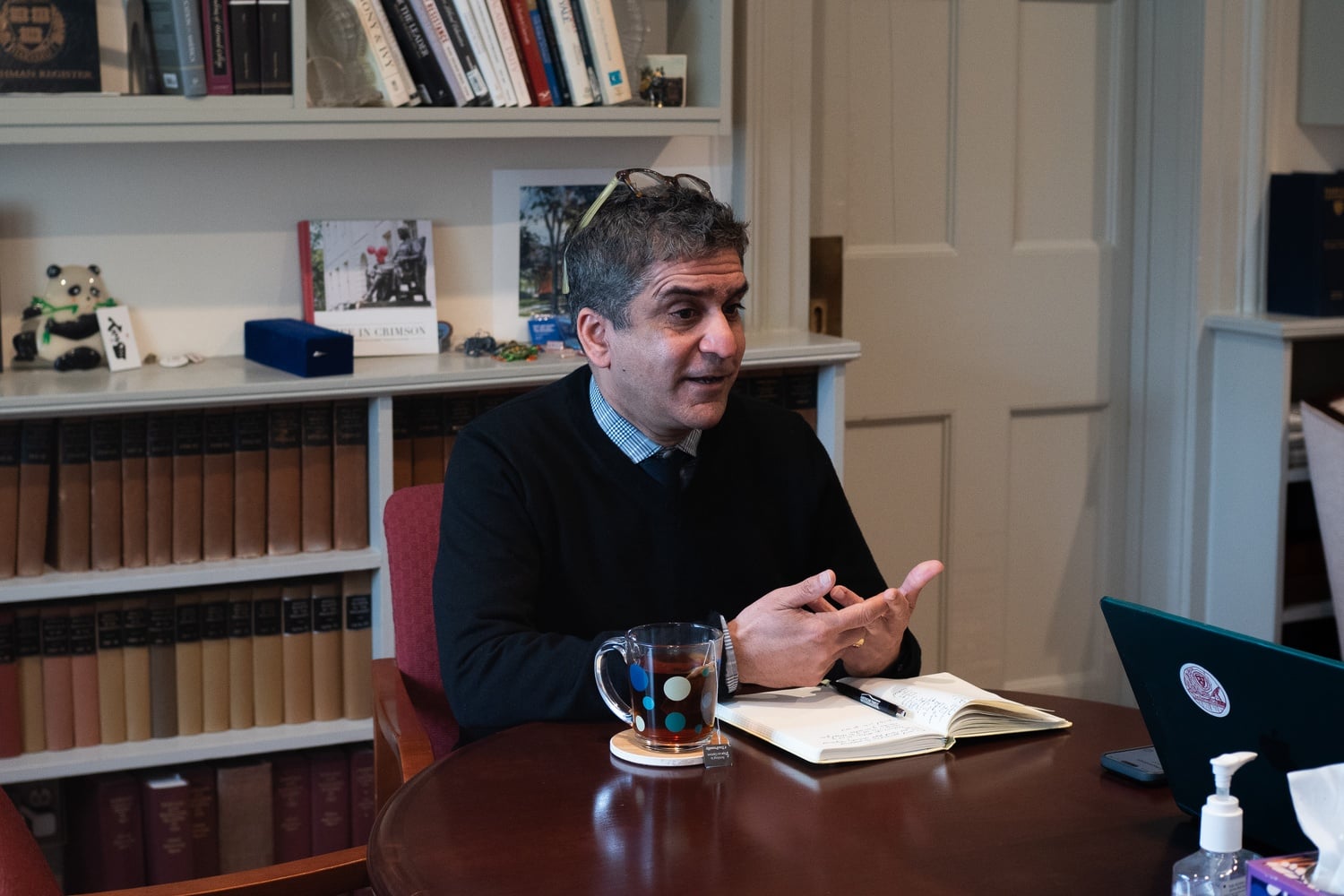
Former Harvard College Dean Rakesh Khurana criticized the December 2023 congressional testimony of three university presidents on campus antisemitism — including then-Harvard President Claudine Gay — saying none of them could explain what a university is for.
The remarks, delivered in a lecture at Cornell University last week, are Khurana’s most direct public comments on the backlash that ended Gay’s presidency and set off two years of federal scrutiny of Harvard.
Khurana delivered the Milton R. Konvitz Memorial Lectureship in American Ideals on Thursday, an annual Cornell lecture named for the civil liberties scholar who taught there for four decades.
His talk — “From Institutional Mission to Administrative Means: The Bureaucratization of Universities” — argued that universities have grown too heavy with administrators and lost institutional legitimacy. Khurana earned his bachelor’s degree at Cornell.
Displaying images of the hearing’s four witnesses on a slide, Khurana named Gay alongside MIT President Sally A. Kornbluth, University of Pennsylvania President Elizabeth Magill, and Pamela Nadell, a professor of history and Jewish studies at American University.
“To have four presidents, none of whom could articulate the mission of what a university was during the congressional hearings, was very challenging,” Khurana said.
Three of the four witnesses were university presidents. Nadell, the fourth, testified as an outside expert on antisemitism.
“It was critiqued as legalistic, a perceived double standard, a failure to recognize the political mind,” Khurana added.
Gay testified before the House Education and Workforce Committee on Dec. 5, 2023, where Rep. Elise M. Stefanik ’06 (R-N.Y.) pressed her on whether calling for the genocide of Jews could violate Harvard’s rules against bullying and harassment. Gay answered that it could be, “depending on the context.”
The exchange went viral within hours. Magill resigned four days later. Gay stepped down on Jan. 2, 2024, ending the shortest presidency in Harvard’s history.
Get The Crimson in your inbox.
Khurana had not commented publicly on the testimony or the backlash that followed until last week. He wrote in a statement to The Crimson that he had nothing to add to the lecture, calling it “an academic talk on higher education and organizational theory, a field that I have researched and written about for many years.”
He stepped down as dean in June 2025 after 11 years in the role, the longest tenure in a century, and is now a professor of sociology in the Faculty of Arts and Sciences and a professor of leadership development at the Harvard Business School.
Khurana drew his own criticism over Harvard’s response to campus protests. The Administrative Board, which he chaired, suspended or placed on probation 13 seniors over the spring pro-Palestine 2024 encampment in Harvard Yard, rendering them ineligible to graduate. The FAS voted overwhelmingly to grant them degrees anyway, but the Harvard Corporation refused — a decision that prompted more than 1,000 people to walk out of Commencement.
Khurana was also among the administrators deployed to reassure major donors after several paused their giving over Harvard’s response to Hamas’ Oct. 7, 2023 attacks.
In the lecture, Khurana tied the presidents’ performance to how universities are built. Successful institutions accumulate internal pressure, he said, and respond by hiring people to manage them.
“We hire and manage people to manage those internal pressures,” Khurana said. “Building and staffing the bureaucracies that can cope with the growth is the biggest challenge.”
Borrowing a distinction from sociologist Philip Selznick, Khurana said management “focuses on efficiency and coordinates bureaucracy and solves technical problems,” while leadership “focuses on mission, protects values” and “preserves the institution’s identity.”
“Leadership is about producing change, often dramatic change, and we became — over time — over-managed and underled,” Khurana said.
He put a number to the growth. The number of recognized academic fields grew from 409 to 2,137 in 40 years. Administrative and professional staff at the universities he studied grew roughly 4.5 times their 1975 level, while tenured faculty and enrollment stayed close to flat.
He named one only as a school in Connecticut — an apparent nod to Yale University that drew laughs. Between 2003 and 2021, its human resources department jumped from 11 staff to 192, and its development staff spiked from 71 to 333, while the faculty went from 610 to 675.
The cost, he said, has been borne by students. The price of college has roughly doubled since 2000, and the full cost of an undergraduate degree at a private institution now approaches $500,000.
“The consequences of this have been severe,” Khurana said, pointing to cuts to graduate admissions and research funding. Bureaucracy, he argued, left universities “unadaptive” because they were “set up to deal with stable, routine tasks.”
“We stifled innovation and creativity because they’re sources of unpredictability,” he said.
Khurana said rising inequality had also reshaped how universities raise money, pushing them toward a small number of very large gifts. When he proposed a mass fundraising event as dean, he said it was told it was the wrong approach.
“‘Oh, we should have an event, I’m going to invite 1000s of people, see if they’ll contribute and increase participation,” Khurana recalled saying. “They said, ‘Rakesh, we don’t gather rabbits anymore; we hunt elephants.’”
“Basically you go after fewer and fewer funders,” he added.
That arrangement held, Khurana said, only as long as donors asked for nothing in return — and it has not survived the collapse in public trust. Donors now style themselves as “impact philanthropists” who want a say in how their money is spent, he said, citing disputes at Yale over who would run programs they had funded.
Harvard donors have organized around exactly that approach. The 1636 Forum, an alumni group co-founded in 2024 by former Facebook executive Samuel W. Lessin ’05, steers givers away from unrestricted gifts toward specific faculty, departments, and student programs. It has helped coordinate eight figures in earmarked donations.
Khurana also faulted selective universities for trading on their own exclusivity. Fewer than 40 American colleges admit less than 20 percent of applicants, he noted, and the rest do most of the country’s education.
“Rightly or wrongly, I think too much we treat ourselves as if we’re a handbag rather than a public service,” he said.
“I know that Hermes is capable of making more than it does, and so we started valuing ourselves on scarcity,” he added.
That logic, he said, was part of why tuition rose 5.5 to 6 percent a year at a time when inflation ran between 2 and 2.25 percent. Harvard has raised its cost of attendance for five years running, to $91,634 for the 2026-27 academic year.
“The fact that we didn’t respond by expanding what we do, I think society is holding a mirror to us,” Khurana said. “We should have held it up to ourselves first.”
—Staff writer Megan L. Blonigen can be reached at [email protected] and on Signal at mblon.50. Follow her on X at @MeganBlonigen.
—Staff writer Graham W. Lee can be reached at [email protected]. Follow him on X at @grahamwonlee.
Want to keep up with breaking news? Subscribe to our email newsletter
Have a tip for The Crimson? Share it confidentially