The Secret Garden
What is the place of a garden within the Ivory Tower? Can planting a few stalks of asparagus, noticing an oak tree, or switching the type of grass we walk on really teach us how to change the world?
There are two versions of this story.
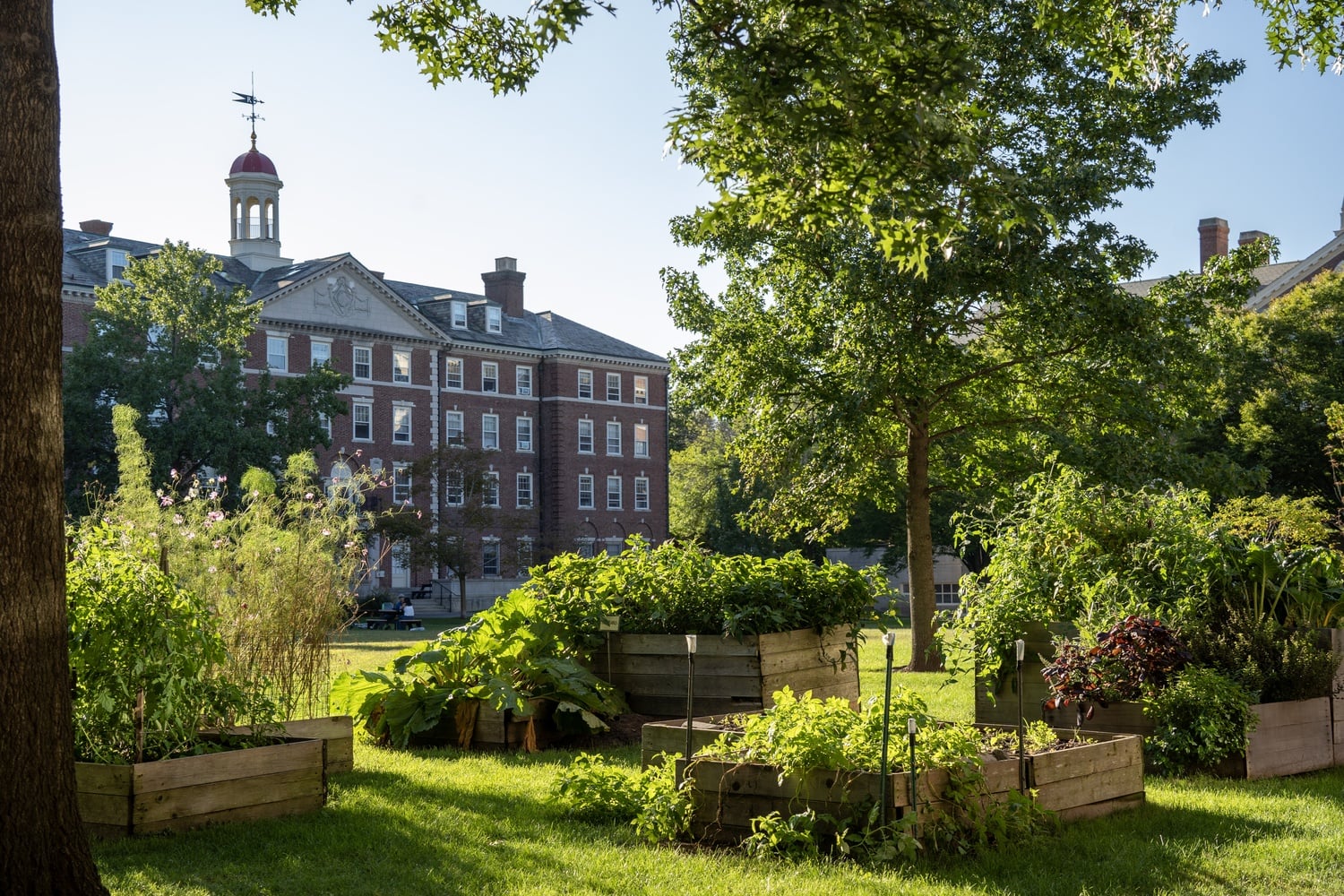
The first is the garden you can see: a collection of 33 raised beds in the Radcliffe Quadrangle. It often escapes people’s notice, tucked away in a shaded corner of the Quad Lawn under a trio of oaks. Nominally, and fiscally, it starts and ends as a Cabot House amenity: a recreational space for students interested in gardening and a pleasant decorative addition to the Quad’s aesthetic when the flowers bloom in summertime. This is the version of the story that dictates how many resources the garden gets.
The second outgrows the wood-boxed bounds of the first. In this incarnation, the garden is an alternate vision for living and learning at a university, one that promises to teach by doing. It is a model for what students’ engagement with their environment could look like. In its grandest form, it is a catalyst for optimism about the climate crisis, and a space that encourages students to create big change through small actions.
Funding limitations, however, make it difficult for the garden to reach these tall ambitions, as does the scarcity of those things needed to turn a bulb into a turnip or a House into a home: time, care, and light.
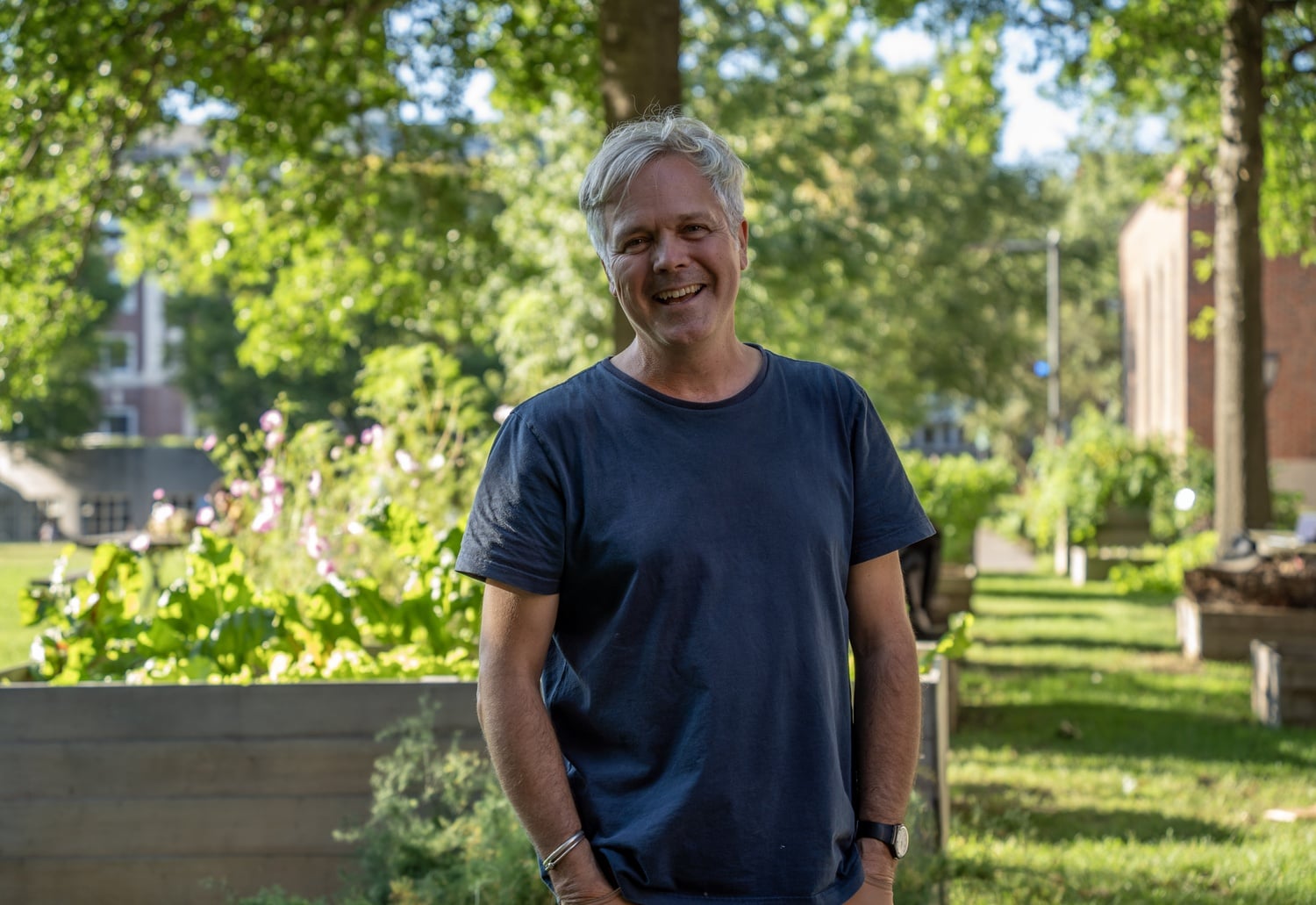
If the Quad Garden is able to exceed its physical limitations, it is largely due to the efforts and enthusiasm of one man: Gavin H. Whitelaw.
Whitelaw’s official role on campus is Executive Director of Harvard’s Reischauer Institute of Japan Studies: researching foodways for academic journals, writing about Japan’s material culture, and managing the Institute. His hours in the garden are unpaid and his work there does not appear in his official job description. But anyone involved with the garden will tell you that Whitelaw is its heart.
Biking over from his off-campus home, Whitelaw is at the Quad at least two or three times a week, putting down compost and pulling up potatoes. He coordinates the garden’s planting, weeding, and harvesting, and teaches a Summer School class (“The Anthropology of Food and Foodways”) that often holds discussion sections there. He can talk for hours about food culture or varieties of leafy greens. He introduces himself as the “executive steward” of the garden.
Whitelaw is among a handful of folks at Harvard who want to create opportunities for students to care for plants and learn how they grow. They believe this kind of stewardship is one of the best and most important things you can do with your time at college, maybe even your life.
But it’s not a widely shared priority at Harvard. Largely of their own accord, these individuals choose to create something they believe is worthwhile, and hope that, after they’re gone, someone else feels the same way.
As higher education rushes to define and defend its purpose at a time of great skepticism, what is the place of a garden within the Ivory Tower? What does it take to build a sustainable movement? And can planting a few stalks of asparagus, noticing an oak tree, or switching the type of grass we walk on really teach us how to change the world?
Loose Anarchy
The nor’easter that the Weather Channel predicted for the last weekend of September never hit Cambridge in full force, but it’s raining enough as I walk to the Quad Garden that I wonder whether anyone will show up. Whitelaw last texted the Garden Crew WhatsApp group on Friday about an indigo dyeing workshop he had planned. By late afternoon on Saturday, among all my other notifications of cancellations, bumped messages, and reschedulings, there is no confirmation from the Garden Crew. It seems Whitelaw is simply trusting people to be there.
His faith proves well-founded. When I arrive, half an hour late, a dozen students are crammed into the garden’s greenhouse. It is smaller than my common room. Holding court at the head of a long white table, running two blenders full of what looks like a bodybuilder’s spinach smoothie, is Whitelaw. He grins and waves when he sees me, and yells over the roar of the not-quite-Nutribullet for me to grab a silk handkerchief from a nearby bucket.
Whitelaw pours out the frothy concoction, which is neither spinach nor kale but Japanese indigo leaves freshly harvested from the beds outside, into a giant tub. On the count of three, students drop their handkerchiefs — twisted, folded, and tied with rubber bands — into the brew and swirl them around as Whitelaw yells, “Manipulate! Manipulate!”
After what he deems to be an adequate amount of manipulation, we dunk the handkerchiefs into three progressively clear tubs of water to wash off the residual leaf coulis. We unfurl the cloth to reveal tie-dyed patterns so blue they glow under the grey September sky.
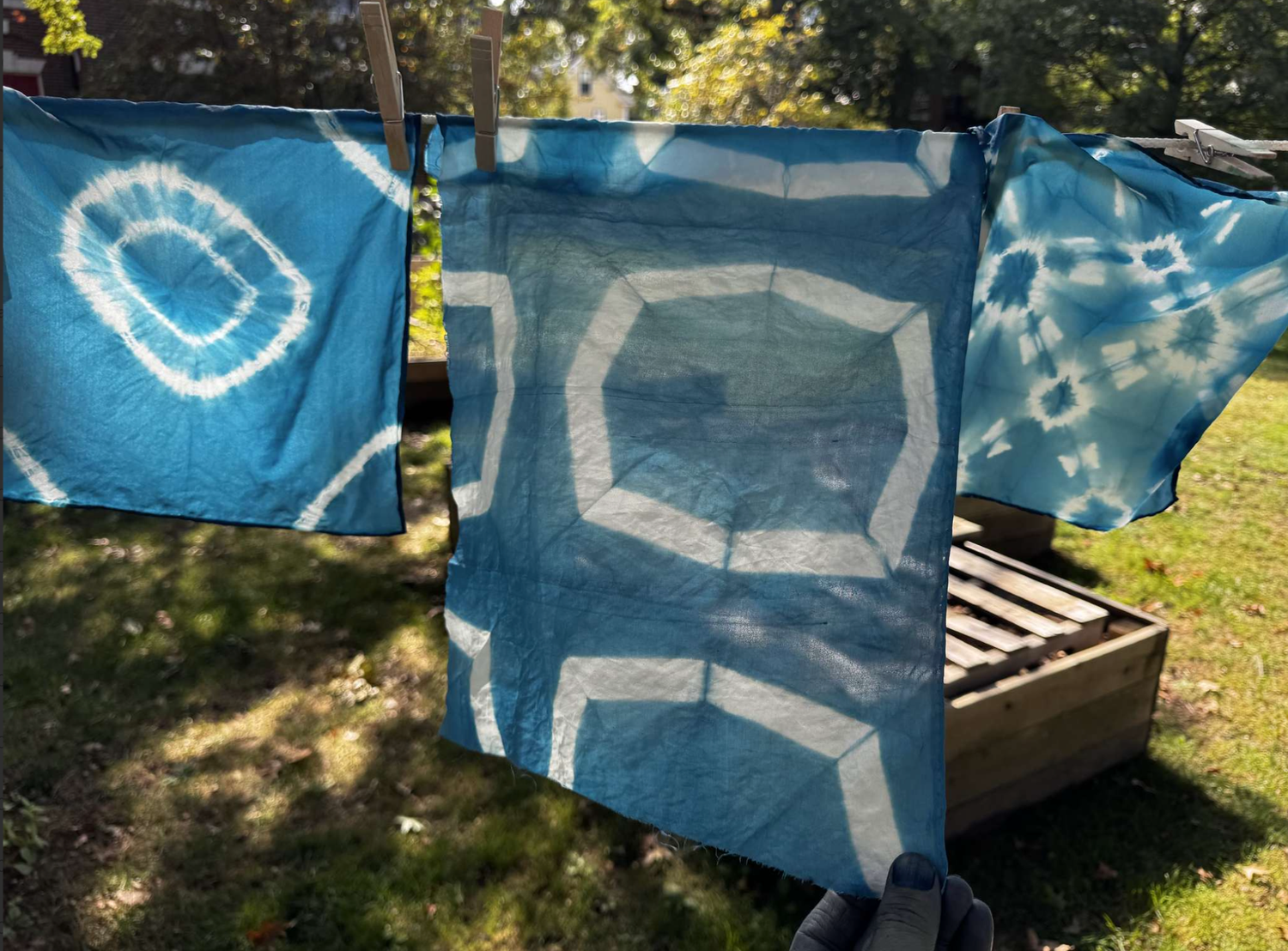
This is not the garden’s first indigo event. Last fall, Whitelaw brought in his college roommate, a textiles professor at Indiana University, to teach students about the history and chemistry responsible for creating the denim-blue dye. These workshops are a proof of concept for the Quad Garden as a space for hands-on learning — a space where students can engage with and apply what they might otherwise only read about.
Events like this one, which Whitelaw organizes on his own initiative, are what have allowed the garden to grow from fewer than ten beds to around 33 — 16 half-beds (4 feet by 4 feet) and 17 full beds (4 feet by 8 feet).
“Honestly, Gavin gives more, way more than what’s reasonable,” says Zazie Huml ’25, who has been involved with the garden both as a student in Cabot, and now as a non-resident tutor. “He’s a shining light, I think, for the garden community. A guardian angel, if you will.”
Raised on the southeast coast of Massachusetts, Whitelaw worked on a local farm from middle school to college before moving to rural Japan for a teaching position. As a masters’ student at Harvard, he served as a tutor at the soon-to-be-shuttered Dudley Co-Op, where students would often cook with food from a small garden on the property. Whitelaw became involved in the Quad Garden in 2022. When he started teaching his Summer School course on foodways, he approached Ian J. Miller, the Cabot House faculty dean and Reischauer Institute professor of environmental history, about the possibility of having students in the course get involved with the garden. Miller readily agreed.
Given both Whitelaw and Miller’s involvement with the Reischauer Institute, the garden has a decidedly East Asian bent. In one bed are shishito peppers that are like Russian roulette: one in every twenty will kill your taste buds with spice. Whitelaw grew those peppers himself, in his Cambridge Community Garden plot, and then propagated them in the Quad. There are daikon radishes, which get sweeter and less spicy the colder it gets, and which Whitelaw is hoping to turn into relish that can be used by Cabot students.
Whitelaw keeps the garden running in conjunction with a group of 10 or so undergraduates and Cabot House tutors. People volunteer to regularly water the plants or cut bouquets of flowers for Cabot’s dining hall, an ad hoc system Whitelaw describes as a sort of “loose anarchy.”
Sometimes plants, too, arrive in the garden serendipitously. Earlier in the semester, a student in Pforzheimer House purchased 80 tomato seedlings from an heirloom seed exchange called Baker Creek, picking a few varieties from over 130 types with names like “Mortgage Lifter” and “Rebel Starfighter Prime.” Soon after they arrived, she realized her dorm had neither the space nor the sunlight to sustain so many tomato plants. One of the Pfoho tutors contacted Whitelaw, who found room for them in the garden. Reach into the web of tangled stems, and you might come away with a couple small orange bursts of summer. Or, as Whitelaw calls them, “tom-ah-toes.”
In the beginning…
The Garden Crew WhatsApp group is one of the few digital traces of the Quad Garden, which is virtually unsearchable online. Google Maps makes no mention of a garden in the Quad, nor does the Cabot House website, Harvard Magazine, or Flyby’s Housing Market articles for any of the Quad Houses — or indeed, any article from The Crimson. Google Street View, which uses images from 2014, reveals nothing but bike racks where the garden is now. Unless you stumble upon a mention of it in Cabot House’s Instagram captions, according to the internet, the Quad Garden does not exist.
What does exist online, however, is an archive of an older garden. The seeds of what is now the Quad Garden were first sown, not in the Quad at all, but in front of Lowell House.
In 2010, a group of Harvard affiliates interested in sustainably growing food conceived of a space that would allow Harvard and Cambridge community members to engage directly with what they eat. Undergraduates partnered with the Office for Sustainability and the University Planning Office, Harvard Undergraduate Dining Services’ Food Literacy Project, and Landscape Services to make the vision a reality. Students, staff, and faculty in the Graduate School of Design’s Landscape Architecture and Technology Department helped design the space, and the whole project was overseen by Harvard Medical School’s Center for Health and the Global Environment.
Most campus spaces already had dedicated “program uses” (House courtyards, for example, are used for graduation), so Landscape Services directed the students towards a 560-square-foot lot on Mount Auburn Street, which was not in use except for the electrical infrastructure buried beneath it. Due to the presence of these utilities, and the toxicity of much of Cambridge’s topsoil, the team of staff and students envisioned the garden as 25 raised cedar wood beds filled with soil that could safely grow produce.
The Harvard Community Garden, christened by popular vote after a public naming contest that also included the entry “Veggitas,” officially opened on Earth Day weekend in April 2010. “We are excited to be the first generation of Harvard students to grow food on campus,” Louisa Denison ’11 said in a Harvard Gazette article about the new initiative.
Undergraduate interns worked in the garden through the summer months. They ran a blog and a Facebook page, posting regular planting updates and recipes for baba ghanoush, rutabaga fries, and pea guacamole. Maintenance was facilitated by close work with Landscaping Services, who were invested in making sure the very public-facing space didn’t grow “untidy.”
Root vegetables flourished alongside leafy greens, all grown using compost. Purple carrots and white eggplants; onions and garlic; okra and radishes; cantaloupes and watermelons; sugar snap peas and ground cherries; fall pumpkins and summer strawberries; kale, arugula, and chard. Thanks to a partnership with HUDS, the fruits of students’ labor went not only to the growers themselves but to dining halls across campus, which rotated weekly “Chef’s Tables” featuring at least one garden-grown ingredient. In earlier years, some produce was also sold at the Food Literacy Project’s farmer’s market, but much of it, sometimes 20 to 30 pounds a week, was donated to the Harvard Square Homeless Shelter and other community partners around Boston.
The community garden became very famous, very quickly. People came from Cambridge, Boston, and Watertown each week to participate in open-access workdays and attend movie nights with titles ranging from “Asparagus! Stalking the American Life” to “The Lorax,” “WALL-E,” and, of course, “Ratatouille.” There were May Day celebrations, Earth Day brunches, and a “magical mystery tomato sale” — as an old Facebook post advertised it.
Finally, there was “Farmal,” a garden party that promised to be the social event of fall 2015, with around 4,000 registered attendees and an extensive waitlist. A resale market for tickets sprung up on Facebook; one Berklee student pledged that whoever got her in would get a shoutout in her first album.
But the River Gods said it was not to be. Just three days before the event of the season, the Garden Project canceled Farmal. After struggling to get the necessary entertainment license, the student organizers ultimately refunded everyone’s tickets, citing “overwhelming demand, lack of space made worse by ongoing construction, and pressure from the University.”
Farmal was just the first domino to fall. House Renewal soon sounded the death knell of the Harvard Community Garden. With Dunster, Winthrop, Lowell, and Adams all slated for consecutive renovation projects, the University determined that the lot in front of Lowell was needed to house construction trailers. Renovations were “the University’s highest priority” at the time, says Nazneen Cooper, assistant dean for campus design and planning at FAS.
By 2017, the garden had to go.
Rather than discontinue the project entirely, Cooper and the landscaping team were asked whether the garden could be relocated elsewhere. They wanted to keep it near undergraduate houses to allow for student participation, Cooper says, but also didn’t want to keep moving it every time construction started on a different building. And so the garden, or at least some part of it — a handful of beds, the shed, the greenhouse — was moved to the Radcliffe Quad, Harvard’s back-Yard. At first, unsure whether the garden would be cared for in its new Quad home, Landscaping Services moved fewer than 10 of the original 25 beds. And so, the Cabot Garden was born.
Growing Pains
Money Doesn’t Grow on Trees
Now, nine years later, no one at the HMS Center for Health and Environment who oversaw the original garden still works there. Instead of the robust partnerships the Community Garden enjoyed, the Quad Garden must contend with limited funding and operational support.
Landscaping and maintenance staff help repair the beds as needed, but any other garden investment is only possible thanks to the Betty Wold Johnson Foundation Undergraduate Fund, which earmarks money for climate and sustainability projects in residential communities. The money has allowed Cabot to purchase seeds and compost bins, as well as a small solar-powered oven used to host events that get students involved in cooking with the garden’s produce. When the original greenhouse exploded one winter, it was the Wold Johnson grant that made a replacement possible.
However, the Wold Johnson grant is set to time out next year, and it’s unclear what will replace those funds. “We’re hoping that the University will give us some funding,” Whitelaw says, pointing to a few beds that were built for the original garden over a decade ago and whose planks are now falling apart or gone altogether. “Some of these won’t last another season.”
Miller and Whitelaw emphasize that costs to set up and support environmental initiatives are relatively low. The garden is built with an eye towards thrift and longevity: plants like asparagus will come back year after year without needing to be replanted, cold compost uses grass clippings and leaf litter easily available around campus, and seeds collected from one season’s flowers can be planted again next spring.
But History Professor Joyce Chaplin, who teaches an ecological restoration course called HIST 1973: “Rewilding Harvard,” says this is a “difficult moment to talk about” even minor upfront costs for things like environmental restoration. Faced with a budget deficit in the hundreds of millions, Harvard has slashed funding for the Faculty of Arts and Sciences in 2026, cutting non-tenure track faculty funding by 25 percent and laying off 13 percent of College staff covered by FAS restructuring. Remaining resources are allocated according to college priorities, which don’t always align with initiatives like a garden.
Short on Time
Whereas the Harvard Community Garden had a dedicated director (the assistant director of the HMS Center for Health and the Global Environment), Whitelaw’s stewardship of the garden is a strictly voluntary one. Miller, too, has big dreams for the garden but must balance pursuing them with his jobs as professor of environmental history and faculty dean. The Garden Crew is not an officially registered student group, so it does not receive money from the Harvard Undergraduate Association. Plus, many of the students drawn to the garden are seniors, which, combined with tutor turnover, means the group of volunteers has to be reconstituted every fall.
“Right now it’s really run off the enthusiasm of some students who are very load bearing, and Whitelaw, who is also very load bearing,” says Huml, the Cabot House tutor. “I could see how it would be in a precarious situation if there weren’t a couple individuals who really are doing the brunt of the work.”
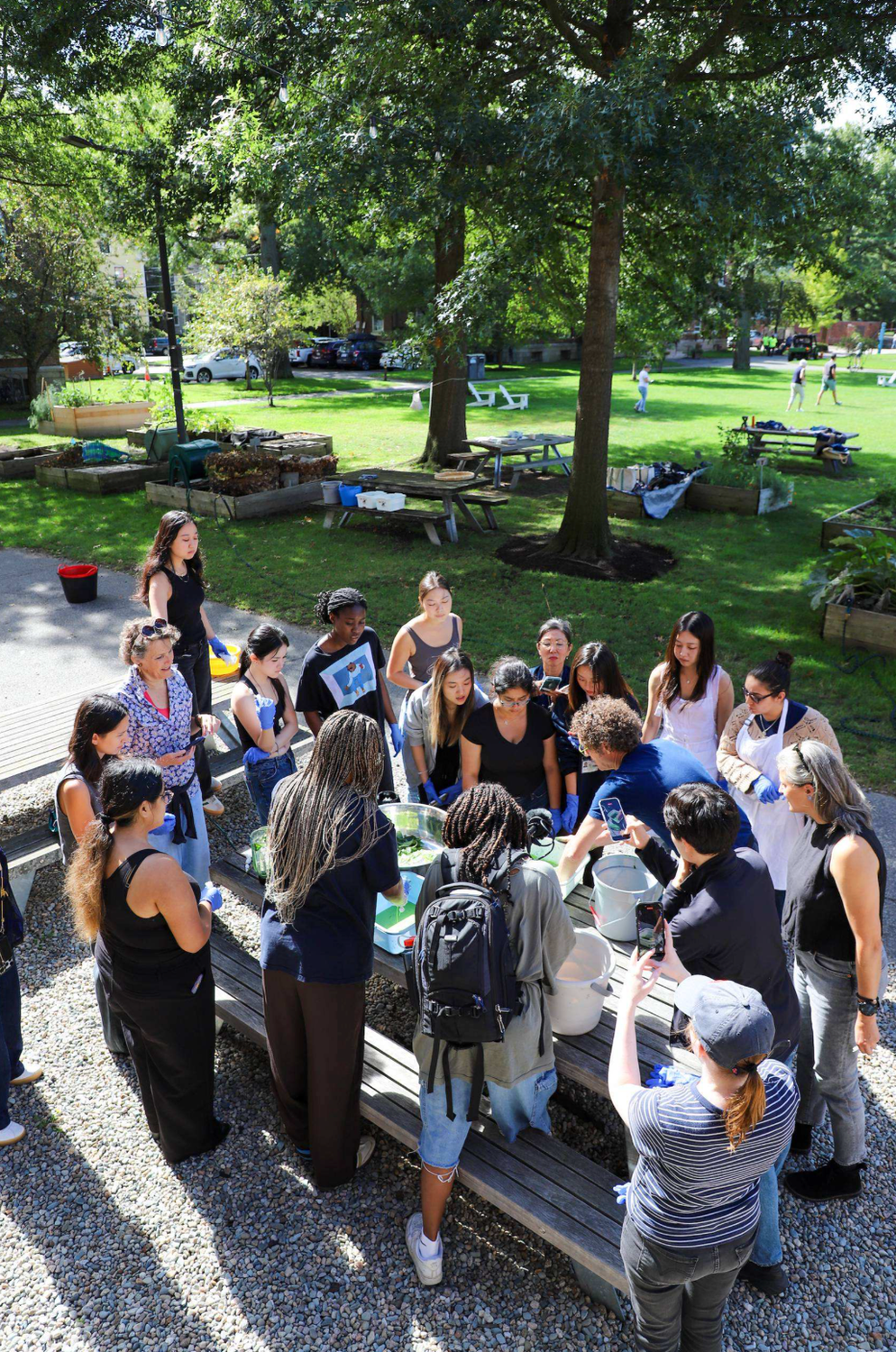
Whitelaw’s programming has recently brought more people to the garden. Events, when Gavin is able to put them together, are fairly well attended. Around 20 people showed up to the 2025 indigo dyeing workshop, including students, faculty, Japan’s Consul General, and Harvard College Dean David J. Deming.
Without more funding and staff, however, greater involvement is difficult to imagine. Whitelaw emphasizes that without more robust structures in place to manage interest and programming, the garden cannot handle too much more student participation. “300 people coming to work on the garden is not going to be possible,” he says.
Relegated to Shade
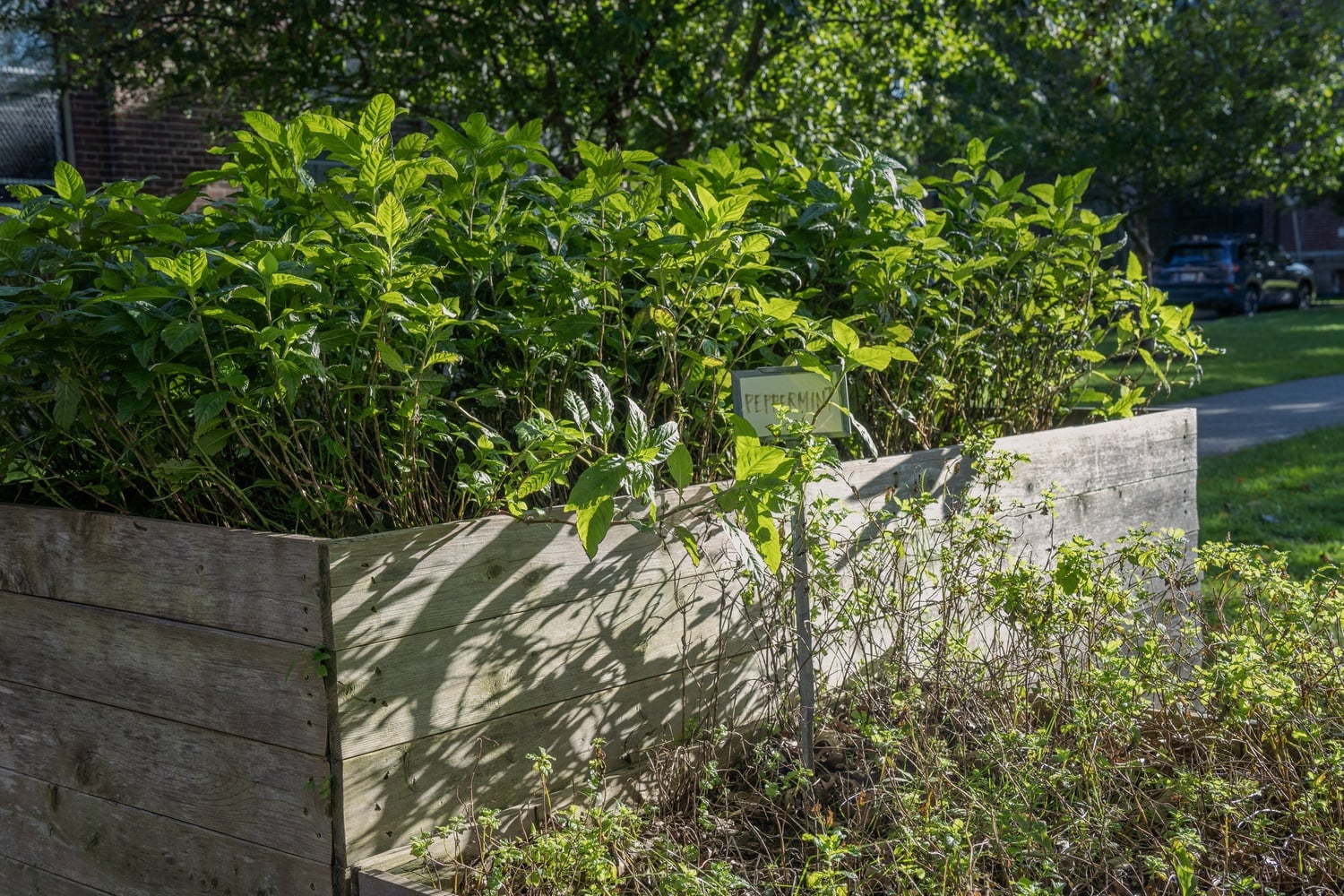
What Whitelaw calls the tragedy of the garden is that its most productive months are also when most students are off campus. For much of the school year, the beds lie barren and covered in snow. Even when the weather is conducive to growing, though, FAS decisions restrict the garden to a shaded corner, away from direct sunlight. FAS has maintained that the beds should not encroach on the Quad Lawn. This is partly a reflection of logistical priorities — the lawn is also used for athletics and other student events — and partly aesthetic ones.
“We wanted to maintain the formality of the main green, which is what makes the quad by typology,” says Cooper, the assistant dean for campus design. Part of that typology is a border of trees around the Quad. Several large oaks block sunlight from reaching many of the garden’s beds, limiting both the types of plants there and how much they can grow.
The aesthetic determinations ruling the garden’s fate often stem from an idealized notion of the historical character of Harvard’s buildings and green spaces. Cooper, for example, feels that landscaping and greenhouse placement should shape themselves around historic buildings in order to respect them. That same respect goes for the Quad Lawn. “The lawn is something we inherited,” Cooper says. “It has been a Harvard landscape for many, many, many, many years.”
Chaplin, though, says some of these ideas about what a campus should look like are fairly recent, pointing out that the Yard wasn’t always maintained in the way it is today. For instance, the paths leading through the Yard used to be dirt instead of pavement, with wooden planks laid atop them in the winter. Harvard Yard has been relandscaped several times, as recently as the 1990s. The wide expanses of resource-intensive, “country-club” grass in Harvard Yard and the Quad Lawn — which Chaplin says have “little more ecosystem function than crushed gravel” — are not as traditional as some might think. Rather, they have “just become a kind of default, and lazily so.”
Chaplin acknowledges the pressure that comes with Harvard’s global prominence and high rate of tourism. But she thinks the university can and should use that visibility to retrain expectations about the ideal college landscape by transforming its own.
For now, whereas pounds of produce flourished under direct sun in the Community Garden, the Quad Garden’s cherry tomatoes are not so happy. A quarter of the garden’s beds are so completely in shade that Whitelaw doesn’t even try to plant in them, using them for things like compost instead.
Cooper argues that such restrictions have actually helped the garden innovate — such as a recent project to grow shiitake mushrooms in the darker, damper environment. But when I ask Whitelaw about his ideal world for the garden, he immediately tells me he’d put away the hypothetical million dollars I offer him into an endowment and asks only to move the garden into the sun.
In the meantime, he plants potatoes in black cloth baskets and then follows the sun, moving them throughout the day from one sunlit spot to the next. He calls it “guerrilla gardening.”
A Language People Get
Though hands-on engagement with the environment is a priority for some Harvard affiliates, there are few institutional structures for such experiential learning at the College. Harvard’s Office for Sustainability’s sustainability reports for the last few years focus largely on transitions to clean energy and make little to no mention of student involvement with green spaces. (The term “green space” appears only once in the 2024-25 report, in connection with a rewilding project at the Business School.) That’s not to say that there are no ways for students to engage with sustainability on campus. The Office for Sustainability offers quite a few. But they consist largely of things like professional development and consulting opportunities (like the Council of Student Sustainability Leaders) or temporary grants for more small, individual-led projects that remain disconnected from each other. A large-scale, University-wide project like the Harvard Community Garden remains a thing of the past.
Deming tells me he thinks it can be valuable for students to engage with spaces like the Quad Garden “to the extent that they want to,” (he also points out that you never know if you could meet someone at the garden who could help you get a job) but he says he is reluctant to tell students what they should be doing with their time.
The most successful gardens, however, seem to be those woven into a school’s academic fabric and institutional goals.
The Harvard Divinity School Garden, for example, has become an integral part of the graduate school. The garden is a field site for their Master of Divinity degrees, offering students titles for their roles and positions for caring for the garden over the summer, and is prominently featured on the Divinity School’s website. It’s also an extracurricular space for ecospiritual reading groups, harvest parties, wine nights, and solitary contemplation. But Leslie MacPherson, Gavin Whitelaw’s counterpart at the Divinity School Garden, says it’s the academic aspect that has justified the project to administrators.
“People can be dismissive about this sort of stuff,” MacPherson, who is also a departmental administrator in the Office of Ministry Studies, says of connecting with nature. Instead, pointing out concrete ways the garden supports the academic mission of HDS tends to be a more effective approach. “That’s a language people get.”
The HDS student group EcoDiv first pitched the idea of a community food garden in 2009. According to MacPherson, the proposal was initially met with some confusion. But then an operations manager who MacPherson says “by all rights, should not have said yes,” signed off on the project. With the assistance of HDS staffers and a grant from the Office for Sustainability, the garden went from a few rows of plants to a robust collection of raised beds.
Now, the garden is a thriving campus community.
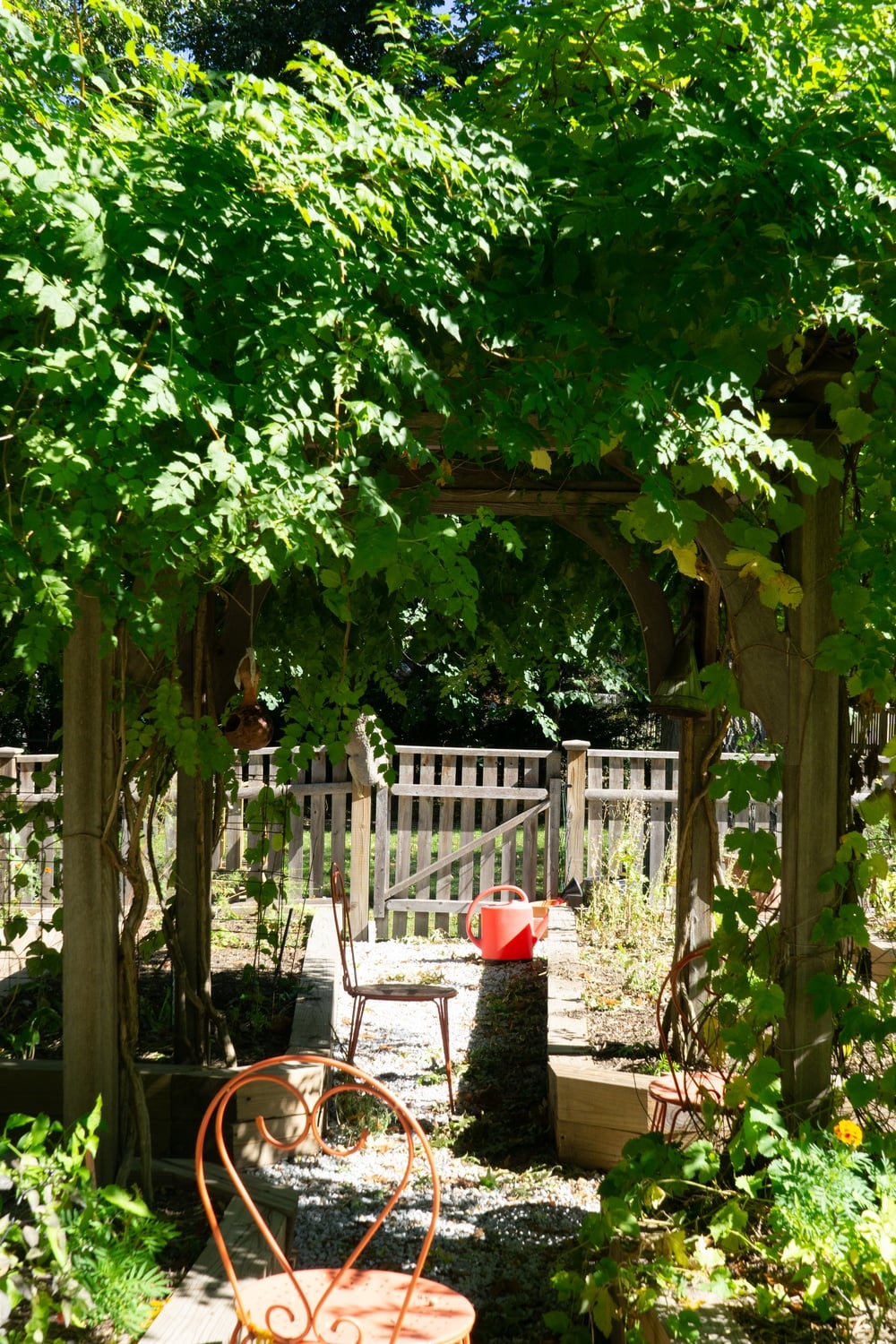
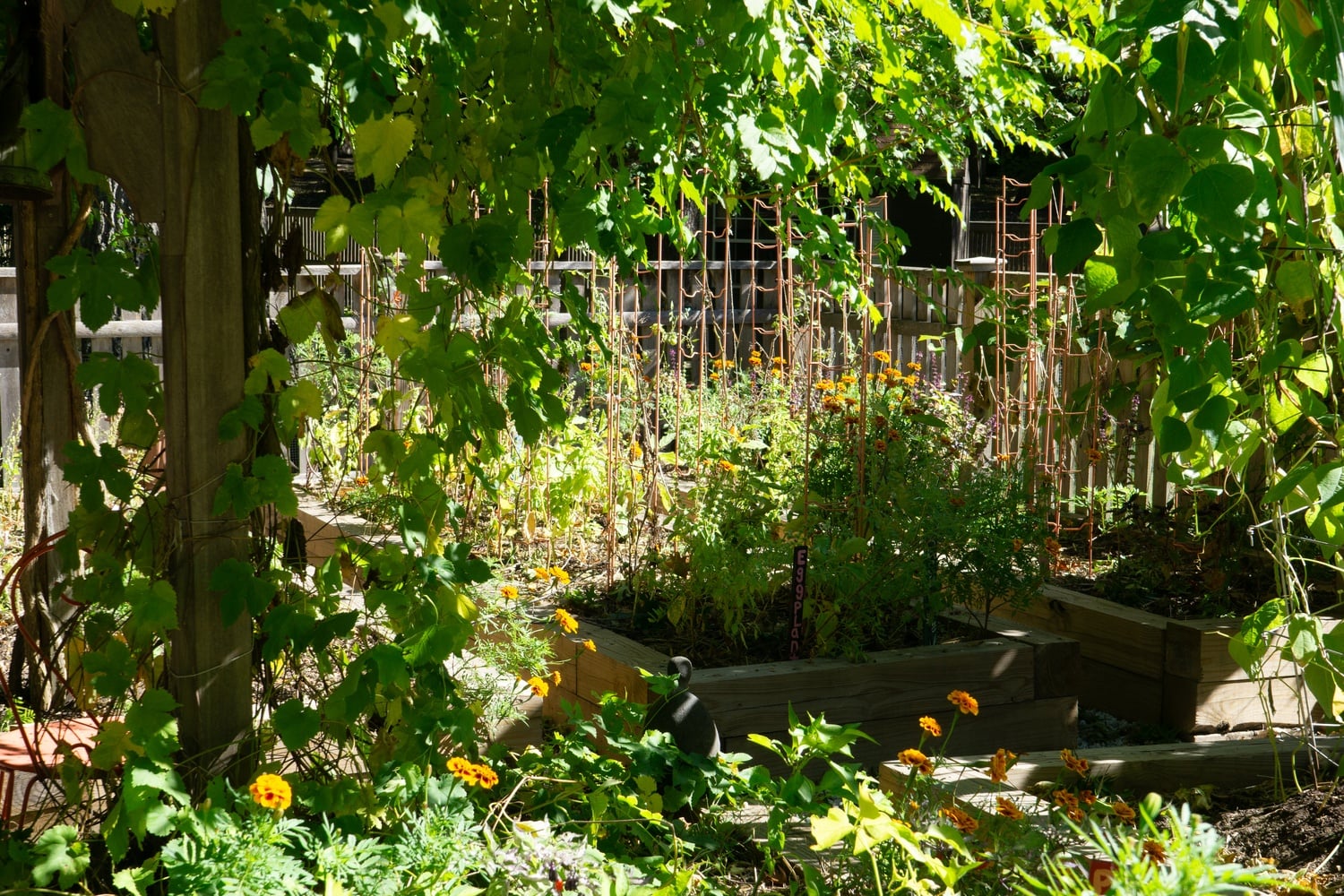
MacPherson takes me down a path of stepping stones and the sound of cars fades away as I enter a fenced-off garden, around the same size as the Quad Garden, with a wooden pergola covered in trumpet vines standing in its center. There are purple cosmos here, like in the Quad Garden, and golden marigolds growing between eggplants, herbs, and ground cherries. One of the beds is a trial run of Three Sisters farming in partnership with the Harvard University Native American Program. Beans from the Stockbridge-Munsee tribe, whose seeds were gifted to the garden by a doctoral student, twine up maize stalks alongside squash vines.
Like Whitelaw, MacPherson is the Divinity School garden’s primary champion, spending hours each week tending to the plants out of love rather than commission. “When I die, they will need to step up and find someone else,” MacPherson tells me, sounding less bothered about her fate than the garden’s. “I don’t know who that will be. But I hope there’s another staff person who cares about it.”
Other institutions have garden programs that are not so dependent on one person’s investment. Whitelaw and Miller point, in particular, to Yale.
Nearly 25 years old, the Yale Farm takes up an acre of land near Yale’s Old Campus and is touted as a key educational initiative at the University. Overseen by the Yale Sustainable Food Program, this community garden has a number of things the Quad Garden does not: chickens, honeybees, around 200 plant varieties, and a dedicated staff. It is featured in the curricula of 18 classes across 15 concentrations (or as Yale calls them, “majors”); engineering students design rodent-proof chicken feeders for the Farm’s hens, anthropology students study perennial planting techniques, and Russian literature students thresh wheat by hand “for an experiential grounding in the agricultural work described in Anna Karenina.” Outside of class, students can attend weekly workdays, work as student managers, participate in the Harvest orientation program, or apply for a summer garden internship with a $5,000 stipend.
Burrs
Although the Divinity School garden and Yale Farm have more institutional support, Whitelaw and Miller believe in the Quad Garden’s ability to spark inspiration among their students even while operating at a smaller scale.
Take, for example, the mushrooms.
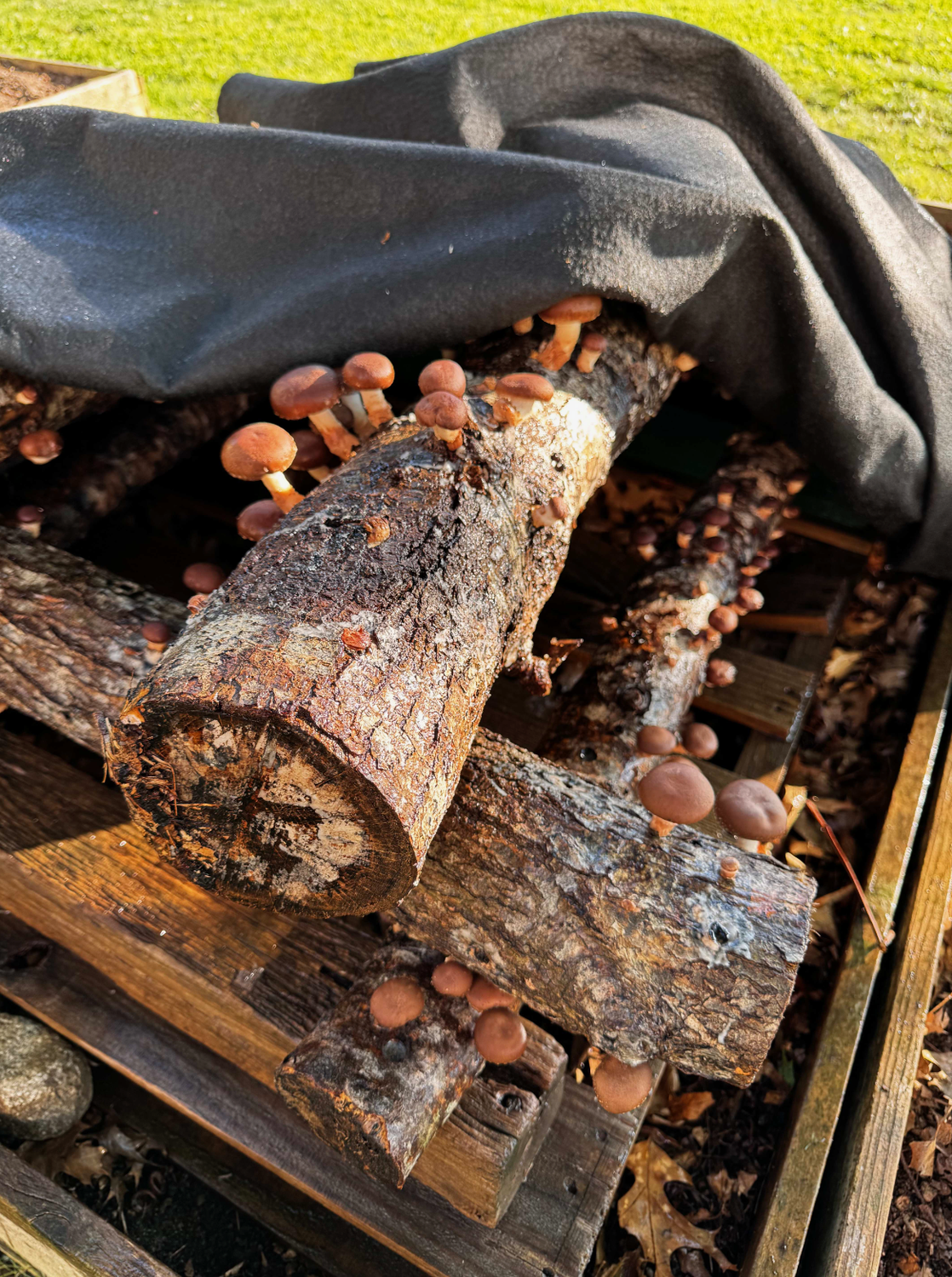
Whenever Whitelaw sees a landscaping crew trimming trees on his bike rides around campus, he stops and asks them for spare logs. He then organizes workshops in which students drill around 50 holes into each log and fill them with shiitake mycelia — essentially the mushrooms’ roots.
The logs incubate at Whitelaw’s parents’ home for months until they’re fully colonized. Then, Whitelaw dunks the logs in cold water for 24 to 48 hours to trick the mycelia into thinking that it’s perfect shiitake weather. At last, back on campus, he piles them in the garden’s most shaded beds and covers them with a dark blanket to convince them they’re in a wooded undergrowth (and to keep away any nonhuman foragers). The logs he shows me were hoodwinked in this way just a few weeks ago, and they are already sprouting bigger shiitake than I’ve ever seen at a grocery store.
He shows me how to harvest the mushrooms — how to tell if they’re ready to eat by the way their caps are curling under, how to cut them off the log with a pocket knife — and explains that the tannins I’m tasting have a unique oaky depth because of the wood they’re grown in.
Whitelaw believes that even small interactions like these can spark conversations and ideas that stick to students like burrs as they move through Harvard and beyond. “Just an afternoon here could be the encounter that makes someone incorporate this into their practice or take it to their community or school and want to try it out,” he says.
Jeromel Dela Rosa Lara ’23, former Cabot House resident and Crimson News editor, had been a casual plant lover before coming to college, but was studying the social sciences at Harvard and didn’t imagine he would have an opportunity to garden on campus. Lara only noticed the raised beds on Quad Lawn when the school went on lockdown during the Covid-19 pandemic. He was one of just a few students who remained on campus, and says that a community “organically and spontaneously” sprouted up around caring for the alive but unkempt garden.
It was through those he met at the Quad Garden that Lara found the Cambridge City Growers, a group that was dedicated to creating free gardening opportunities and organizing a community fridge over the pandemic. His involvement in both spaces taught Lara that environmental action was inextricable from the socioeconomic issues he cared about, from land use to food access. “It’s good to be aware, to read about, to learn in the classroom the issues of climate change or the issues of food insecurity,” he says. “But then to step outside to actually know or experience and put one’s hands and one’s feet in the mud, literally? That’s a greater learning experience.”
Now, he teaches at a boarding school in Jordan, the second most water-scarce country in the world per a report by UNICEF, and says that his experience in the garden continues to inform the work he does. As an advisor for the school’s newspaper, he encourages students to go out and witness in person the stories they’re writing about, such as olive harvests impacted by drought.
“That, maybe one could say tiny, college experience, ” Lara says — “I still carry that with me.”
To Miller, stories like Lara’s prove that the garden, at its best, is a sort of “raised bed on a hill.”
Ultimately, gardening remains a hard sell for students deciding where to spend their often over-subscribed time. Even as environmental activism becomes front of mind for students, they often turn to more explicitly pre-professional clubs like the Harvard Undergraduate Clean Energy Group. According to Cole A. Cochrane ’27, the organization’s co-president, HUCEG has more than quadrupled in size within the last few years, offering professional opportunities that garden work may not and encouraging students to contribute to clean energy fueled growth rather than slowing down. “We understand that Harvard students have ambitions and want to leave a legacy,” Cochrane says.
But Whitelaw thinks a legacy doesn’t have to be something big or permanent. It can be as simple as planting seeds that will sprout for future generations. “More than likely, it’s the small things that are going to have kind of a lasting impact,” Whitelaw says, “and actually may be more profound and meaningful for you.”
And while pre-professionalism might be a powerful force on campus, so too is a growing desire among some students to disconnect from the artificial world of the internet and reconnect with the physical one — to, quite literally, “touch grass.”
Nearly all the people I talk to say one of the best things the garden does is recalibrate what they notice, and by extension, what they care about. Though wary of sounding too “spiritual” or “hippie,” students point to something energizing about that shift in attention and pace. “Moments in the garden are among the more peaceful and grounding and meditative ones that I have,” Huml says, “and where I feel like a better version of myself.”
You can’t create a When2meet with the shiitake, negotiate a flower’s bloom to fit into your Google Calendar, or get Claude to weed the beds. You can’t pull an all-nighter to make the radishes grow any faster. Blight hits the potatoes, squirrels nibble at the leafy greens, and passersby pick the tomatoes before you get to see them ripen. To Whitelaw, these lessons in patience and disappointment are some of the garden’s most valuable.
Reminders that not everything is under our control, and that change is not only possible but inevitable, bring Whitelaw a measure of hope. As headlines about irreversible ecological damage proliferate in our feeds, working with our hands is a very different kind of antidote to fatalism than eco-consulting or finance. In Miller’s assessment, the environmental crisis is not at its core a technical, political, or economic issue, but “a cultural problem about assumptions of what is possible and what isn’t.” Perhaps rewilding and gardening offer pathways to possibility.
Lauren T. Wong ’27, who took Chaplin’s Rewilding Harvard course last spring, says that positively contributing to the physical landscape of campus made her realize, simply, that “it’s not that hard to just institute a change in your life that could be beneficial to others.”
According to Deming (the only person I ask who says without hesitation that he is a climate optimist), reckoning with how one can positively impact their surroundings is a necessary part of the Harvard experience. “I think every single Harvard College student and alum should be asking themselves that question,” he says. “What am I going to do to contribute back to society, to pay back the great experience I’ve had here?” How students choose to grapple with that question, if at all, is up to them.
Whitelaw, Miller, Chaplin, Lara — each have big dreams for an environmental campus. Whitelaw wants to get students from the local public schools involved with the Quad Garden. He imagines putting up QR codes so that passing students and community members can read about the garden’s project and learn some gardening skills. Lara hopes that students will start their own environmental initiatives; Miller wants to make working in the Quad Garden part of the new Energy, Climate, and the Environment concentration; Chaplin dreams of a Miyawaki forest on Harvard’s campus, and Whitelaw of a garden in the Yard.
“This institution can do anything it wants,” Whitelaw says. “Within reason.”
Whitelaw says he’s not sure what will happen to the Quad Garden after him. But even if no one takes up the cause, he is proud of what he has created. “Not everything has to go on forever,” he says. “I think you can leave something better off than what it was.”
Epilogue
I started writing this article last winter, when the garden was asleep. I spent a long time trying to get it right, to communicate somehow the bigness of Whitelaw and Miller’s vision for a campus that physically nurtures and is nurtured by its students. Like MacPherson, I tried to find pragmatic justifications for this project, to find studies and statistics that would establish the stakes and convince someone to read 6,000 words about a few boxes of dirt next to a shed. But something about the garden kept slipping through my sentences. Again and again, I tried to ask people big questions: On what scale do you think change is possible? What is our place in our environment? What is to be done with the time we have? How has the garden changed you? And because they were thoughtful, their answers were no good to me, their replies too qualified and deliberate to make for good quotes. So I tried to talk about the garden in other ways: a handful of tomatoes, a blenderful of indigo. A conversation, a student’s smile.
Recently, I made the walk back over to the Quad. Fall had settled definitively into the air — shiitake weather — and some of the beds lay barren, their bounty already harvested. As I sat there, watching squirrels dash after acorns, the world around me preparing for another winter, I wasn’t wondering whether anyone would read or care about my article. Instead, I was looking at the carpet of dead leaves, and imagining how excited Whitelaw would be to turn them into compost.
It was strange to think I had been a stranger to this place not long ago. I thought of the girl who came up to me and Whitelaw while he was giving me a tour of the garden’s September bounty. Arms laden with packages, she asked whether we knew anything about the garden; Whitelaw, laughing, said yes. After several semesters of walking by the garden and wondering about it, Gemma L. Maltby ’27 had finally found the right person to ask.
She and Whitelaw hit it off, swapping fond memories of other gardens and stories of farming practices in Italy and Japan. I saw her again, a week or two later. Her hands were marbled blue from sticking them gloveless into a vat of indigo. A few days later, she asked me if I wanted to join her to visit a garden at the Boston Medical Center that Whitelaw had told us about, that first September day.
I started to understand, then, the dignity of the little things — a moment of sunlight, a pause to admire an oak, a spontaneous conversation about a pile of logs — that others had been sharing with me all along. It turns out it is hard to distill hours of conversation and weeks of getting to know a place into a few clever paragraphs, just like it is hard to make people stop and stick their hands in the dirt if they don’t want to, even if you think they should.
You can make the trek over to the Quad Garden, if you want to. And if you do, Whitelaw will be there with an easy enthusiasm for the little things in your life, and a handful of potatoes for you to plant.
—Associate Magazine Editor Megha Khemka can be reached at [email protected].
Want to keep up with breaking news? Subscribe to our email newsletter
Have a tip for The Crimson? Share it confidentially