
The Art of Appeasing the River Gods
Three decades after Harvardians first conducted a ritual sacrifice to avoid being Quadded, what do the River Gods want now?
“I do not know much about gods; but I think that the river/ Is a strong brown god—sullen, untamed and intractable,” — from T.S. Eliot’s “The Dry Salvages.”
ow to appease the fickle River Gods?
Last Thursday marked the third decade that freshmen Harvardians have engaged in all manner of often contradictory and usually perilous superstitious Housing Day Eve activities in an attempt to appease the so-called “River Gods” and ensure that chants of “C-A-B-O-T, you just won the lottery” the following morning are indeed merely the cruel pranks of dorm-storming Riverites.
These days, most freshmen hoping for a River House put their faith in the aqueous Gods known by such names as Pink Whitney and Smirnoff Strawberry. Freshmen don their weekday best to attend services held in stuffy common rooms across the nine River Houses and administered by upperclassmen priests scarcely more coherent than their ephemeral congregation.
From what this writer could glean during his own sojourn between the Houses, current River Run theology does not extend far beyond the inherent virtues of getting plastered with your friends. In the spirit of Chester James Carville Jr., it’s the alcohol, stupid.
(Presumably, if one has a raging hangover, the distress of being assigned housing in the Radcliffe Quadrangle hardly ranks as the most painful sensation racking one’s temples.)
But appeasing the River Gods used to be a much more pyromanic ritual, defined less by pushing the limits of one’s liver than finding creative reasons to set things on fire. Alcohol was imbibed as frequently as it was used for setting various constructions on fire and sending them down the Charles.
It was not until 2004 that The Crimson used the term “River Run” in reference to the practice of drinking distilled liquors in the courtyards of each of the River Houses. The alcohol, to some extent, was initially an afterthought.
The first recorded offering in Crimson archives to the River Gods was in 1996, the year randomized housing was implemented at Harvard. The system was the project of then-College Dean L. Fred Jewett ’57, and intended to ameliorate the self-segregating tendencies of the previous scheme under which students ranked their top four Houses.
On that inaugural Housing Day Eve, William F. Abely ’99 traveled to the Weeks Footbridge with his blocking group. The pilgrims brought on their persons a brittle plant from the September PBHA Plant Sale named Tom and a measure of Jack Daniels whiskey. Tom was alighted and ceremoniously jettisoned into the Charles; a poem composed specially for the occasion was recited.
The River Gods evidently found their offering sufficient enough to place the Abely blocking group in a plum Leverett House suite within sight of the site of Tom’s demise.
Abely passed down the tradition of divine appeasement to Adam G. Kosberg ’00, whose blocking group — inspired by learning of the sacrificial rites of the ancient Canaanites in a class on the Bible — chose to sacrifice in lieu of flora, a sort of fauna. Kosberg’s group doused effigies (“voodoo dolls”) of two mates who made last-minute exits from the blocking group with Jim Beam and set them on fire before throwing them into the Charles.
Apparently satisfied, the Gods abided their admittance to Leverett House.
One blocking group boasted in 2000 of a planned orgy in celebration of housing day, while the first-year band “Invisible Downtown” intended a performance of their (hit?) song “Living in the Quad.” (“Living in the Quad. Yeah. Yeah. Yeah.” went the chorus.) A Wigglesworth blocking group told The Crimson of a planned ritual strikingly similar to Kosberg’s that had been passed down to them.
Practitioners soon evolved from plants and effigies to release somewhat more buoyant sacrifices into the Charles.
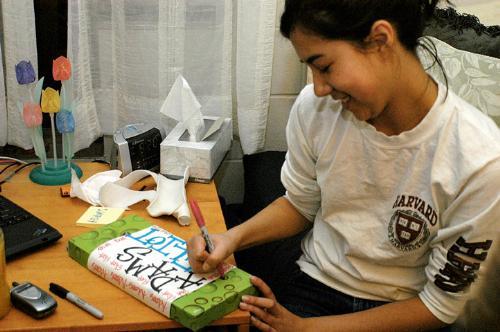
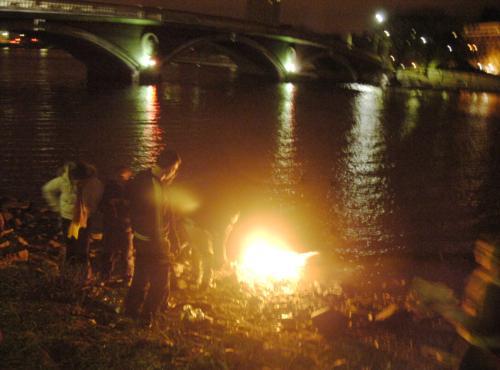
Prefects Lorrayne S. Ward ’03, Peter P. Monteleone ’03 and Jordan D. Scopa ’04, led Canaday C freshmen in sending cardboard boats down the river in 2002. Naturally,and with the aid of barbecue lighter fluid, the boats were lit on fire.
Ward said in an interview that she had taken part in the Housing Day Eve ritual as a freshman in 2000, and that it was passed down to her by her own prefects. As a freshman, sending a flaming boat down the river already felt to her like an ingrained Harvard tradition.
By 2004, the tradition had advanced both in technology (sleek shoeboxes ornately decorated with River House insignia replaced primitive newspaper apparatuses) and in popularity (now, the banks of the Charles were crowded with other idolaters).
That year, Literature and Arts C-61, “Rome of Augustus” inspired Canaday C, (still with Scopa as a prefect) to call their launch the “Canaday C-Aeneid,” for as much as the Trojan Prince Aeneas sought a new home in Italy in wake of an Achaean victory, these first-years sought a new home in an upperclassman House.
Drinking shots in each of the houses had by then emerged as a nascent part of the tradition, but continued to be outshone by the more fiery appeasements that lit the black night of Housing Day Eve.

***
Who — or what — exactly are these so-called “River Gods” that Harvard students are praying to?
For the benefit of the loyal reader who desires to avoid being Quadded, this writer has assembled a few possible candidates for your consideration. Adjust your River Run rituals at your own peril.
In the eighteenth century, some hundred years after Harvard’s founding we find the seven constituent bloodlines that composed the old established gentry of the Connecticut River Valley in Western Massachusetts, known to historians as the River God clan. Though the eponymous “River” of these River Gods refers to the Connecticut River, many of them were Harvardians, and it would not be a great leap to presume that they once communed closely with the Charles.
One such River God, the Reverend Solomon Stoddard, was indeed the first librarian at Harvard and the grandfather of a certain Jonathan Edwards, of Great Awakening fame; neither would likely have approved of such idolatry as the rituals that Abely and Kosberg got up to.
Then there’s President A. Lawrence Lowell, Class of 1877, establisher of the very Housing System that the River Gods claim to hold sway over. We know, after all, that “In the beginning God created the heaven and the earth” (surely, the River Houses and the Quad, respectively) and “the Spirit of God moved upon the face of the waters” (President Lowell, boating across the Charles, no doubt). Is it really so unreasonable that Lowell (in some less-than-corporeal form) might be our God of the Charles?
A more recent candidate may be found in Jewett, the father of randomized housing and the first cause in a chain of effects that led to the River Run rituals Harvardians hold dear today, the same rituals that have caused so many woes for University Hall, his former domain. Freshmen will note that Jewett advocated during his time at Harvard for allowing students between the ages of 18 and 21 to consume alcohol in controlled environments.
The Algonquian Massachusett people, who called the Charles Quinobequin (literally: “meandering”), didn’t have River Gods in the same sense that the Greeks had Achelous, Alpheus, and Asopus. They did, however, believe in manitou — the spiritual power inherent in natural phenomena, not least among them geographical features like rivers.
Indigenous peoples also provide us with this writer’s favorite candidate, the Big Water Snake, a horned serpent that recurs across Native American mythologies (the Algonquian Massachusett among them) and attacks travelers from its lurk in rivers and lakes. One imagines this serpent pulling inebriated freshmen from the Weeks Bridge and depositing them, no worse for wear, on the stairs of the SOCH.
***
Whoever they are, the River Gods largely drop out of The Crimson archives until 2009, when freshmen boats (set alight, in a show of ever greater technological innovation, with such substances as Axe Body Spray) prompted reports of a fire at Weld Boathouse. Cambridge Fire Department, Cambridge Police, the Massachusetts State Police, and HUPD all swarmed the bank of the Charles, threatening arrest and chastising students for their ritual.
It is with this incident, it seems, that the authorities began their crackdown. As former Dean of Freshmen Thomas Dingman ’67 tells me, the City of Cambridge did not appreciate the necessity of sending flaming boats down the river to appease the River Gods and threatened heightened Cambridge police presence if Harvard couldn’t reign in its heathen students. (The Crimson, for its part, published a staff-ed entitled “Burn, Baby, Burn,” criticizing Harvard’s “excessive” response and defending the tradition as harmless fun.)
Come 2010, Harvard deployed its formidable security forces to the gates of River Houses and the banks of the Charles, and freshmen lost swipe access to River Houses. One freshman was unfazed and simply decided to do a “Quad run” instead. “That’s right—suck it HUPD,” he told The Crimson.
“The popo? Fuck the popo,” another anonymous freshman was quoted by The Crimson.
Other freshmen cleverly engaged in the ritual a day early, and one student (who presumably now earns her living as a lawyer) determined that a “raft” was technically not a boat and was therefore not prohibited by the threatening email sent by Dingman to the freshman class in anticipation of their antics.
Alexandra A. Petri ’10 wrote an op-ed in The Crimson bemoaning the crackdown. “What’s wrong with excessive, sometimes dangerous alcohol consumption?” Petri asked. “If freshmen want to run around the river burning boats and taking shots, even police presence will only go so far to stop them,” Petri noted.
The following year saw the continued presence of security forces and warnings of Ad Boarding, yet the tradition seemed stronger in spirit than ever, with the opposition of the administration engendering the tradition with attractive rebellious undertones.
One freshman told The Crimson that to “say that there won’t be drinking and partying is a blatant lie,” and that he believed those two activities to be “crucial, according to tradition.” The Crimson characterized the night as a game of hide-and-seek; freshmen continued to find ways to dispatch their boats down the Charles.
2013 saw a frenzied episode in which the campus came under the impression that College authorities had resorted to espionage by surreptitiously surveilling email lists in an attempt to locate and deter hosts of River Run events. (In actuality, there was an anonymous tip-off.)
A contemporaneous Harvard Political Review article complained of “liberal paternalism” and accused University Hall of “trampling Fair Harvard’s informal cultural treasures,” criticizing the administration for attempting to characterize River Run as an inferior tradition and arguing that restrictions would only add more peril to the rituals. In offering a t-shirt decorating party as a substitute, it was argued, Harvard seemed to be under the “strange belief” that “what students really want more of is supervised space for sober activities.”
Dingman articulates to me the administration’s genuine concerns: Harvard could not condone illegal underage drinking, nor could it ignore calls from Cambridge to stop students from sending (albeit primitive) naval weaponry down the Charles. Drunk students on Memorial Drive, Dingman said, often caused near-accidents. And Faculty Deans, busy preparing to welcome freshmen the following day, were not particularly enthused by throngs of drunk youths sojourning through House Courtyards.
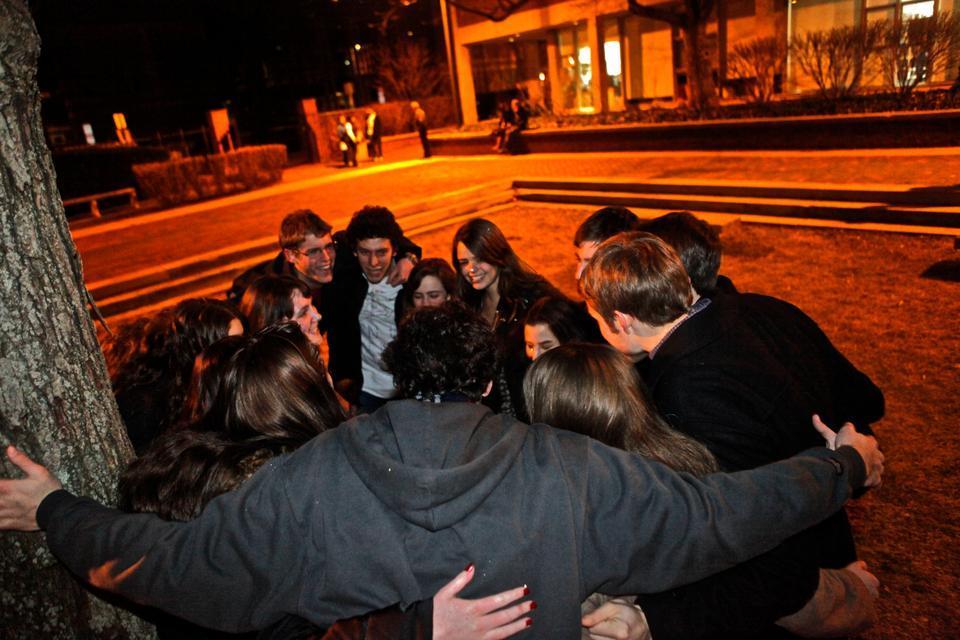
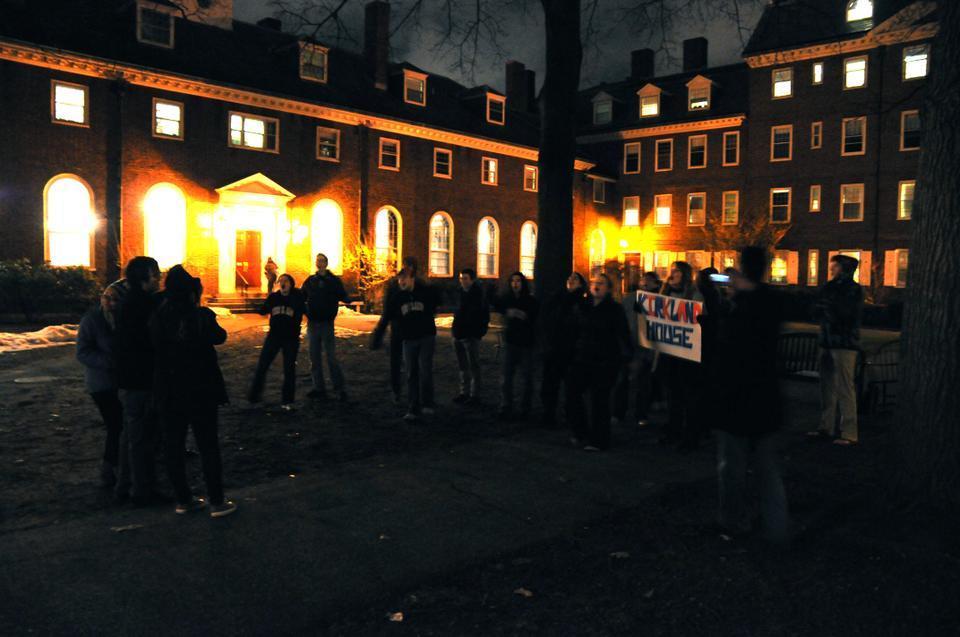
By 2015, Harvard seemed to have successfully suppressed the boats, and contemporaneous mentions of River Run focused on the drinking part of the ritual, rather than the incendiary sacrifices that had previously characterized the ritual. Freshmen would now have to make do with merely shouting ganbei or santé in every River House to appease the Gods.
The College remained unenthused with the groggy tradition, yet administrators found that the more they clamped down, the more devoted freshmen became to appeasing their lotic Gods. Much as the speakeasies of the 1920s derived their chic from roving prohibition agents, that Harvard opposed River Run became intrinsic to the allure of River Run; sneaking around was all part of the fun.
Freshmen scaled walls, jumped onto dumpsters, and climbed through windows to evade security and complete their moonshine ritual. In “How To: River Run (from the Police)” Flyby suggested impersonating a police officer. After all, “Middlesex County Cambridge Jail beats the quad.”
Downing shots and then subsequently attempting to climb finialed wrought-iron fences was not without its risks: visits to Health Services tended to spike on Housing Day Eve. (“But if it weren’t for the alcohol poisoning, who would visit UHS?” Petri had asked in 2010.) At some point, Harvard seems to have decided that harm mitigation might be a better tact.
Beginning in 2024, freshmen were granted swipe access on Housing Day Eve, a change that some celebrated as a prudent acquiescence to the realities of public safety, and others facetiously decried as a failure to allow freshmen the full enjoyment of being chased along the river with pitchforks, so to speak.
Freshmen now face little security forces at House Gates and instead find food trucks hawking grilled cheeses and dumplings. Associate Dean of Students Lauren E. Brandt ’01 reminded freshmen over email that they ought to eat “a substantial meal” before they drink. Dean of Students Thomas Dunne served pizza slices at 53 Dunster Street until 1 a.m. I seem to recall saluting an HUPD officer I encountered while leaving Quincy and saying “Thank you for your service.”
Swipe access is still inconsistent, as I found when my blocking group almost got locked in Dunster’s courtyard, but the only actual opposition to our presence occurred when my shouting in German in the stairway of the Inn attracted the ire of an unidentified Eliot House tutor. The elevator was, by contrast, unguarded.
No students I asked seem to be aware of the charred roots of River Run, and indeed, it’s not clear just how much faith modern River Runners have in the River Gods to prevent their damnation to the Quad.
For myself, all I can say is that despite my skepticism towards most forms of superstition (among them, organized and disorganized religion, studying in anticipation of exams, and abstaining from exercising an injured limb) I hold no such prejudices against the now time-honored heretical rites of River Run.
I choose to believe that the River Gods really do lurk beneath the polluted waters of the Quinobequin, and the only thing that can appease them is gradual intoxication by means of taking the sacrament: transubstantiated by sheer force of religious faith, I drink the blood of the River Gods with glee.
Quite clearly, it worked. This writer is now a proud member of Quincy House. (Coincidence?)
— Magazine writer Andrew W. Shlomchik can be reached at [email protected].
Want to keep up with breaking news? Subscribe to our email newsletter
Have a tip for The Crimson? Share it confidentially