‘Knowledge Is Myth’ Review: A Chimera of Thought, Culture, and History at the Carpenter Center for the Visual Arts
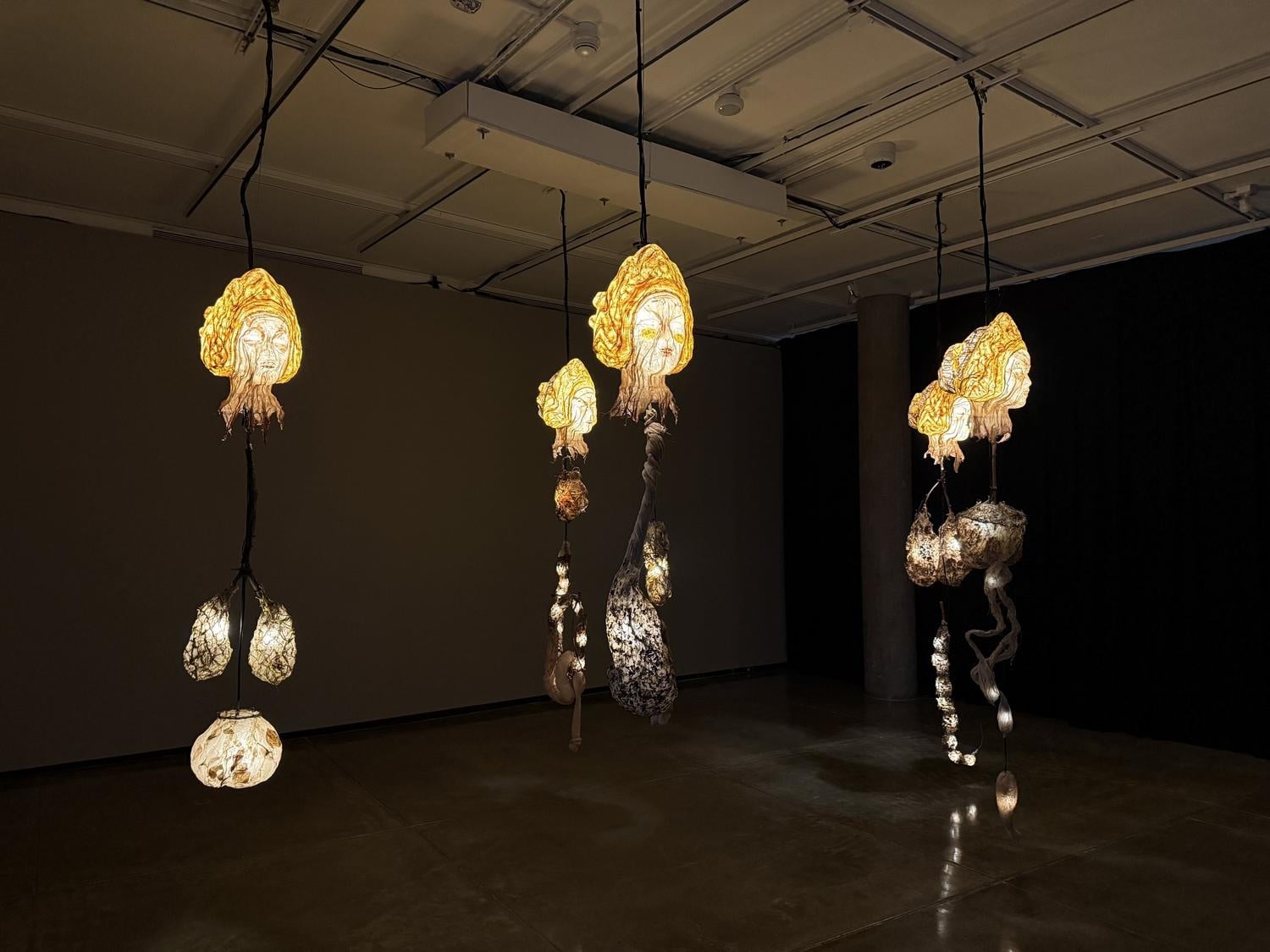
In “Knowledge Is Myth: Chimeric Continuities,” the Carpenter Center for the Visual Arts brought together artworks, artifacts, and analysis from four artists across and beyond the Harvard community.
In this brand new featured exhibition, AYDO (Ayoung Yu and Nicholas Oh), Cole Lu, Enzo Camacho and Ami Lien, and Candice Lin together question how history has perpetuated falsehoods such as racial eugenics and cultural inferiority. Perceived at the time as scientific “knowledge,” such beliefs led to systemic hurt across eras of colonialism. Through the use of mythological figures, the artists proposed an alternative narrative, depicting the beauty of misunderstood tradition and the strength of diverse peoples. The exhibit’s own analysis pointed at Harvard University’s motto “veritas” — meaning “truth” in Latin — as exemplifying the question of what constitutes real knowledge. However, the contents of the exhibit also presented their own chimeric identity, creating an interdisciplinary message spanning biology, folklore, film, and more that is sure to pique the interest of any visitor.
In the main foyer of the exhibition, sits three water fountains of ceramic and bronze made by the collective AYDO. “Morphologies of Becoming” (2026) uses key animals from Korean legends — the snake, tiger, and crane — to pay tribute to cultural memory, despite the enduring impact of Mongol invasions on Korean identity. Nearby, another work by AYDO, “Fermented Dreams” (2022-2026), utilized dual TV displays. A scene followed the birth of a woman from a heart-like womb, another featured the Korean egg-like cookware“onggi.” Eventually the film mourned a concrete ancestor, laying among the ferns.
Not far, Lu’s two-headed plaster cast of Orthros dog incorporated Western folklore and made the viewer question the figure’s twisting expression of anguish. Although the work sat somewhat disjointed from the surrounding focus on Korean culture, the decision instead emphasizes the piece’s strength: forcing one to take a look at the forgotten or unjustly outcast groups of society.
Behind a glimpse of darkened glass, appeared Camacho and Lien’s pulsing French Indochina’s “ahp” spirits — disembodied heads surrounded by clicks of the forest. “waves move bile” (2020) incorporated mixed media such as banana peels, chia seeds, wheat flour, and seaweed to depict faces of anger, languish, and determination. The corn husk’s withered grooves offered brilliant depth in illuminating the history of French colonialist expansion into Asia, visualizing in a 3D space collective trauma. A viewer is first encapsulated by the decayed art in front of them, then driven to the piece’s interpretation and meaning — whether prescribed or self-formed.
Next followed an interplay of historical artifacts provided by the Harvard-Yenching Collection and the Harvard Art Museums, alongside contemporary depictions of 18th and 19th century scientific diagrams by Lin. One pamphlet sorted eight racial groups, corroborating each with the native animals based upon grotesquely racist origins and ideals. In doing so, Lin created a disturbing collision between the scientific sketches that many associate as fact with the horrors of human prejudice.
Finally, looping back to the main entrance was a series of works by Lu. Two canvases filled by dinosaurs enclosed in The Crystal Palace during The World Expo, which showcased human fascination with knowledge and curiosities such as extinct dinosaurs. The burnt linen paintings were accompanied by an acrylic and mahogany case, featuring two print reproductions. When placed next to an antique table with a bronze head, half-human, half-horned animal, the pieces solidified the 19th century’s role in the exhibition.
What made “Knowledge Is Myth” stand out is the broad — yet cohesive and comprehensive — deep dive into the intellectual implications behind the art. AYDO’s performance art not only poignantly depicts Korean culture but its scenes remained abstract and eclectic enough to intrigue a viewer into unraveling the mystery of the artist’s ‘why.’ Historical artifacts also provocatively encouraged confronting Lin’s commentary on how ‘knowledge’ so easily relied upon faulty ‘facts.’ However, while the exhibit incorporates multiple fields of study, at times the influx of angles and ability to employ methodological perspectives from multiple disciplines may overwhelm and crowd out the central messaging. Historical context might get favored by analysis of artistic medium or the implications between artists — yet this only extends the exhibition’s chimeric complexity.
“Knowledge Is Myth: Chimeric Continuities” is on display at the Carpenter Center from October 1 through December 13. Stop by for a critique of how humanity used knowledge to justify the past and explore new perspectives for analysis in the present.
Want to keep up with breaking news? Subscribe to our email newsletter
Have a tip for The Crimson? Share it confidentially