Garber Convenes University-Wide Faculty Committee on Scientific Research Priorities
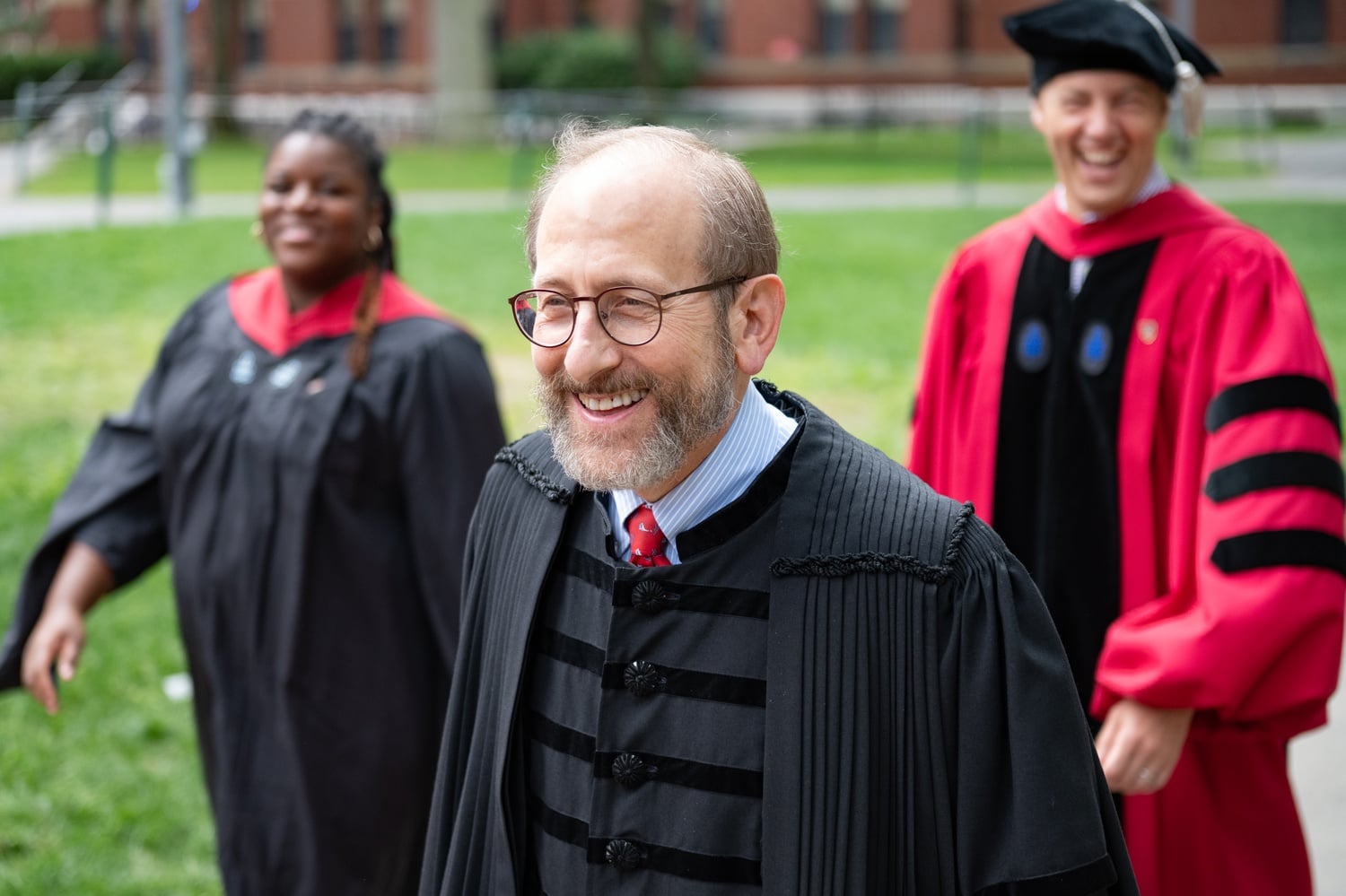
Harvard President Alan M. Garber ’76 quietly convened a University-wide committee of faculty members to develop a new vision for scientific research over the next several years, according to six people familiar with the matter.
The group, known as the Science Advisory Committee, formed over the summer, one person said, and includes roughly 15 to 20 faculty members. It is chaired by former Provost Steven E. Hyman and Immunology Department Chair Arlene H. Sharpe ’75, that person and one other said.
The committee is still in its early stages. Faculty members were being individually approached to join subcommittees as recently as last week, and several subcommittees with distinct focus areas are being finalized, including one dedicated to neuroscience, two people said.
The committee’s formation is closely tied to the University’s effort to bolster fundraising for scientific research in the wake of federal funding cuts. The five people said the committee’s work was designed to provide a framework for fundraising initiatives tied to scientific research. One person added that the committee was explicitly working with Harvard’s Alumni Affairs and Development office.
The people in this article were granted anonymity to discuss a committee that has not been publicly announced.
University spokesperson Jonathan L. Swain confirmed that the Science Advisory Committee — led by Sharpe and Hyman — would be “developing a process to engage in faculty consultation across the University.”
Swain wrote that the University was in the “early stages” of the process, intended to “identify areas where Harvard can have a transformative impact on scientific research.”
The push to develop a coherent, University-wide strategy for the next era of scientific research — and one explicitly tied to fundraising — is the most concrete step the University has taken to rethink its approach to research since the government froze nearly $2.7 billion in Harvard’s funding in spring 2025.
University officials have said for the past year that Harvard will need to diversify its funding sources in response to unreliable government support for scientific research.
There are now early signs of that work around the University. The Alumni Affairs and Development office launched a new team focused on “transformational giving” after a spring reorganization, according to a September organizational chart obtained by The Crimson.
Get The Crimson in your inbox.
The team is headed by Kasia Allen, who was promoted to assistant vice president of philanthropic partnerships, according to the chart. The office also launched a summer hiring spree, recruiting more than 20 donor-facing fundraisers to court major gifts.
The committee appears to build upon a Monday announcement that the University would designate $150 million to support cutting-edge scientific research. Of the sum, $100 million will be distributed to schools in proportion to the federal funding they receive, and the remaining $50 million will go to centrally organized “cross-disciplinary faculty research initiatives.”
The $50 million has been earmarked for four targeted research areas — neuroscience, immunology, energy and climate, and industry-oriented research — and investments in computing infrastructure, including expanded access to state-of-the-art artificial intelligence models.
Earlier this week, one of the University’s biggest donors, Kenneth C. Griffin ’89, who paused his giving to Harvard to 2024, announced a $3 billion gift to Carnegie Mellon University, the largest single gift in the history of U.S. higher education.
The gift will put $2 billion toward a satellite campus in Miami, Fla. focused on “societal challenges rather than academic majors” and $1 billion toward investments in the school’s main campus, including $500 million for its School of Computer Science, which will be renamed for Griffin.
Harvard has had fundraising successes of its own. The Faculty of Arts and Sciences overshot a $500 million fundraising goal for the last fiscal year, bringing in roughly $800 million in donations. The school also met a $100 million Research Accelerator Challenge to shore up funding for Ph.D students, and announced last month it was seeking another $100 million.
Though a federal judge restored Harvard’s frozen research funding in September 2025, the Trump administration has continued to look for new ways to cut off the University’s access to federal money.
Lawyers for the University will defend that ruling before the First Circuit next week, when the court hears the administration’s appeal. And in August, a federal judge shot down a Department of Justice lawsuit filed in March that sought to claw back nearly $1 billion in federal research grants over Harvard’s alleged failure to adequately respond to campus antisemitism. (The Justice Department appealed the case to the First Circuit.)
The Department of Defense separately sought in August to limit Harvard’s access to federal grants, conditioning them on an audit of the University’s partnerships with foreign institutions. Harvard was one of 30 universities that received the order.
—Staff writer Hugo C. Chiasson can be reached at [email protected] or on Signal at hcc.35. Follow him on X @HugoChiassonn.
—Staff writer Elise A. Spenner can be reached at [email protected] or on Signal at elisespenner.82. Follow her on X @EliseSpenner.
Want to keep up with breaking news? Subscribe to our email newsletter
Have a tip for The Crimson? Share it confidentially