Artist Profile: Pneuhaus’ August Lehrecke on Immersive Art, Collaboration, and Inflating Excitement for GSD Workshop
For Pneuhaus, an artist collective based in Rhode Island, the work/play divide isn’t much of a binary at all — it’s just as flexible as their inflatable art. August Lehrecke, the co-founder of the group, will bring the work to Harvard Graduate School of Design on Nov. 2 for the Rachel Dorothy Tanur Memorial Lecture on “Building with Air.”
Lehrecke sat down for an interview with The Crimson and spoke about the unique and playful collaboration that is characteristic of Pneuhaus. Starting as students at the Rhode Island School of Design, Lehrecke and his co-founders, Levi Bedall and Matthew Muller, formed the collective after they created a plastic igloo and placed it on the RISD green.
“If you’re an architect, you have to have many years of training, and permitting, and things to make anything that exists in the built environment. So for us, it was really exciting to find something that could work at that scale and just bring people in, just from a curiosity perspective,” said Lehrecke.
That public reaction drives the group, pushing them to find new ways to incorporate engagement and immersion in their art. Since that first piece on the RISD lawn, which prompted them to switch their senior theses to inflatable art, Pneuhaus has prided itself on experimenting with various scales and materials to mold the physical space that the artwork inhabits.
“So I’d say we are always thinking — depending on the project — about how it will be used or engaged with. But in the beginning, I think it was more spatial. Like, okay, we can build these things that you can go inside of. What types of things can we do with that? Can we filter light in through fabric? Can we sort of create, sort of a pitch dark space?” Lehrecke said.
As their practice evolved, the collective grew in both their craft and approach to public art. When they began to balance bringing their fantastical visions to life with practical constraints, they needed to face the realities of creating art that will be engaged with by outside actors.
“But I think the arc of starting as students, you sort of have this grand vision of, ‘Oh, this is so fun. Inflatables can change everything. They can be disaster relief shelters. They can be the future of housing. They can do all this stuff.’ Which there are applications of these things, but you kind of run into actually building those things so that they work,” Lehrecke said.
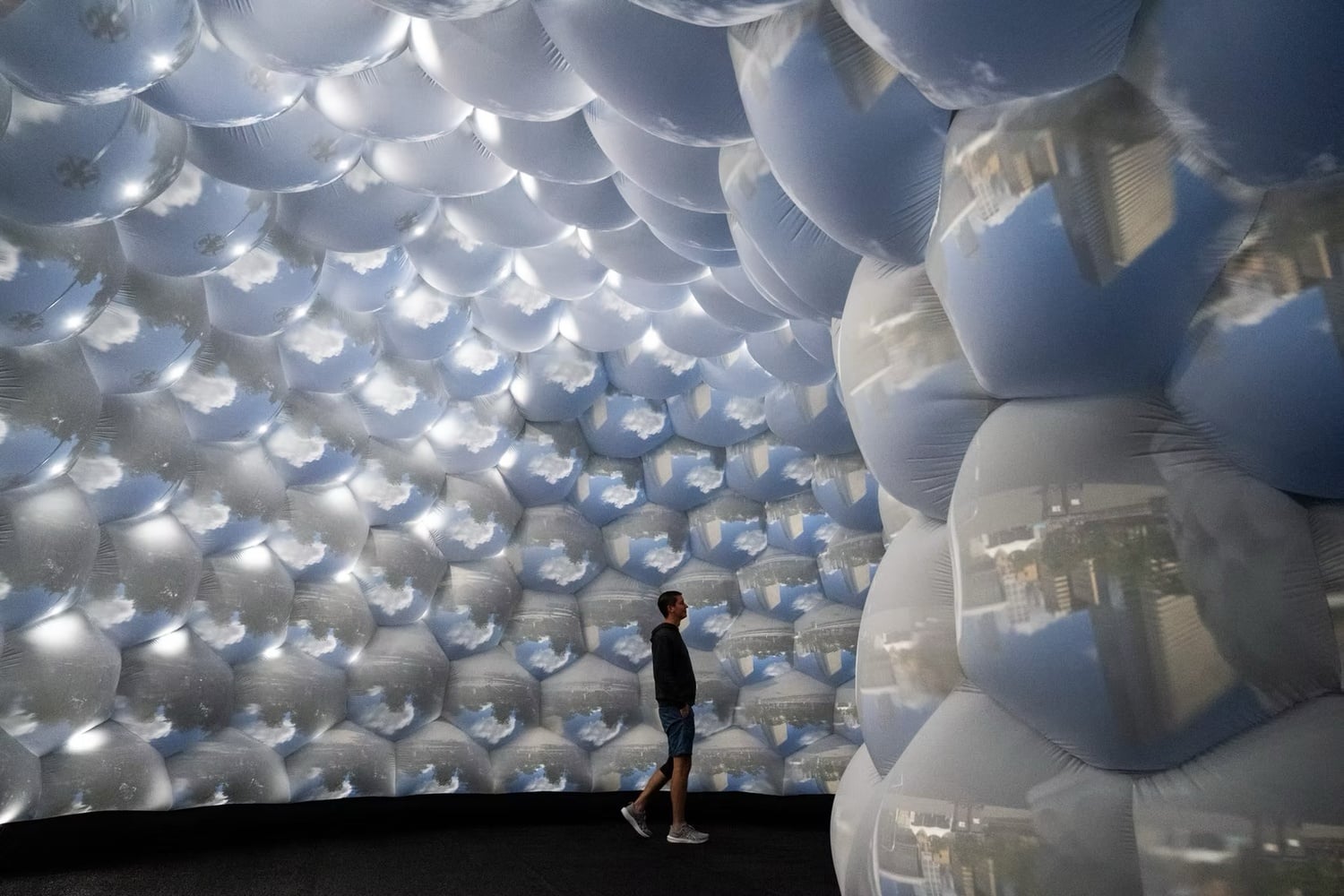
One of their most recent projects, “Compound Camera No.3,” played with manipulating space and technology. The project created a visual of reflected images inside an inflatable room that mimicked what Lehrecke described as the “inside of a fly’s eye.” The work pulls influence from other Pneuhaus pieces, such as “Camera Obscura” and previous renditions of the “Compound Camera,” and continues to develop the collective’s portfolio of manipulating light and physical space to create novel visual effects.
“You can actually focus each of the cells by pushing in onto the fabric, and it’s like a camera. You’re focusing on different depths of fields. But there’s no digital technology. It’s just a lens and a piece of fabric. So it’s like a very analog way of engaging with something that people sometimes think are projectors or digital-like devices. But it’s really just a physical way of playing with optics,” Lehrecke said.
Looking forward to their workshop in a few weeks, Lehrecke is excited to bring Pneuhaus’ work to the Harvard community. The group plans to bring modular inflatables, similar to the ones they have been developing for their “Fun Fridays.” Participants in the workshop will be able to create their own module by attaching inflatables into a large chain.
Of utmost importance is Pneuhaus’ emphasis on collaboration and leaning into human instincts. Appealing to both the physical nature that entices participation and the trial-and-error process of creating art, the collective aims to provide a natural resistance to the disconnect that an ever-automating world can create.
“Let’s put it this way: Other mediums probably struggle. Like, if you were to put a New Media Art piece out in the street, you’d need to explain it to people to go and use that thing,” Lehrecke said.
Pneuhaus’ art is different: The only qualification viewers need in order to approach its curiosity.
“So many people see these round, soft things and just want to engage with them with their bodies. It’s not just kids,” Lehrecke said.
Pneuhaus’ Nov. 2 workshop at the GSD is free and open to the public, with sign-ups located on the GSD website. The event will feature much of the hands-on, collaborative experiences that the collective embodies in their professional practice. As both a means of playful expression and an avenue for learning about the physicality and science of more unique textiles, the inflatables will surely leave their (albeit bouncy) mark on Harvard.
—Staff writer Sophie M. Houck can be reached at [email protected].
Want to keep up with breaking news? Subscribe to our email newsletter
Have a tip for The Crimson? Share it confidentially