As the Grade Cap Looms, Arts and Performance-Based Classes Prepare to ‘Nudge' Grading Toward Compliance
With Harvard’s cap on A grades approaching, the College’s performance-based classes are changing how they assess students, shifting from “vibes-based” grading to more concrete performance metrics or, in some cases, considering dropping letter grades altogether.
The new Faculty of Arts and Sciences policy will cap A grades in most undergraduate courses at 20 percent of students, plus four more, to curb the College’s grade inflation. The policy will be implemented course by course and, according to The Crimson’s analysis of grading data, is poised to hit smaller Arts and Humanities courses unevenly.
Although the policy will officially take effect in fall 2027, Dean of Undergraduate Education Amanda Claybaugh has urged faculty to follow the cap this fall as an “absolute maximum.” Several large introductory courses have already agreed to comply with the shift.
But performance-based classes have traditionally relied on “more vague and more arbitrary” grading than most Harvard courses, Theatre, Dance and Media professor David M. Levine said. TDM’s “vibes-based training” style could advantage students, he added.
Last year, 91 percent of undergraduates in Theatre, Dance, and Media courses received a flat A, the highest share of any Arts and Humanities department, and well above the College-wide rate of 63 percent. In the five years before the pandemic, the department’s average A rate ranged from 61 to 79 percent.
Music and Art, Film, and Visual Studies, the College’s other studio and performance departments, follow the same pattern. In 2024-25, 83 percent of undergraduates in music courses received an A. In AFVS, which teaches studio art and filmmaking, the A rate rose from 65 percent in 2019-20 to 78 percent last year.
Had the cap been in place in 2024-25, all but two of the three departments’ 152 courses would have exceeded it — including none of TDM’s 51 courses, 35 of Music’s 36, and 64 of AFVS’s 65.
Peter Simpson, a lecturer in physical theater, said that evaluating these “importantly subjective ideas” under an objective cap is “dilemma-fraught.”
The Crimson spoke to faculty in both TDM and the Music department about how they plan to adjust to the upcoming grade cap, and found differing approaches, from tightening rubrics to moving to SAT/UNSAT grading.
Asked whether the FAS would issue guidance for performance-based courses, FAS spokesperson James Chisholm said the decision to adjust grading policies in preparation for the grading cap would be up to individual faculty members’ “discretion.”
Get The Crimson in your inbox.
“We can’t speak to what individual faculty members might be considering implementing, or what they might’ve already implemented this Academic Year,” he wrote.
Stricter Rubrics
Simpson, who teaches movement-based acting courses, said that in TDM meetings addressing the grade cap, the Bok Center for Learning encouraged professors to provide more measurable feedback going forward.
“What came up in terms of this grade inflation prevention or mitigation is this idea of ‘Okay, how do we nudge a performance-related, expression-related class, and then throw some markers that are just frankly easier,’” he said. “Evidentiary things that a student can look at and go like, ‘I understand why I got that B.’”
These markers, five TDM professors said, often come in the form of rubrics – but, Levine said, “not everyone is going to do it that way.”
“But since students want some accountability for the grades that they’re getting, we’re going to have to offer something,” he said.
This year, Levine is aiming to give A’s to no more than 30 percent of students in General Education 1050: “Act Natural” and is adding “granular” rubrics with more specific point systems.
Simpson is also adding a stricter rubric this semester, requiring a weekly writing assignment and grading basic “professionalism,” attendance, and timeliness.
“The rest of it is sort of a question of to what degree does that take up, what level of dominance does that have in the final grade percentage?” he said.
Simpson has decided to “scale up” the importance of the writing assignments and “mechanical” markers in his grading system.
But Simpson said he doesn’t yet know how he will grade a student who struggles with the more measurable tasks but excels at looser, performance-based work.
“It’s going to be very hard for me to tell a best student they’re a B student, while someone else who hits those more concrete rubrics, but doesn’t seem to be breaking through a lot of barriers creatively — that’s going to be a slight dilemma,” he said.
In using a more specific rubric this semester, Simpson said he’s noticed “a little more deflation” in students facing evaluation.
“If I critique something and say they were missing a component, you can see immediately, like, ‘Oh God, darn it,’ you know,” he said, adding that he used to give more leeway around rubric expectations.
Simpson expects striking the right balance to be complicated. Students can get caught up in wanting “to just hit all the exact rubrics exactly as you’re laying it out,” he said, which stifles the freedom that is “what ultimately artistry is supposed to encourage and emerge from.”
Moving SAT/UNSAT
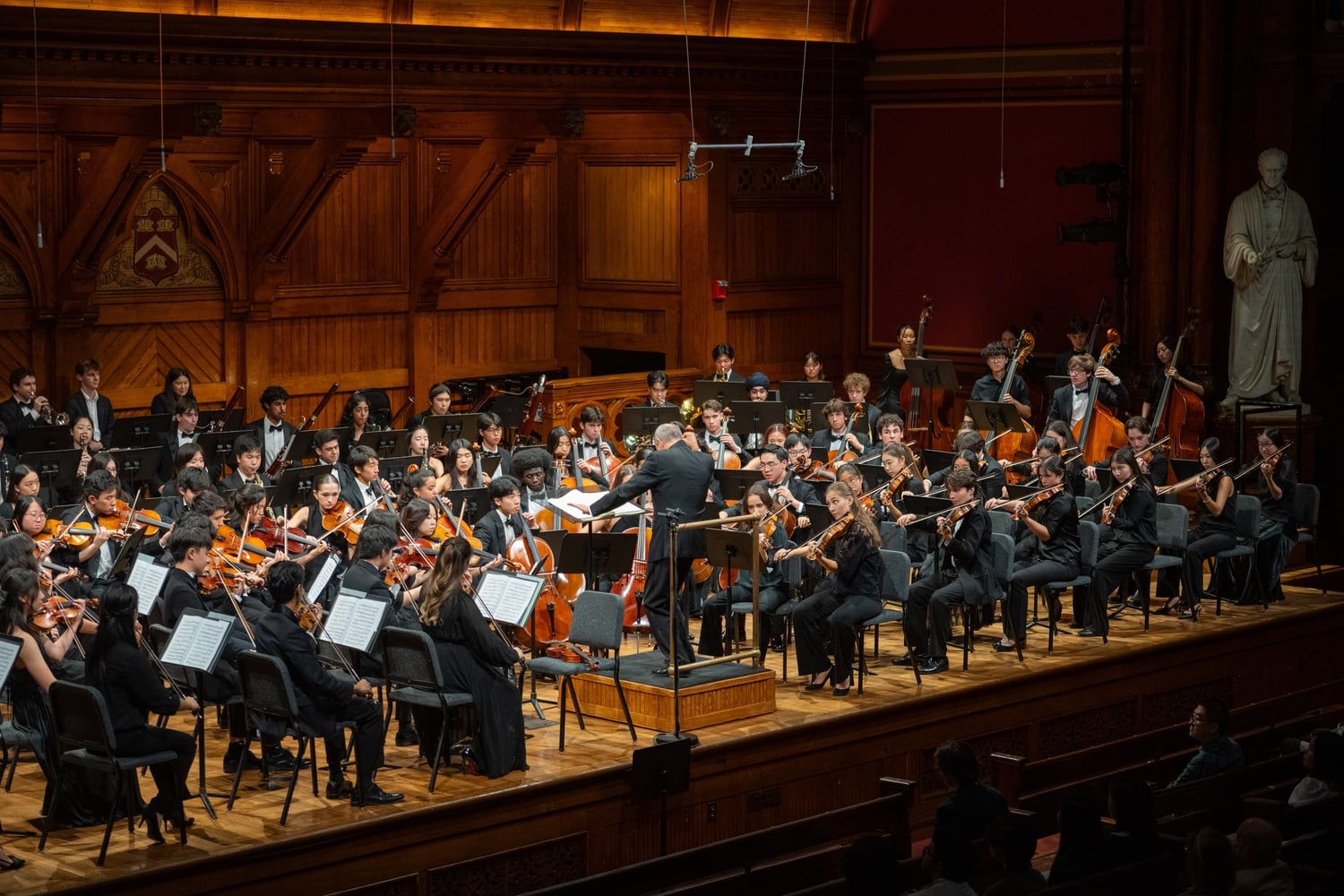
Federico Cortese, conductor of the Harvard Radcliffe Orchestra, said there is “really no right solution” for evaluating arts and performance-based classes under the new grade cap.
“I’m not against what they are doing,” he added. “How it applies to art is a different story.”
One alternative that might work, he said, would be to move all performance-based classes to pass/fail. He argued this would address what he sees as a divide between his performance-based grading philosophy and the different expectations for strictly academic courses.
“The problem is that grades are, for a group like HRO, also a way to reward an extraordinary effort and an extraordinary talent, which makes perfect sense, but not in the strict academic world,” he said.
HRO’s more than 100 members are chosen through a rigorous audition process and often rehearse eight hours a week, Cortese said. As a result, he said, he is not “comfortable” ranking and evaluating these students against each other.
A SAT/UNSAT system could be a solution, but would have to apply evenly across all arts and performance-based courses, he said.
“If we decide that performance can be only SAT/UNSAT, and I have no problem with it, even with HRO,” he said, “then, all performance classes should be SAT/UNSAT.”
Otherwise, he said, students’ commitment to music classes would be unfairly devalued while other performance-based classes with similar issues offer grades.
TDM faculty said the pass/fail option has not yet been discussed in TDM department planning.
“I have not heard of any professors who have that plan, but that doesn’t mean that they aren’t out there,” said Kate Brehm, a TDM lecturer.
“No one said it, so I’m going to presume that we’re all grading,” Simpson said.
Cortese said he is waiting for final instruction from the College. He said the best option for him would be to award “A medals” to students that will appear on their honors transcript but not count toward final GPA, but that he didn’t know if the provision was “doable.”
“I’m waiting for directions,” he said.
‘Not Necessarily a Clear Divide’
Another challenge that courses in the department face, Derek Miller, the TDM chair, said, “is that there’s not necessarily a clear divide between entry-level courses and upper-level courses, and/or we simply don’t offer enough courses in a given area to make that kind of distinction,” leading to a wide range of experience levels in classes.
Less experienced students might then feel anxious that they won’t be able to earn A’s in TDM classes under the new grade cap policy. To address this worry, Miller said the department will emphasize both student effort and natural talent.
“A very experienced actor who comes in the class and remains masterful through the class can earn the A minus,” he said. “A student who has no acting experience and who pushes himself, takes some risks, takes notes in a certain way, has clearly tried to rehearse in particular ways, put in that extra time, done something exceptional — that’s an A, and that doesn’t bear on how good a performer they are.”
Cortese said a similar divide emerged when evaluating different courses in the Music department. Evaluating a performance-based class at an academically focused school like Harvard is especially difficult, he said, because everyone comes from a different background.
At Harvard, some students are at a conservatory level, he said, while others are just learning “how to play piano,” which makes assigning grades difficult.
Miller believes that the new grading policy will prompt faculty to redefine standards and push students to aim higher.
“We’re at an institution that strives for excellence, and we stopped grading that way, and we’re being invited to restore that at this very small level,” he said.
—Staff writer Alma T. Barak can be reached at [email protected] and on Signal at almabk.54. Follow her on X @almabk_.
—Staff writer Theresa F. Bartelme can be reached at [email protected] and on Signal at theresabartelme.15. Follow her on X @theresabartelme.
Want to keep up with breaking news? Subscribe to our email newsletter
Have a tip for The Crimson? Share it confidentially