
We Analyzed a Decade’s Worth of Harvard Grades. Here’s What We Found, Department By Department.
In 712 Harvard course offerings last year, every enrolled undergraduate received an A.
In another 532, A’s were common enough that the class would have violated the Faculty of Arts and Sciences’ newly approved grade cap — a policy that will soon limit top grades in most undergraduate courses to 20 percent of students, plus four more.
Together, those courses made up more than half of all undergraduate course offerings in a confidential grading dataset obtained by The Crimson, offering the clearest picture yet of how deeply Harvard’s grades have been compressed at the top — and how unevenly the faculty’s new cap will hit when it takes effect in fall 2027.
A Crimson analysis of more than 22,000 rows of course-level grading records found that A grades rose from roughly 44 percent of undergraduate grades in 2014-15 to about 63 percent in 2024-25.
But the rise was not spread evenly across the College.
In Arts and Humanities courses, roughly 78 percent of students received A’s last year. In Social Sciences, the figure was 62 percent. In the Sciences and the School of Engineering and Applied Sciences, A’s made up 57 percent and 56 percent, respectively.
That divide matters because the cap — approved by approximately 70 percent of faculty who voted — will be imposed course by course. That means a large statistics class where fewer than one-third of students receive A’s and a small humanities seminar where everyone does will be judged against the same formula.
Some courses are already close to the new standards. In Statistics 110: “Introduction to Probability,” 29 percent of students received A’s last fall, almost unchanged from the 33 percent in 2014-15. Chemistry 17: “Principles of Organic Chemistry,” rose from 22 percent to 29 percent over the same period.
Others would have to change dramatically. Humanities 10A: “A Humanities Colloquium from Homer to Joyce” — Harvard’s flagship first-year humanities course — awarded A’s to roughly 25 percent of students in 2014. Last fall, it awarded A’s to 63 percent. Its spring counterpart, Humanities 10B, rose from 31 percent in 2015 to 70 percent last spring.
The records from the “grading dashboard,” first created by the Office for Undergraduate Education in spring 2025 for faculty and obtained by The Crimson, recast a debate long dominated by Harvard’s average GPA as a department-by-department reckoning. They show that grade inflation has moved unevenly across the College, leaving some fields far more exposed to the new cap than others.
Get The Crimson in your inbox.
Here’s what the data shows about where the cap will hit first.

Humanities Courses Saw Most A’s
Faculty reports, including ones from 2001, have long warned that Harvard grades were rising. But the course-level data shows that some departments have moved much further than others.
Within Arts and Humanities classes, the rise was especially pronounced in several languages and literature departments. Germanic Languages and Literatures saw the share of A’s rise from 45 in 2014-15 to 83 percent in 2024-25. English rose from roughly 47 percent to 82 percent, and Romance Languages and Literatures rose from 48 to 81.
Some of the highest A rates were in smaller programs. Theater, Dance, and Media awarded A’s to 91 percent of students last year, the highest share of any Arts and Humanities department with substantial enrollment.
Folklore and Mythology awarded 87 percent A’s, while Ethnicity, Migration, Rights awarded 86 percent.
The numbers do not necessarily mean those courses were easier or less rigorous. Smaller seminars often use different forms of assessments than large lecture courses, and departments vary widely in how they evaluate creative work, participation, written assignments, exams, and research.
But the new policy will compress those differences into a single formula.
The Social Sciences, meanwhile, saw the largest increases outside the Arts and Humanities division.
Government, one of the College’s largest social science departments, more than doubled its share of A’s, from roughly 31 percent to 68 percent.
Social Studies rose from 41 percent to 77 percent, while the Committee on Studies of Women, Gender, and Sexuality rose from 56 percent to about 88 percent.
Mind, Brain, Behavior and the Global Health and Health Policy both awarded A’s to nearly 90 percent of students last year.
In the Sciences, the sharpest increases came from a mix of small programs and larger departments.
Chemical and Physical Biology awarded A’s to every student in its courses last year, though it enrolled only 13 students across three course offerings. Stem Cell and Regenerative Biology, meanwhile, rose from 42 percent to 77 percent, while Human Evolutionary Biology reached 69 percent from 44 percent.
SEAS remained the least inflated division overall, but its grades also rose. Applied Mathematics saw A’s increase from 42 percent to 64 percent. Computer Science rose from 40 percent to 50 percent, and Engineering Sciences rose from 45 to 60 percent.
A few departments, however, fell in the opposite direction. Applied Computation’s A rate fell from 62 percent to 48 percent. Statistics dropped from 44 to 38 percent.
Government professor Alisha C. Holland, a member of the subcommittee, said the group was aware of divisional differences — and chalked them up to class size, rather than culture.
“Departments with more small courses have higher A rates, and that pattern is remarkably consistent across all four divisions. When you compare small courses in the sciences to small courses in the humanities, the grading looks quite similar,” she said.
“Arts and Humanities will be asked to make some of the largest adjustments because they started with the highest rates, but under the cap, every division converges toward a similar range,” she added. “We modeled this explicitly: the effective caps across divisions are quite close to one another, particularly for courses of similar size.”
Pandemic Peak Persevered.
The pandemic marked the sharpest break in the decade of grading data.
Harvard moved classes online in March 2020, and the 2020-21 academic year was the only full year in the dataset when undergraduate instruction was largely remote. That year, A grades surged across the College.
The share of A’s rose from roughly 54 percent in 2019-20 to 66 percent in 2020-21 — the largest year-over-year increase in the data reviewed by The Crimson.
The spike did cut across divisions. In the Social Sciences, A’s jumped from 53 percent to 67 percent. In the Sciences, they rose from 50 percent to 65 percent. Arts and Humanities, which already had the highest rate before the pandemic, climbed from 67 percent to 77 percent.
After students returned to more normal academic conditions, A rates fell slightly, but never returned to pre-pandemic levels. Across the dataset, A’s dropped to roughly 60 percent in 2021-22, then climbed back to 63 percent last year.
The persistence of that spike was especially clear in smaller courses, where A’s were already most common.
In 2024-25, courses with 12 or fewer undergraduates awarded A’s to 79 percent of students. Courses with 13 to 30 students awarded A’s to 71 percent. The share fell as classes grew: courses with 31 to 50 undergraduates awarded 68 percent A’s, courses with 51 to 150 awarded 64 percent, and courses with more than 150 awarded 52 percent.
That pattern complicates the new cap.
The faculty’s formula gives small courses more room than large ones: every class can award A’s to 20 percent of undergraduates, plus four additional students. A 10-person seminar, for instance, could still give six A’s and comply with the policy. A 200-person lecture could give only 44.
But small courses also start from much higher A rates. A 12-person seminar could give six A’s under the new formula — half the class. Last year, courses that size gave A’s to 79 percent of students.
Physics professor Matthew D. Schwartz proposed an amendment to the “plus four” that would instead allow professors additional A’s up to 0.6 times the square root of total enrollment — a revision that aimed to tighten the number of A’s in smaller classes.
But faculty shot down the proposal in a poll before the vote took place.
Large courses face the inverse problem. Their A rates are lower, but the cap cuts more deeply. A 200-person course grading at last year’s large-course average would award As to about 104 students. Under the new formula, that number would fall to 44.
Schwartz, who supports the subcommittee’s proposal, nevertheless pointed to issues with class size in the original proposal.
“This lack of balance is unprecedented in Harvard’s history. Students will quickly figure out how to game the system -- many will take smaller classes that they are not interested in or not prepared for just to get A’s,” he wrote.
“And I worry about the middle ground: with 5 students there can be 5 A’s, but with 14 students there are only 6 A’s possible. So in the 6-14 range, each additional student makes it worse for the others,” he added.
‘Into the New Regime’
Some instructors are not waiting until fall 2027 to adjust.
In Government 97: “Tutorial - Sophomore Year,” Government Ph.D. student John Koo told students that the teaching team had graded with the coming cap “in mind.”
Average grades across Gov 97 sections fell between a B and B+, according to Koo’s announcement.
“The teaching team has graded with the 20% + 4 cap on As in mind to give you a mental transition into the new regime (with the quota being calculated from the full enrolment of Gov 97, not by each section), but we have not imposed an actual cap on As this year,” he wrote. “That is to say, the grading standard is high, but we did not withhold As solely because there were X other people getting As.”
The class is one of several large courses where the coming cap has already begun to reshape grading conversations.
Government lecturer Sergio Imparato — who teaches Government 1090: “Biotech Ethics” — also instructed teaching fellows this spring to limit A grades to roughly 50 to 60 percent. The course, which regularly enrolls hundreds of students, awarded A’s to roughly 80 percent of students when it was last offered in spring 2025, according to the obtained data.
Imparato told students at a dinner this semester that he was unsure whether he could continue offering Biotech Ethics in its current form under the new grading regime, according to Dev S. Ahuja ’27, a former Crimson Editorial editor.
Imparato told students he would likely have to opt out of the cap and grade the course on some form of satisfactory-unsatisfactory basis, a change that could reduce enrollment.
Imparato did not respond to multiple requests for comment.
The shift reflects the timeline outlined by College Dean David J. Deming at an open forum last month. Deming said administrators would “strongly encourage” faculty to begin imposing the cap in fall 2026, one year before its formal implementation.
General Education courses may be especially exposed to the new policy. The program sits outside the FAS’ divisions, enrolls large numbers of students, and has seen its own rise in A grades since it launched in 2019.
Across Gen Ed courses, A grades rose from 50 percent to 63 percent in 2020-21, a 13 percentage point jump. A rates then fell slightly in 2021-22, but remained well above the faculty’s new target.
Faculty have long worried Gen Ed courses lack rigor. The program updated its guidelines in 2024 in part to address grade inflation, and faculty voted last spring to eliminate the option to take one of the four required Gen Ed courses pass-fail.
But not every instructor expects to overhaul their course.
Harvard Medical School professor David S. Jones ’92, who teaches Gen Ed 1116: “Medical Ethics and History,” said that he hoped “any reforms will have been debugged” once the cap descends after next year.
Jones said he had shifted the course to in-class exams in 2023 because of concerns about artificial intelligence.
Roughly 72 percent of students in the class received A’s when it was last offered in 2023.
“I don’t expect major changes, other than a lower overall curve than recently,” he wrote in a statement. “The mandated distribution (20% A’s) would be similar to what it was when I started teaching 20 years ago, and more generous than it was when I was a TF 30 years ago (or a student 35 years ago).”
‘A Fair Shake’
Faculty supporters of the cap have argued that lower grades will make Harvard transcripts more meaningful to employers and graduate schools.
In conversations with law school and medical school deans, the grading subcommittee wrote that admissions officers had struggled to identify extraordinary candidates “in a sea of 4.0s.” The committee said the conversations also suggested that Harvard’s move could encourage other schools to adopt similar measures. (Yale University proposed a more stringent version of Harvard’s cap two months later.)
Admissions officials interviewed by The Crimson said they would adjust to the new policy.
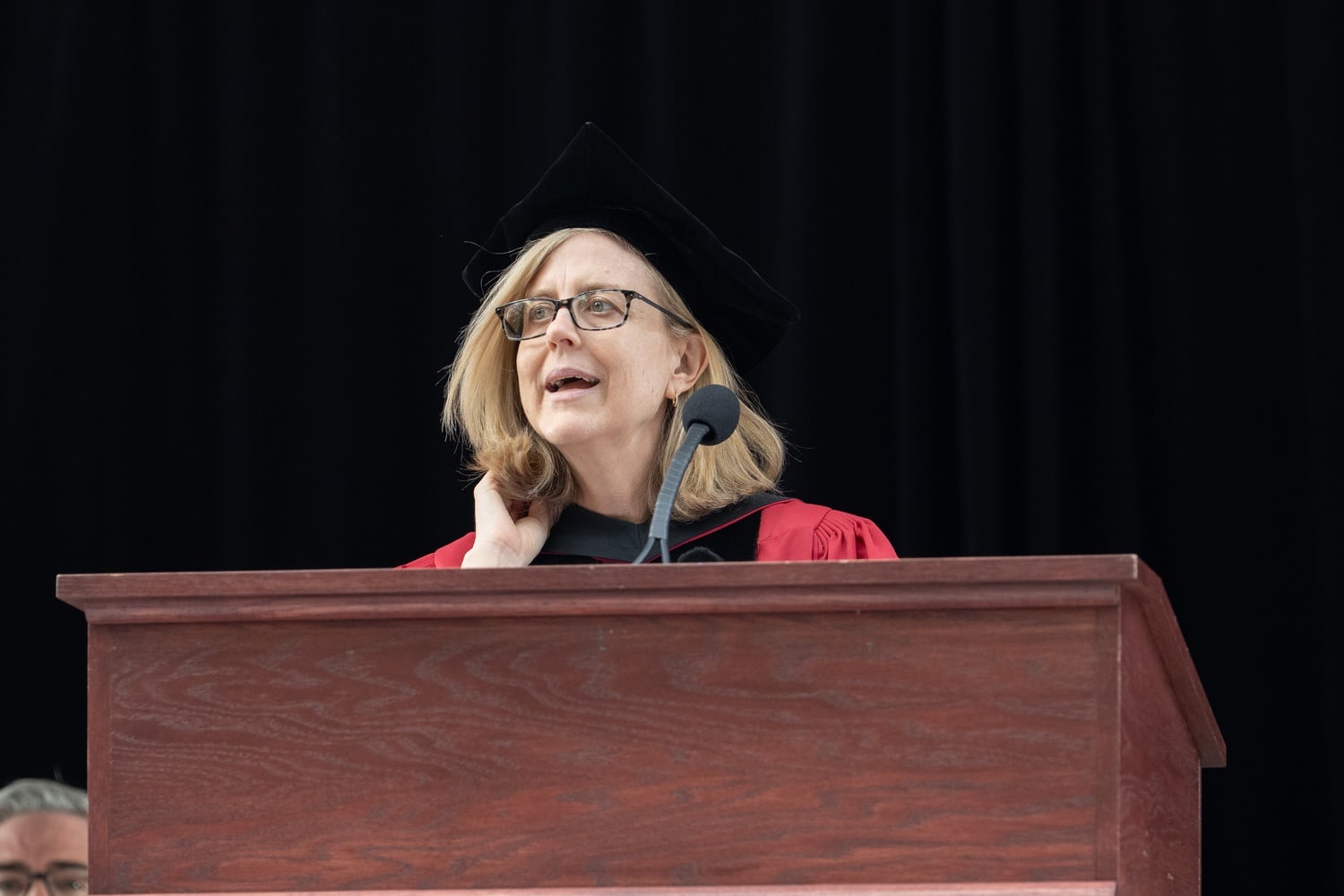
Michigan Law School Senior Assistant Dean Sarah C. Zearfoss, who spoke with Claybaugh in January as Claybaugh consulted admissions deans about grade inflation, said the cap would likely affect only a small number of applicants.
“I do think that at the margins, giving fewer A grades will affect outcomes for some small number of students, but I think because Harvard is Harvard — and Harvard students who are at law schools, anyway, tend to have very high LSAT scores — that will mitigate the impact of any lower grade,” she said.
Harvard Law School Assistant Dean of Admissions Kristi L. Jobson ’06 wrote in a statement that admissions officers are accustomed to interpreting changes in undergraduate grading systems.
“Harvard College students and graduates present excellent candidacies for admission to law school, and I expect that law school admissions offices will continue to be excited to receive applications from the College if the grading framework shifts,” she wrote.
Medical school admissions officials struck a similar note.
Neha Vapiwala, dean of admissions at the University of Pennsylvania’s Perelman School of Medicine, said she also spoke with Claybaugh in January — just before the subcommittee’s first grading recommendations were released to the public.
“I’m not saying the cap itself is the right thing or the solution,” Vapiwala said. “But I will say that we appreciate that the effort is being made.”
Admissions processes for Ph.D. students could be slower to adjust. Unlike law school and medical school admissions, graduate admissions are often less centralized and department-based — meaning information about Harvard’s new grading policy may not spread evenly.
Charlotte Yano, a graduate admissions coordinator for Carnegie Mellon University’s Computer Science department, said she had not previously heard of Harvard’s proposed grade cap. She said Harvard was not among the worst grade-inflation offenders.
“If they are going to do this with the intent of increasing the value of those higher GPAs in relative terms to their other scores, they’re going to have to do a better job of getting the word out to other schools that that’s what they’re doing,” she said.
Others said admissions committees would adjust quickly.
Henry A. Lester ’66, chair of the Graduate Admissions Committee for the California Institute of Technology’s Neurobiology Option, wrote that it would be “just a few minutes” for admissions committees to adjust their evaluation criteria.
“‘Harvard exceptionalism’ will become a non-issue — at least for judging grades during the next graduate admissions cycle,” he wrote.
“Summing up in words of one syllable,” he added, “you and your friends will all get a fair shake here.”
—Staff writer Abigail S. Gerstein can be reached at [email protected] and on Signal at abbysg.97. Follow her on X @abbysgerstein.
—Staff writer Amann S. Mahajan can be reached at [email protected] and on Signal at amannsm.38. Follow her on X @amannmahajan.
Want to keep up with breaking news? Subscribe to our email newsletter
Have a tip for The Crimson? Share it confidentially