Harvard Bok Center Expands Revamped Fall Training to All FAS Section Leaders
Harvard required all teaching fellows, teaching assistants, and course assistants in the Faculty of Arts and Sciences to complete mandatory teaching training for the first time this fall, extending a requirement that previously applied to only new section leaders.
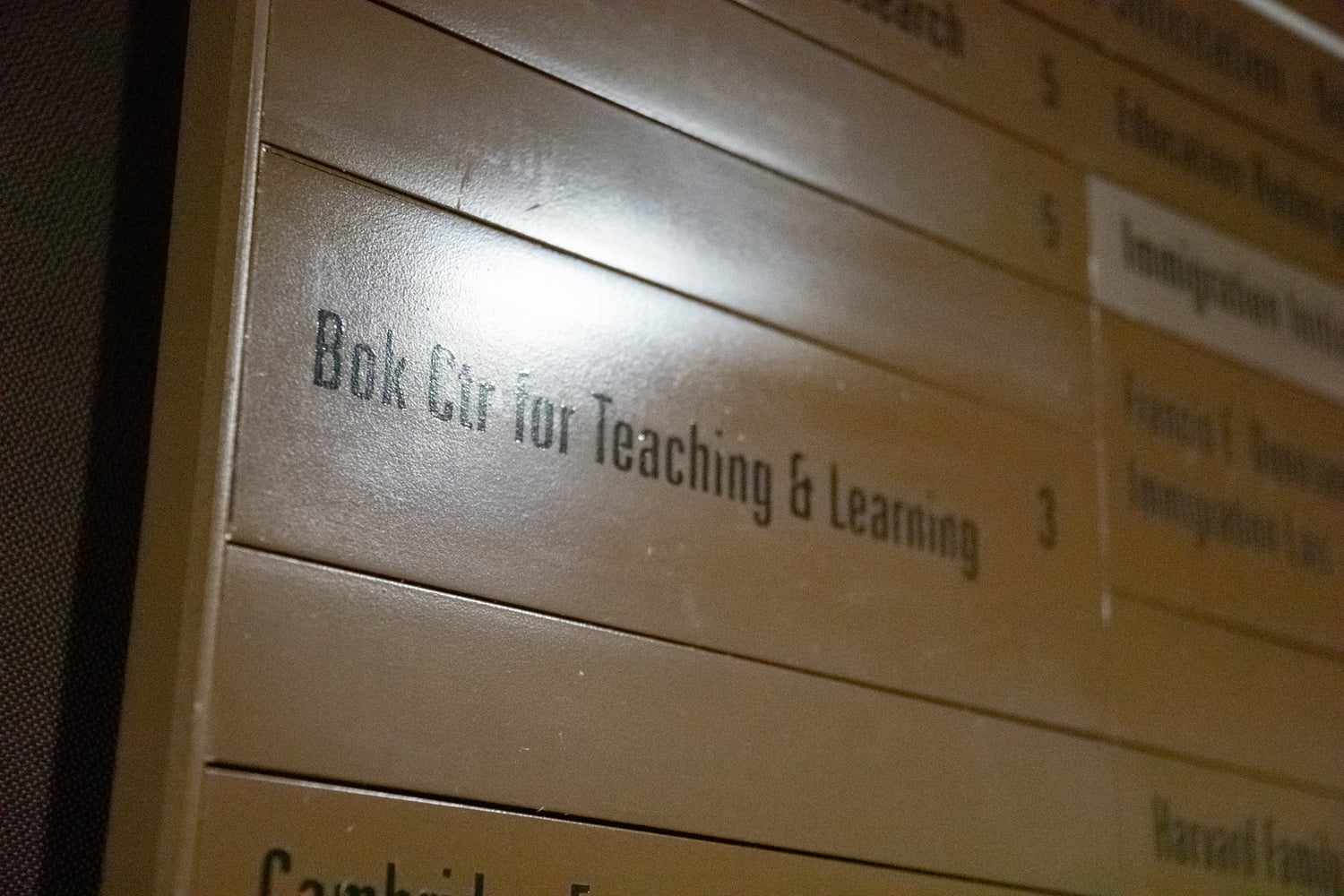
The Derek Bok Center for Teaching and Learning trained 1,556 section leaders from late August through early September, according to faculty director Karen L. Thornber — more than doubling their capacity from last fall, when the Center trained roughly 700 first-time TFs and TAs.
New TFs and TAs attended a two-hour workshop that briefed them on the fundamentals of instructing, including grading, handling student concerns, and working in a teaching team. Returning TFs and TAs chose two hourlong sessions from among a list to attend during the center’s Fall Teaching Week, and CAs attended a separate workshop tailored to teaching as an undergraduate.
This fall’s programming is the culmination of a two-year effort led by Thornber to rebuild the training infrastructure for section leaders, a program she said was too small and out of date when she took over at the Bok Center in July 2024.
“I realized a couple things — first, just a small percent of the TFs, TAs, and CAs were being trained, and secondly, that the training really didn’t meet current needs,” Thornber said. “So I spoke with my colleagues in the FAS, at OUE, the College, GSAS, and fellow faculty more broadly, and we all agreed — we need to redo this training.”
The overhaul came amid a broader reorganization under Thornber, the center’s first permanent faculty director in nearly four years. The center restructured just months into her tenure, shedding 25 percent of its staff and consolidating four programming arms to two.
The new training caught on quickly. The center piloted a redesigned program with General Education TFs in January 2025, got approval from FAS Dean Hopi E. Hoekstra to make the training mandatory in fall 2025 for all new TFs and TAs teaching in the FAS, and expanded this fall to undergraduate CAs and returning TFs and TAs.
Get The Crimson in your inbox.
The revamped training is also in line with a University-wide effort to make students more comfortable disagreeing in the classroom. Thornber said part of the training focuses on teaching controversial topics and creating a setting where students can express opposing viewpoints.
“They have to be really careful to create an environment where everyone can thrive, where students feel free to express a range of opinions without worrying, ‘Is my TF going to agree with me?’” Thornber said.
Several section leaders said the trainings were broadly helpful, though two teaching fellows said the tools didn’t feel directly applicable to their courses.
Hadrien Davier, a graduate student at the Kennedy School and first-time TF for Economics 10a: “Principles of Economics,” said that the nature of classes like Ec 10 left little room for the participation-focused strategies that the training emphasized.
“It doesn’t suit a class like Ec 10, the same way it wouldn’t suit a math class where you’re just there to learn math,” Davier said. “I think it maybe feels it fits more Gen Ed or humanities, where maybe you have more discussion, debates — that’s not at all the format of the class.”
Logan R. Hyslop, a first-time TF for Math 22a: “Vector Calculus and Linear Algebra I,” said he found the Math department’s own training relevant to his work, but said the Bok Center one felt more like a “box to tick.”
“I think the training with the department was definitely a meaningful use of time for starting off getting these teaching skills,” Hyslop said. “It was useful with the training that Harvard provides to at least know the policies and understand what they are, but it drags on a little bit.”
Thornber said the Bok Center was already revising the program for next fall with this feedback in mind and planned to bring in more STEM instructors to lead tailored training sessions.
“We realized upon reflection, we weren’t doing enough explicitly to help our STEM colleagues, and that that wasn’t deliberate at all,” Thornber said. “You can’t catch every lacuna every time, but that really became apparent to us.”
Want to keep up with breaking news? Subscribe to our email newsletter
Have a tip for The Crimson? Share it confidentially