Harvard Refutes Report That Admissions Office Has Conducted Targeted Outreach to Jewish Day Schools
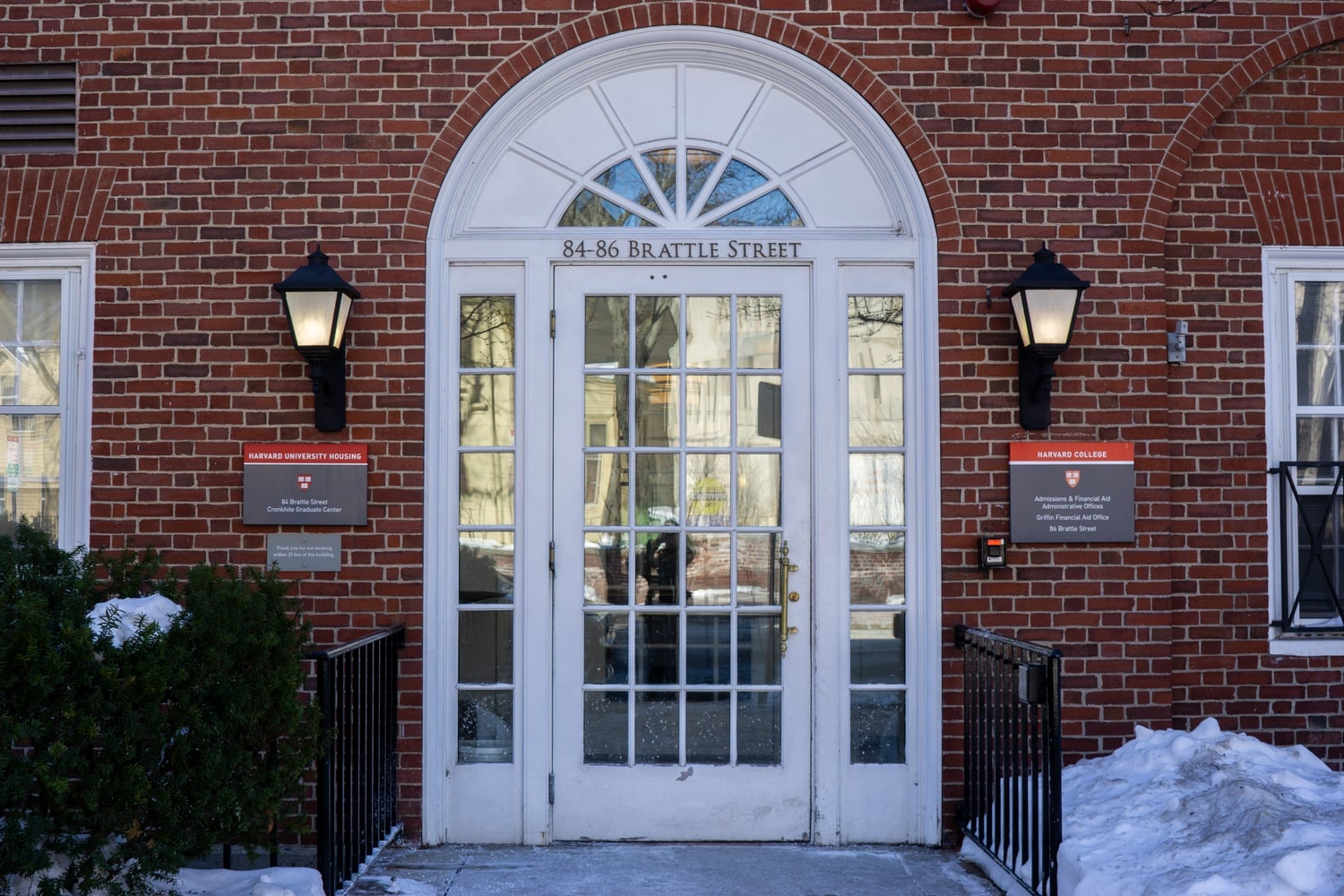
Harvard College’s admissions office disputed a report that it has conducted targeted outreach to Jewish day schools, saying the claim — and remarks attributed to its top admissions official — are inaccurate.
The Washington Free Beacon reported last week that Dean of Admissions and Financial Aid William R. Fitzsimmons ’67 said at a Feb. 20 Harvard Chabad Shabbat dinner that Harvard had begun outreach to Jewish day schools, following the lead of Brown University, and had already seen promising results.
But a Faculty of Arts and Sciences spokesperson said Fitzsimmons was not a scheduled speaker at the event and that “comments attributed to him are not accurate.” The spokesperson also rejected broader assertions that Harvard had recently increased outreach to Jewish day schools.
“Harvard College has long sought applicants from a variety of educational backgrounds, including religiously affiliated high schools,” the spokesperson wrote in a Tuesday statement.
According to three students who attended the dinner — held at the Harvard Business School — Fitzsimmons was acknowledged at the event but did not deliver formal remarks.
Rabbi Hirschy Zarchi, the president of Harvard Chabad who attended the dinner, also said Fitzsimmons was introduced at the dinner but did not make a public comment.
Zarchi, who described Fitzsimmons as a “great friend,” said the dean has regularly communicated his desire to ensure that Jewish students — “broadly and including specifically at Jewish day schools” — know that Harvard values them as applicants.
But Zarchi said he was not aware of any formal increase in admissions outreach to Jewish day schools from Harvard administrators this year. He added that Harvard Chabad frequently communicates with prospective Jewish students and day schools independently, and that work has come up in conversations with Fitzsimmons.
“He certainly sees in us an address to communicate to the Jewish world about how Harvard values Jewish students and Jewish applicants, including those from Jewish day schools,” Zarchi said.
The Free Beacon updated its story Tuesday with an editor’s note stating that remarks originally attributed to Fitzsimmons were incorrect.
Get The Crimson in your inbox.
Other Jewish student organizations have also conducted outreach to the broader Jewish community independently of the admissions office.
Rabbi Jason B. Rubenstein ’04, executive director of Harvard Hillel, said in a statement that Hillel has been “publicly raising the alarm” about the decline in Harvard’s Jewish population.
“Over the past several years, we have worked closely with Dean Fitzsimmons and others in admissions to help them understand the Jewish community,” Rubenstein wrote.
Hillel has hosted Shabbat dinners for prospective students, at least one of which included an admissions officer to answer questions.
“Our data indicate that those efforts have had some success, and that the number of admitted Jewish students in each of the past two classes, while still below a threshold of communal viability, has increased markedly over previous years,” Rubenstein wrote.
The dispute follows a new report that has intensified scrutiny of Jewish enrollment trends at Harvard. The Harvard Jewish Alumni Alliance, an alumni group, released a 64-page analysis last week estimating that Jewish undergraduate enrollment has fallen by roughly half over the past decade to about 7 percent.
The report draws on multiple data sources — including Harvard Crimson freshman surveys, a 2016 Brandeis University study, and Hillel International estimates — to approximate enrollment trends.
The HJAA report argues that the decline cannot be fully explained by broader demographic or admissions trends, comparing Harvard’s trajectory to peer institutions. It found that Jewish enrollment has remained stable or increased at some schools, including Brown University, over a similar period.
A University spokesperson pushed back on the HJAA report’s conclusions, writing that “Harvard does not collect data on applicants’ shared ancestry or religious identity.”
“Any estimates that exist on applicant data come from external surveys, which vary widely in methodology and cannot reliably measure changes over time, outline differences across schools, or explain application, admission, or enrollment patterns,” the spokesperson added.
HJAA President Adrian D. Ashkenazy ’96 defended the group’s methodology, arguing that its findings are consistent across data sources.
“The Crimson survey data has been thoroughly vetted for selection bias and secularization trends and is impacted by neither,” Ashkenazy wrote in a statement. “The declines are real, substantial, and undeniable.”
The report’s release also coincides with intensifying federal scrutiny of Harvard’s treatment of Jewish students and antisemitism on campus. Days after it was published, the Department of Justice filed a lawsuit accusing the University of violating Title VI of the Civil Rights Act by failing to adequately respond to antisemitic and anti-Israeli harassment on campus following Hamas’ Oct. 7, 2023, attacks.
The complaint seeks to recover federal grant funding and asks a court to appoint an independent monitor to oversee Harvard’s compliance with civil rights law.
The Department of Education also opened two investigations on Monday — one into antisemitism complaints on campus and another into whether Harvard has complied with the Supreme Court’s 2023 decision striking down race-conscious admissions.
—Staff writer Celine Muir can be reached at [email protected] or Signal at celinem.33. Follow her on X @celinemuir1.
—Staff writer Alexa M. Schmitt can be reached at [email protected] or Signal at alexaschmitt.15. Follow her on X @alexa_m15_s.
Want to keep up with breaking news? Subscribe to our email newsletter
Have a tip for The Crimson? Share it confidentially