Eliot Renovations Forced Kirkland’s Kitchen Into a Trailer. Staff Say Food Got Better.
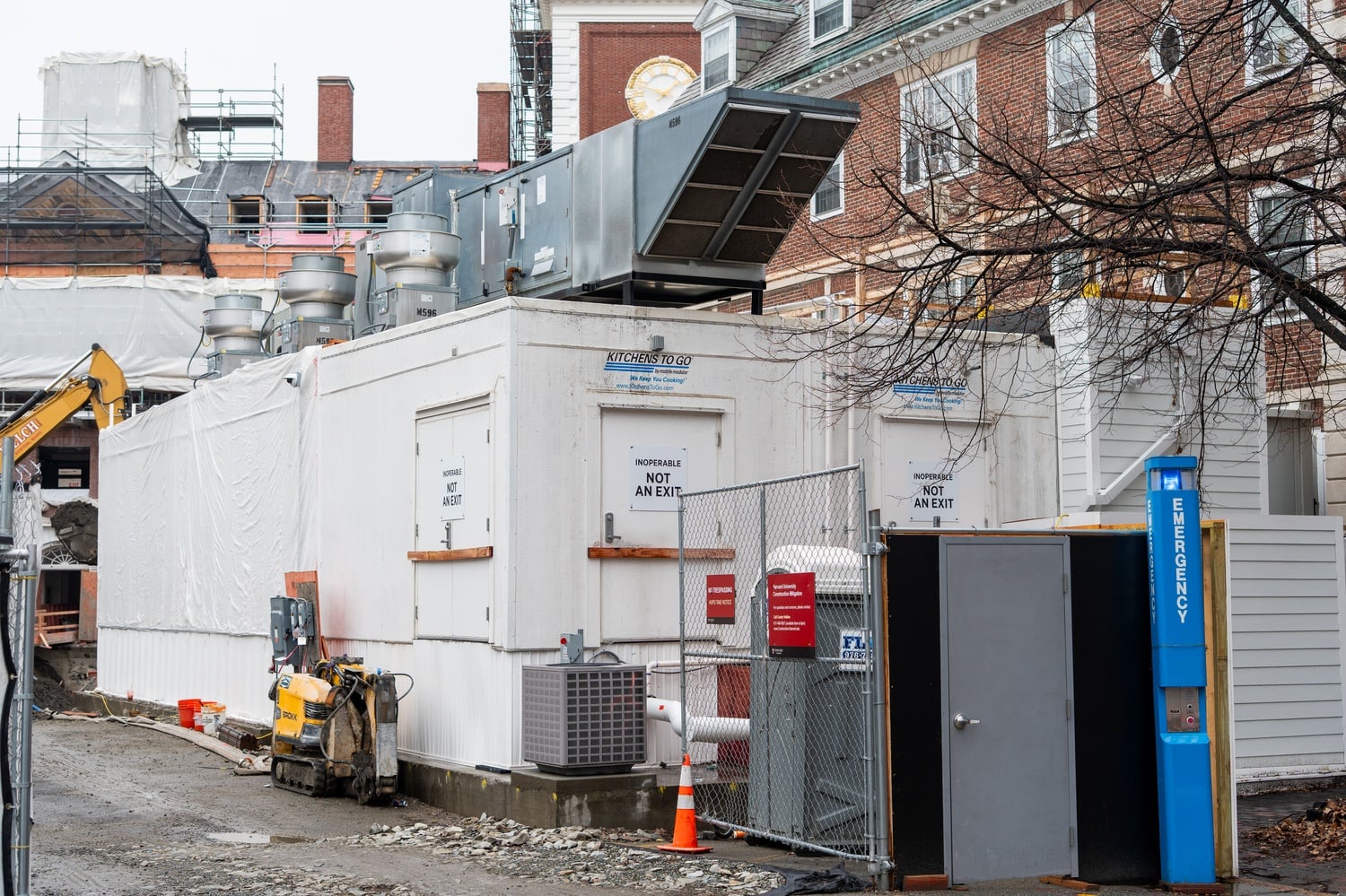
When Eliot House’s renovation forced Kirkland House dining staff out of their longtime kitchen, they ended up in an unlikely place: a trailer parked beside the dining hall.
More than six months later, staff said the improvised arrangement has improved food quality.
The renovation project — which Harvard began in June 2025 and is expected to continue through fall 2027 — displaced the shared Eliot-Kirkland kitchen staff and pushed operations into a trailer and temporary basement spaces in Kirkland.
Dining staff said the move addressed a longstanding problem of the kitchen being too small to efficiently serve both Houses, which together serve roughly 750 students.
“Before the renovations, our prep area consisted of the grill in Eliot, the grill in Kirkland, one table in the kitchen — roughly the size of one of these dining hall tables — and a blast chiller, which was about the same size,” senior chef Bryant Roy said.
Seven staff members worked in the space, which Roy said may have been “the smallest kitchen for a double house or a single house on campus.”
The kitchen also shared Kirkland’s basement with Crimson Catering, Harvard University Dining Services’ in-house catering and event service provider, further limiting available space.
That changed in fall 2025 when Crimson Catering relocated to a new facility in Allston — just as construction on Eliot began — freeing up additional kitchen space in Kirkland’s basement.
“Now that Crimson Catering has moved to their new spot in Allston, we have their kitchen downstairs to work with, so it’s a lot more space,” said Georgina Paramo, a general cook at Kirkland. “No bumping into anybody, right? It’s different, and it’s a nice change of pace.”
Staff said they now split operations between the expanded basement kitchen and the trailer attached to Kirkland’s dining hall. Most prep work takes place downstairs, with dishes brought upstairs for final cooking and plating.
Get The Crimson in your inbox.
“I prep everything downstairs, and then I get everything, as I call ‘sheet-pan-ready,’ bring it upstairs, and then just cook it in the oven,” Paramo said.
Harvard College spokesperson Jonathan Palumbo wrote that the temporary arrangement is part of a broader effort to preserve students’ dining experience during the House renewal process.
“We recognize that the shared dining experience is an important aspect of that daily engagement for students, so we appreciate the true team effort to provide students access to meals together and the team with access to facilities to prepare and serve those meals,” he wrote.
Though the trailer is temporary, the divided workspace resembles the model planned for the renovated Eliot-Kirkland facility, which is expected to include a centralized basement kitchen and upstairs finishing space.
The additional room — along with the slower pace of serving only one House — has allowed staff to focus more on individual dishes, Paramo said.
“I think the biggest difference, which is good, is that we’re a lot slower because we’re only doing a single House, and I definitely have more time to put extra effort into everything,” she said. “More attention to detail.”
Roy said the added space has also made more complex menu items possible.
“A lot of those recipes with the space we had before, it would have been impossible to prep everything, and now we have the space so we can do really cool stuff,” he said.
Despite its temporary appearance, Roy said the tailor kitchen represents an upgrade over the previous setup.
“The new trailer kitchen alone has more space and more stable equipment than we’ve ever had to work with,” Roy said.
The transition was not without setbacks. Early demolition work on Eliot House caused vibrations that triggered emergency gas shutoffs and electrical disruptions in the trailer kitchen, according to staff.
“It was weird because it was shaking it enough to shut the gas off, like, create an emergency shut-off,” Paramo said. “So we’d have to relight everything. That would happen a couple of times.”
Kirkland House Faculty Deans Peter Huybers and Downing Lu wrote in a statement that the House’s dining staff has worked diligently to minimize disruptions through the transition.
“We are grateful to the Kirkland HUDS team for maintaining consistently high quality while working out of temporary space,” they wrote. “When construction has caused issues, the renewal team has addressed them quickly, keeping dining hall disruptions to a minimum.”
Roy added that the trailer initially ran on a single electrical breaker, meaning multiple appliances could shut down if the system overloaded. The layout also created occasional issues — including adjacent switches controlling the hood lights and the kitchen’s gas shutoff.
Once Eliot’s renovations conclude and service for both Houses resumes, dining staff said they are eager to compete for the top spot in Harvard’s House dining rankings.
“We can really get a good team together and get both Houses right next to each other in the top three, if not the top one and two,” Roy said.
—Staff writer Samuel S. Rudavsky can be reached at [email protected]. Follow him on X @samrudavsky.
Want to keep up with breaking news? Subscribe to our email newsletter
Have a tip for The Crimson? Share it confidentially