Facing ‘Uncharted Waters,’ Erin McDermott Sets a New Course for Harvard Athletics
Five years into her tenure, McDermott has reshaped Harvard Athletics through the pandemic, the rise of NIL deals, and mounting financial pressures — all while pushing a more unified identity and hands-off leadership style.

efore calling the shots for Harvard Athletics, Erin McDermott was running drills as a freshman forward at Hofstra University — sometimes a little too well.
During her freshman year, McDermott’s team had won just two of twenty-four regular-season games, according to former Hofstra women’s basketball coach Ron Rohn. The team spent five weeks drilling “cycles,” in which McDermott’s job was to rebound the ball and return it to the point guard.
At one of her earliest games as a starter — against Yale — the repetition carried over. When Hofstra scored, McDermott instinctively grabbed the ball, inbounded it, and started the next play before referees could blow the whistle.
“Erin got a warning for a delayed game, for not letting the ball go through. But it was pretty funny to us at the time,” Rohn said. “It’s like ‘Way to go, Erin, you’re doing exactly what we do in practice every day.’”
Five years into her tenure as Harvard’s first female athletic director, McDermott has traded drills for a different kind of repetition: the steady, businesslike work of reshaping a 42-team department through a pandemic, the arrival of name, image, and likeness deals, and an unprecedented clash between Harvard and the federal government.
In interviews with The Crimson, more than a dozen coaches, donors, and administrators described McDermott as a hands-off manager who has pushed the department toward a more unified identity, diversified its revenue, and staked Harvard’s recruiting pitch on what Harvard is, rather than on what it cannot offer.
A ‘Hands Off’ Manager’
McDermott spent 13 years at Princeton before leading athletics at the University of Chicago for seven. Coaches who worked under her at UChicago described a leader who gave her staff room to operate.
“She was sort of hands off. She sort of let us manage our team. She wasn’t micromanaging,” said Jason Weber, UChicago’s head men’s and women’s swimming coach.
Get The Crimson in your inbox.
Carissa Sain, a former UChicago head basketball coach who worked under McDermott for eight years, said she appreciated the autonomy as a first-time head coach.
“I think, as a first time head coach, I think she could have kind of come in and micromanaged me in a way that some people do,” Sain said. “That was not my experience at all with her.”
At Chicago, McDermott started a women’s lacrosse program and secured a department-wide partnership with Adidas — an emphasis on branding that coaches said carried over to Harvard.
“She made Chicago a brand,” Sain said.
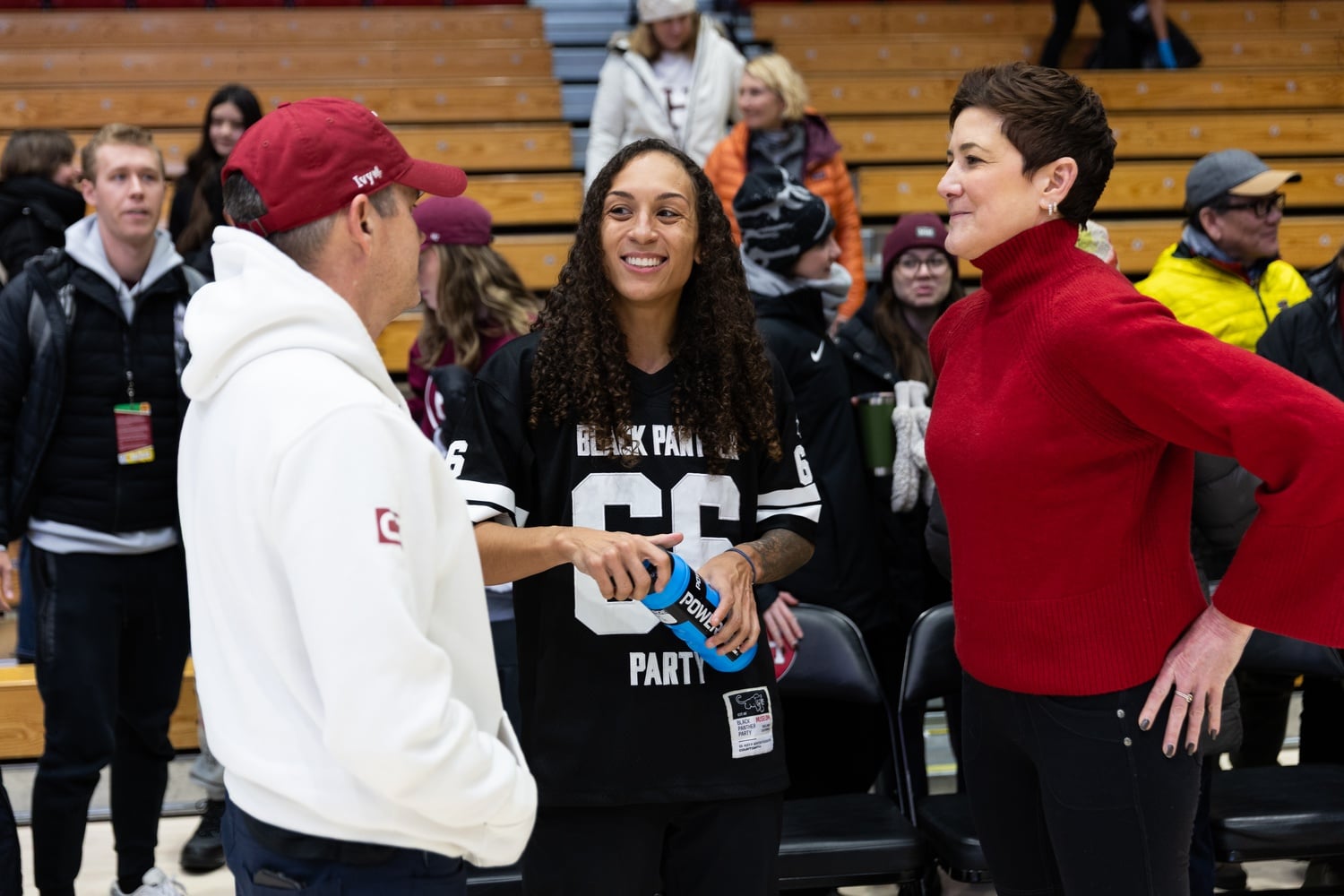
At Harvard, coaches said what has distinguished McDermott most is her presence at games. She has traveled with teams abroad, including a trip with men’s hockey to Ireland last year.
“I’ve never seen an AD who is so involved directly with the teams,” field hockey head coach Tjerk van Herwaarden said. “The fact that she takes time out of her own weekends to be at many, many games to make relationships with our student athletes is something that I’ve never seen before.”
McDermott said she tries to meet each team at the start of its season and stick around after games — in losses as well as wins.
“Whether it’s after a tough loss or a great win, I try to kind of hang around after and just say, ‘Hey, you know, it’s a loss,’” McDermott said in an interview. “Just to give that encouragement, or be in there high-fiving and giving hugs when it’s the positive.”
Building ‘One Crimson’
McDermott took over as Harvard Athletics director in July 2020, after the Ivy League had canceled athletic competition and the University had gone remote. The pause, she said, became an unexpected listening tour.
“I was on Zoom constantly,” she said. “That was what began planting the seeds.”
Those conversations, McDermott said, kept surfacing the same problem: the department was not telling a consistent story about itself. Marketing and communications were running on separate tracks, and the relationship between varsity athletics and the rest of the undergraduate body felt disconnected.
“There was just not a lot of unification around that. So just that’s what started this whole looking at our structure,” McDermott said.
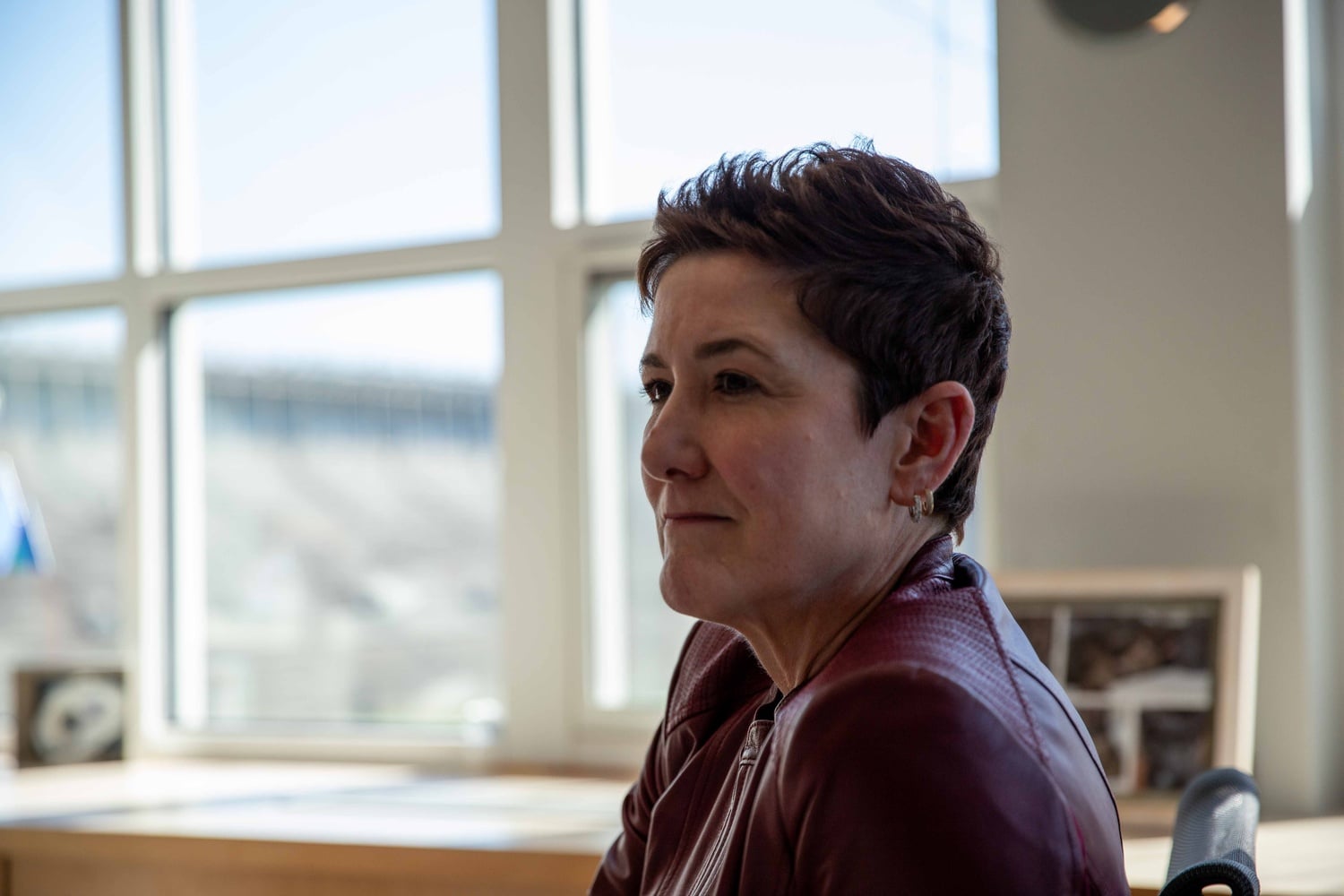
McDermott realigned the marketing and communications teams, created new positions focused on student-athlete wellness and team culture, and launched a development team to drive annual and major gifts. She also installed a layer of seven associate directors, each serving as the point person for five to six teams. She now leads a staff of roughly 300.
The remote year also produced One Crimson, an initiative aimed at integrating varsity athletics with the broader undergraduate body. Its most visible expression is an annual giveaway of One Crimson sweatshirts to first-year students during move-in week.
“I really wanted to send this message of, we want you all to be part of us,” McDermott said. “I knew it wasn’t going to cure all the problems, but I just thought we need to make it clear that this is not a place where this is just for varsity athletes.”
Jessica C. Gelman ’97, president of Harvard Varsity Club, said integration with the undergraduate body had been a clear gap when McDermott took over.
“A big focus was integration with the current students — the students and the student-athletes. That seemed to be a missing connectivity of some sort,” said Gelman, who served on the Board of Overseers’ Visiting Committee for Athletics.
Coaches said One Crimson has also helped reshape the internal culture of the department. Men’s water polo head coach Ted Minnis said he received texts from head coaches and administrators — including McDermott — when he notched his 300th win this month.
“It is a true family feel, and that’s huge for me, because that’s how I’ve built my program is on family,” Minnis said. “And to have the athletic director who I align with her vision. Not that I didn’t align with Bob, but it’s just different.”
Navigating NIL
A year into McDermott’s tenure, the Supreme Court opened the door for college athletes to profit from their name, image, and likeness — a ruling that has since reshaped recruiting at major programs through donor-backed collectives worth six and seven figures.
Harvard, like the rest of the Ivy League, has not established a collective, and McDermott has said it will not. The decision has left Harvard trying to stay competitive in recruiting without matching the money on offer elsewhere.
Lawrence G. Cetrulo ’71 — who is the chairman of Friends of Harvard Fencing — said the environment has forced McDermott into a more pragmatic posture.
“Erin’s approach has been, by necessity, more businesslike, because the athletic environment has turned more businesslike,” Cuterlo said. Fundraising demands, he added, “have never been more important and never been more fraught with challenges.”
Cuterlo described the current moment as “uncharted waters,” pointing to NIL money, the transfer portal, and the growing number of athletes who play for multiple schools.
“There is going to be a reckoning regarding all of this at some point in the near future,” he said.
Under McDermott, Harvard Athletics launched a “Why Harvard” platform to frame the University as offering something a conventional Division I program cannot: flexibility to pursue academics, research, and outside interests alongside a sport. McDermott has said recruits now arrive with clearer expectations, which she believes makes them less likely to leave mid-career.
Women’s basketball head coach Carrie Moore said the pitch turns on what competitors cannot match.
“At the end of the day, it’s not Harvard,” Moore said of rival programs. “They don’t have this degree, they don’t have these professors, and they don’t have this type of experience.”
Men’s ice hockey coach Ted Donato ’91 said the NIL era has forced coaches to re-examine their priorities.
“I think some of the changes have really got us to look in the mirror a little bit and say, ‘Hey, what do we value the most?’” Donato said. “And I think she’s done a really good job of keeping that front of mind.”

Two of McDermott’s most scrutinized decisions have been her head football and head women’s basketball hires. When she selected Andrew Aurich as head football coach in 2024, players and alumni criticized the search process and the choice of an external candidate over two internal finalists.
Two seasons later, Aurich’s program has shared an Ivy League co-championship, and some alumni who had questioned the hire now describe it as vindicated. Robert E. Grady ’79, a longtime Athletics donor, said Aurich had “delivered the goods.”
“It proved to be a great hire,” Grady said. “First two years out of the gates, co-champion of the Ivy League.”
Scott C. Collins ’87, a vice-president of the Harvard Varsity Club, said McDermott had stood by the decision despite pressure.
“There was certainly a lot of discussion about whether she had made the right decision, but I think she stood on what she thought was best,” Collins said. “Not easy with all the different opinions she was getting at the time.”
Moore, hired in 2022, has also delivered. Her team made a run at the WNIT in her first season and opened with a 20-win campaign, and she has compiled 60 wins over her first three years.
Money and Pressure
With the University under financial strain from federal funding cuts and an increased endowment tax, McDermott has told coaches to focus on what they can control.
Van Herwaarden said McDermott has been direct about where the department can and cannot hire, and transparent about the limits of her own visibility into Harvard’s broader financial picture.
“She’ll be very direct and honest about like, well, listen, this presents an issue that we probably will not be able to tackle right away, and therefore we are going to have cuts,” van Herwaarden said. “And on the other hand, she also mentions when there is a potential solution, or solution in the works.”
McDermott has also moved to diversify Athletics’ revenue streams. She pointed to a partnership with Wegmans, which supplies food for student-athletes on Wednesdays, as a model for the kind of corporate sponsorships Harvard intends to pursue more aggressively.
“We are trying to be more creative, more ambitious in a way,” she said.
The department has also begun leaning on its physical footprint. Over the summer, Harvard hosted concerts and drone shows on its athletic grounds — part of an effort, McDermott said, to grow rental income without displacing varsity or recreational programming.
Men’s lacrosse head coach Gerry Byrne said those events serve a second purpose.
“You’re generating revenue,” Byrne said, “but you’re basically also pulling back the curtain for some people on what Harvard is.”
Donors said the effect has been to clarify what Harvard Athletics is asking them to support.
“I think what Erin has done is she’s created a direction,” Collins said. “People know what they’re investing in when they’re donating to Harvard Athletics.”
—Staff writer Julia A. Karabolli can be reached at [email protected].
—Staff writer Tanya J. Vidhun can be reached at [email protected]. Follow her on X @tanyavidhun.
Want to keep up with breaking news? Subscribe to our email newsletter
Have a tip for The Crimson? Share it confidentially