‘Rent’ Review: Viva La Vie Bohème
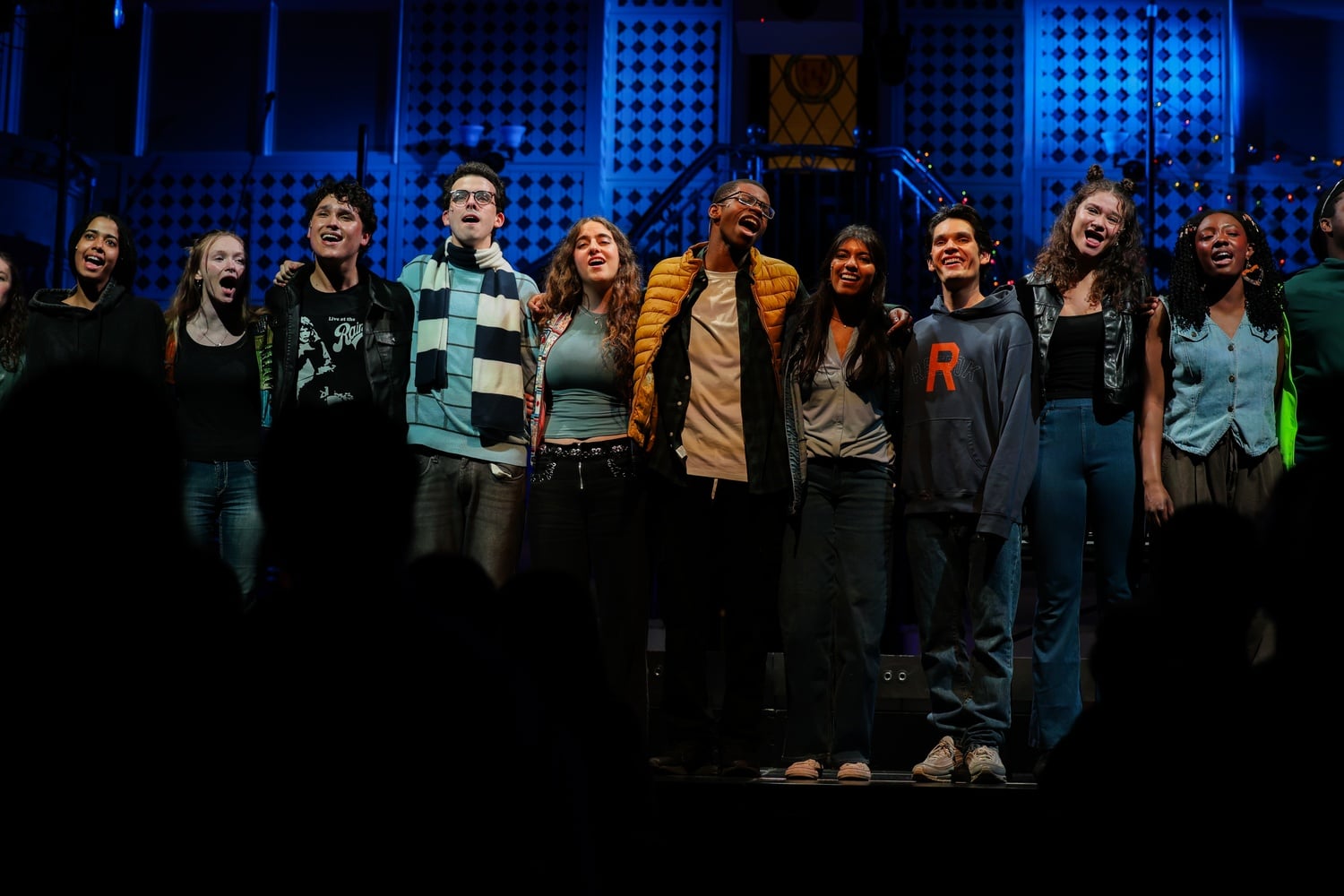
This February marked the 30-year anniversary of Jonathan Larson’s “Rent” on Broadway. A rock opera adaptation of Giacomo Puccini’s 1896 opera “La bohème,” “Rent” follows a group of poor, rebellious young artists living in a circa 1990s East Village beset by gentrification and the HIV/AIDS epidemic. The intensely beloved, landmark musical is quite unlike any other — before or after its time.
Harvard’s own production of “Rent,” directed by Riley B. F. Jackson ’27, inaugurated the newly renovated Adams House Pool Theater (which was a literal swimming pool until 1992) last weekend. In most aspects, the production was faithfully evocative of the original — and that proved to be for the best. “Rent” is a show so specific to its time, so packed full of references, that it takes up most of one’s focus just trying to follow what Larson left for us. The musical has drawn legions of fans — and also critics — for that reason. (It’s a period piece, as Rentheads would defend.)
As for the musical’s plot, over the course of a year, filmmaker Mark (Ben L. C. Arthurs ’27) witnesses the romance between his roommate, the rock musician Roger (Justice L. Sirotek ’27), and exotic dancer Mimi (Isabella K. Lashley ’26), both HIV-positive. Meanwhile, their friend Collins (Olukayode M. Ekundare ’29) falls in love with HIV-positive drag queen Angel (Boston Conservatory at Berklee student Diego Lopez). Mark’s ex-girlfriend, the performance artist Maureen (Nell I. Ranalli ’29), protests — with the help of her lawyer girlfriend Joanne (Anaya Bindal ’29) — ex-friend Benny’s (Gabriel Brock ’26) attempts to evict homeless New Yorkers from a lot he wants to transform into a cyber arts studio.
It’s a lot to follow. But with this cast’s impressive enunciation, expression, and timing, all the different moving parts of “Rent” came alive with not just clarity, but effervescence. Costumes (Rojina Karimirad ’28), props (Jazy A. Childers ’29), scenic design (Ida Chen ’27) and choreography (Lance Anthony ’29) took clear inspiration from the Broadway version. The team’s vision was particularly well-captured by Brock — who absolutely nailed Benny’s character in both vocals and acting — and by Ranalli’s hilarious and electrifying performance as Maureen.
That’s not to say that there wasn’t anything fresh about Harvard’s production. With his rich, almost buttery voice, Sirotek made for quite a departure from the quintessentially gritty-voiced Roger — yet he sold the emotional rock star vibe all the same. Credit must be given to the excellent electric guitarist, Berklee College of Music graduate Oliver Le, who played no small part in charging “One Song Glory” with an echoey angst or in ascending to the anguished climax in “Your Eyes.”
However, in interaction, the performers sometimes felt mismatched — Lashley’s weepy, wide-eyed Mimi seemed almost too fragile against the moody Roger, even with Sirotek’s softened take on the character. Arthurs and Ekundare also played their characters with an animated spirit, which was generally enjoyable but at times verged on goofy next to the more serious Sirotek.
Those subtle issues didn’t distract much, though, thanks to the main trio’s impressive vocals, which were matched in technical and emotional power. Sirotek’s emotionally charged singing was rounded out by the energetically expressive Arthurs and the girlish, pure voice of Lashley. The likable Ekundare and Lopez, meanwhile, anchored the show’s emotional heart.
There’s nothing more helpful to selling “Rent” than the bonds between those onstage, and this production’s ensemble exuded earnest joy — soloists Hannah E. Alexis ’27 and Grayson E. Caffrey ’28 nearly stole the spotlight playing feisty New Yorkers, while all of Mark and Roger’s callers absolutely delivered in their minutes-long solos.
Unfortunately, the audio needed to be slightly louder in the crucial ensemble choruses of “Seasons of Love” and “Finale B” — even in such a cozy theater. The small space, moreover, framed some of the ensemble’s costuming and choreography as more underdeveloped than authentically scrappy. “Rent” had room to dial up these aspects, to be bigger, bolder, and quirkier.
Still, “Rent” more than succeeded at putting the Pool Theater to appropriately creative use. The production team flipped the theater’s typical orientation, centering the stage around a marble staircase, which enabled Lashley to perch atop a banister and slink around metal scaffolding in “Out Tonight.” Ekundare or Bindal’s characters made phone calls from platformed walkways along the sides of the house, and Ranalli and Bindal strode into the center of the audience in their powerhouse performance of “Take Me or Leave Me.” In these fantastic uses of the unique setup, Chen and Anthony reimagined elements of the show’s original blocking with immersive new choices.
Another distinctive fixture of the Pool Theater is its massive arched windows, which flooded light (designed by Lily S. Madison ’29) throughout the space — flashing red and green during “Rent,” seductive purple during “Out Tonight,” and anxious yellow during “We’re Okay.” Combining bold colors with the urban feel of the ceiling’s metal scaffolding, the post-renovation space seemed nearly destined to host what became its inaugural show.
Clearly, the Pool Theater space and the vibrant performers shaped a version of “Rent” that felt intimate and heartfelt, above anything else. The few aspects where the production lacked polish, it made up for by radiating the community connections that are so essential to landing its message. Harvard’s “Rent,” doing justice to both its source material and its landmark role in inaugurating the renovated theater, would’ve delighted any fan. 30 years later, we’re still compelled to shout: “Viva la vie bohème.”
“Rent” ran at the Adams House Pool Theater from April 1 to 5.
—Staff writer Isabelle A. Lu can be reached at [email protected].
Want to keep up with breaking news? Subscribe to our email newsletter
Have a tip for The Crimson? Share it confidentially