Artist Profile: Jack T. Flynn ’26 on the Dread and Joy of Comedy
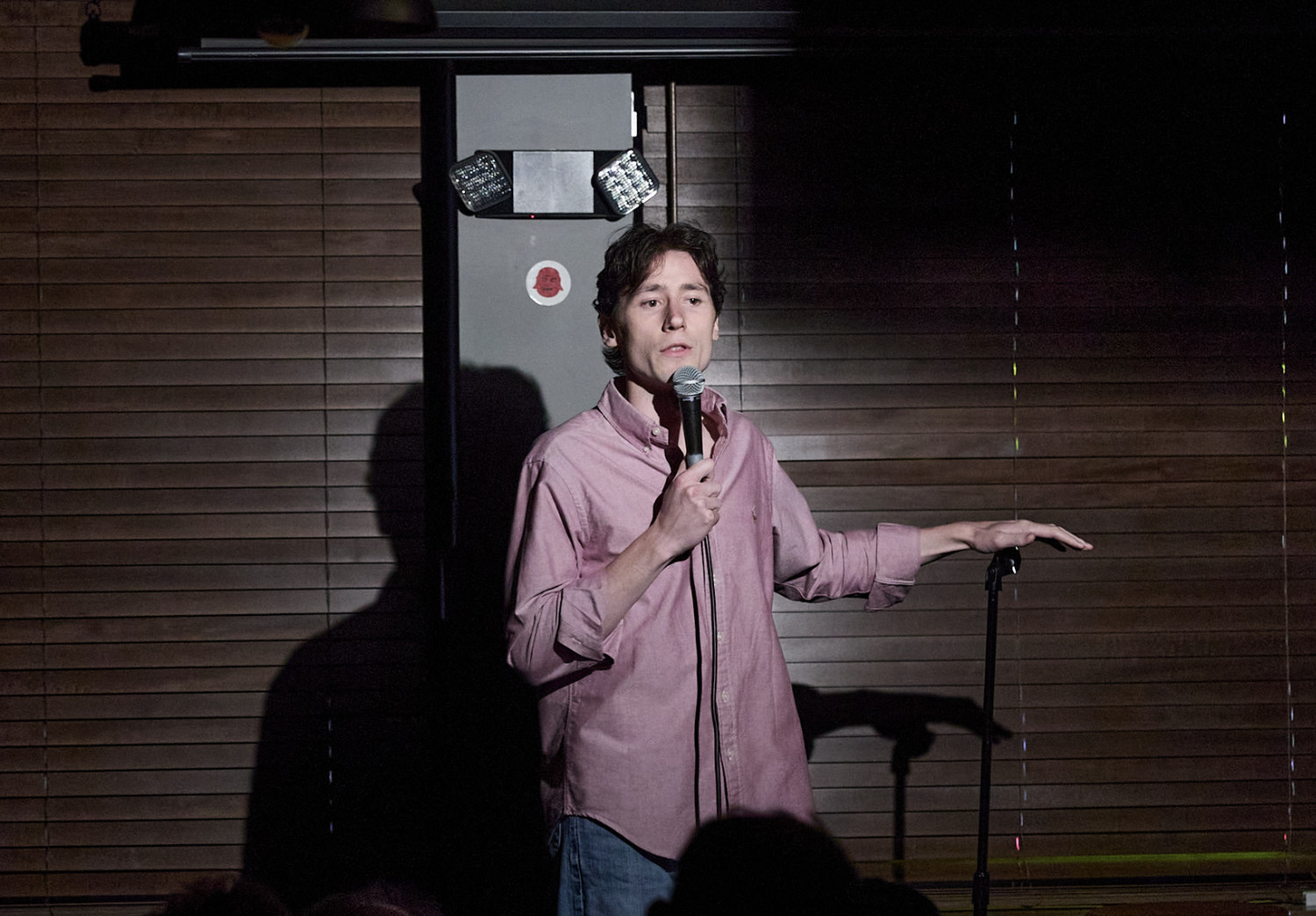
Jack T. Flynn ’26 wants it known that not all of his stand-up is about existential dread.
But it’s certainly something he’s been thinking about as a graduating senior. Flynn just performed his last show with improv troupe Three Letter Acronym. In an interview with The Crimson, much of which was spent postering for said Senior Show, Flynn reflected on the group that has drastically shaped his time at Harvard.
“I had never done improv before freshman year,” Flynn said. “I knew I’d wanted to get into the writing and comedy side of things here, and I just auditioned when I heard about it. And I’m very lucky to have stumbled across it, because it’s, I think, my favorite thing I’ve ever done.”
Growing up, Flynn was “very shy” and improv became a way to push past that.
“I like having my alone time, but improv is a good way to sort of break that force,” Flynn said. “It helps to force myself to remember to have a little fun.”
At Harvard, TLA is the only improv troupe that focuses on the Harold — a type of long-form improvisational structure that allows for recurring characters, scenes, and worlds to build across a show. That practice has helped Flynn with idea generation and overcoming writer’s block.
Three years after joining the troupe, Flynn now serves as co-captain of TLA alongside Katie A. Silverman ’26, helping manage more logistics and preparation than “you’d think for an improvised show.”
“It’s very difficult being the big man on campus,” Flynn said.
Though he loves performing, Flynn’s true passion lies in writing. As an English concentrator, Flynn opted for a creative thesis: a dark comedy sitcom set at a funeral home in the North Shore of Massachusetts. It follows a 30-year-old man who moves back to his hometown to take care of his aging mother, only to find that the sole local job available is directing the town funeral home.
“I wanted to talk about death and grief, and I’ve always found it helpful to bring a little levity into that process,” Flynn said.
Growing up Catholic in Boston, Flynn attended numerous wakes and found them “very awkward” and “kind of arm’s length.” With the sitcom, he wanted to “poke holes” into that world, drawing inspiration from the livelier tradition of Irish wakes.
“In Ireland, the wakes are more like a party, for lack of a better word,” Flynn said. “They’re playing games, and they’re drinking, and there’s a lot of food. And I’ve always thought that it was more fun, and also it was a helpful way of processing.”
He also found inspiration in shows like “Community” and “Derry Girls,” the latter of which has a notable funeral episode. For his thesis, Flynn submitted the first two half-hour episodes of the season and an eight-page treatment, complete with the plot summary for the rest of the episodes. The project grew out of his longtime interest in screenwriting, which he developed through workshops with Senior Lecturer Musa Syeed.
“I’ve always known I wanted to write,” Flynn said. “And I think in recent years, I’ve really gravitated towards screenwriting.”
The interest set in early. Flynn remembers making up stories about his stuffed animals as a child. His mother still occasionally brings up a piece he wrote in the first or second grade, in which he declared writing his favorite part of class.
“So my pretentious side set in pretty early on,” Flynn said.
Comedy, however, offered him a way to move his writing off the page. In addition to improv, college also introduced him to stand-up comedy. Often performing on campus, Flynn runs an Instagram account, @jackflynncomedy, where he posts clips from his sets. Still, he finds stand-up “infinitely more stressful” than performing with TLA.
“If something goes wrong, you don’t really have anybody else to blame,” Flynn said, not before quipping, “except the audience, I guess.”
Flynn has also performed at Gotham Comedy Club in New York City, where he worked last summer and occasionally took the stage. During his stand-up, he feels that a lot of his “existential dread comes out.”
“Bombing in front of a room full of strangers from New York is not a good feeling, but you get over it pretty quickly,” Flynn said. “Bombing in front of everybody you go to school with — I still think about certain shows.”
His sentiment is clear, and it’s why he appreciates his friends’ and improv troupe’s support. In fact, Flynn often turns to TLA to brainstorm his stand-up sets, testing characters or storylines. Silverman, he said, is his “comedy emergency contact.”
One of Flynn’s favorite memories with the troupe is its 24-hour show, a tradition that had stalled after COVID and that Flynn made a point of reviving before he graduated.
On that fateful February day, TLA performed for 24 hours, complete with designated sleeping shifts. Though they were initially worried they’d be “falling apart by the end,” it was an exhilarating bonding experience, with a fatigue that added to the comedy.
In that vein, Flynn sees improv as moving past the fear of failure.
“It teaches you to override some sort of shame mechanism in your brain,” Flynn said. “You’re just suddenly willing to do things that are so dumb in front of a room full of people. I don’t know, I think there’s something very beautiful about that.”
The TLA Senior Show, which happened later that day, was a difficult goodbye for Flynn. Complete with a Harold, their signature “sex with me” game, and the underclassmen imitating the seniors, the show was a heartfelt sendoff to TLA’s five soon-to-be grads.
As graduation approaches, Flynn is still figuring out what comes next. He hopes to work in television, ideally in a writers’ room, though he knows the path into entertainment can be uncertain — it’s a good thing he’s learned how to improvise.
—Staff writer Capri S. Wayne can be reached at [email protected].
Want to keep up with breaking news? Subscribe to our email newsletter
Have a tip for The Crimson? Share it confidentially