One Year In, David Deming Projects Stability and Optimism
Harvard College Dean David Deming has tried to define his first year through student-life wins and public visibility — but his upbeat approach has been tested by budget pressures, office closures, grading fights, and skepticism from students and staff.
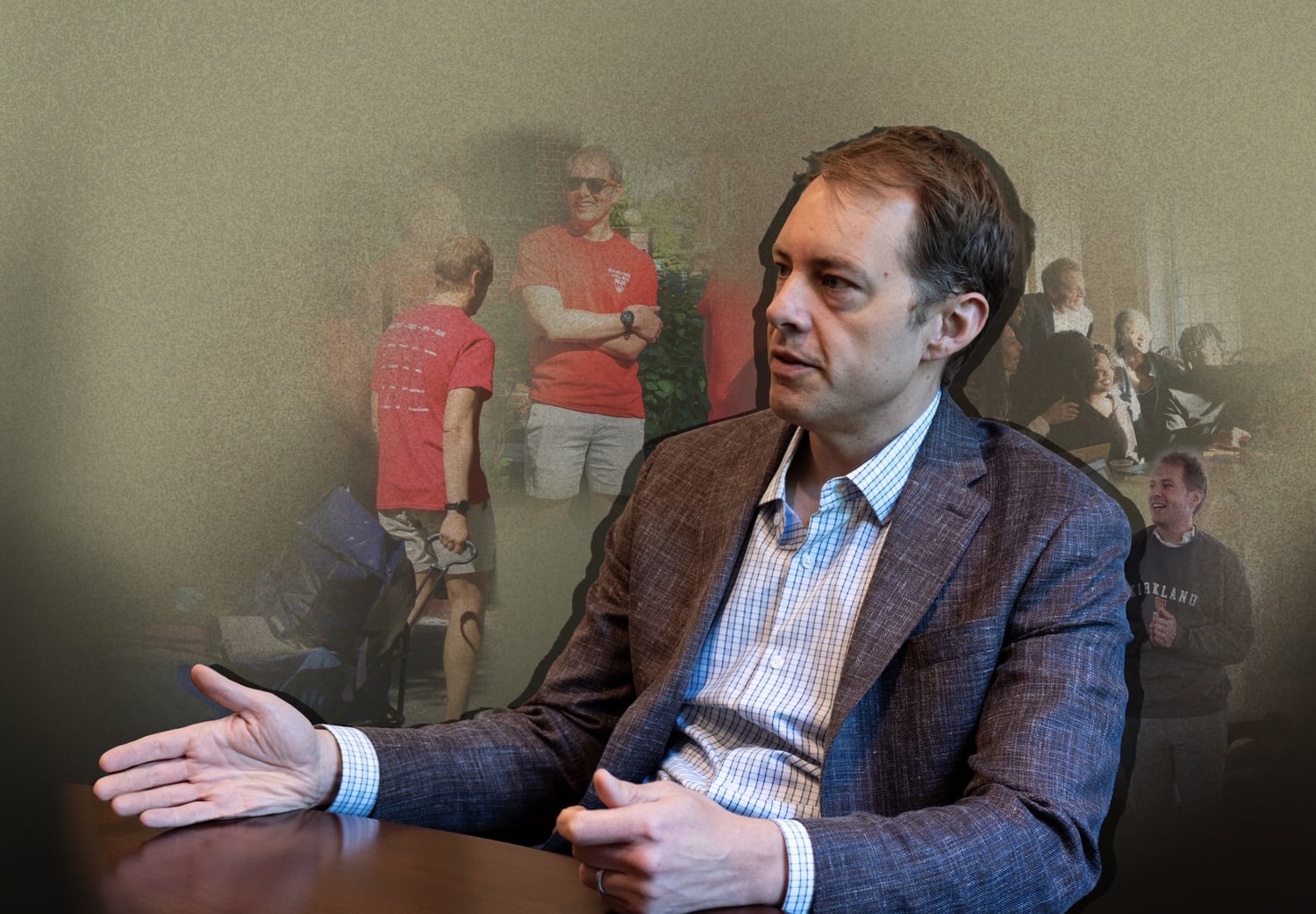
Harvard College Dean David J. Deming says he’s had a “really great” year.
When Deming stepped into the role in July, he inherited more than 7,000 undergraduates, hundreds of staff members, and the consequences of a multimillion-dollar structural deficit he had no hand in creating — all at a moment when Harvard was facing an unprecedented level of federal scrutiny.
But across town halls, alumni dinners, and social media posts alike, Deming has insisted on painting an optimistic picture of the state of the College.
“Harvard is a target in many ways these days, and so somebody has to say, look, this is what our students are actually doing,” Deming said in a Monday interview. “We have a lot to be proud of here on this campus.”
Over the past year, Deming has filled a role that requires him to act as something between an administrator and a mascot, traveling across the country to meet with donors and posting reels of student encounters on his Instagram page.
The office has frequently asked him to defend or absorb decisions made elsewhere, from a contentious grading proposal to the closure of three diversity offices.
Through it all, Deming has held to a consistent line: incremental change, optimistic framing, and an unwillingness to speak on decisions made above him.
“It’s been a really great year for me. I hope the students have felt that. I feel pretty proud of what we’ve all accomplished at Harvard College, especially under difficult circumstances,” Deming said.
In interviews with more than three dozen students, staff, faculty, and donors, many said the approach has yielded improvements to student life — but left some affiliates with a persistent sense that Deming’s public optimism does not always match the reality on the ground.
Get The Crimson in your inbox.
‘Spreading the Good Word’
In July, less than a month into his tenure, Deming traveled to New York for a fundraising event.
“I was talking to a bunch of people, friends of the University, about my vision for the College and what I hope to do,” Deming said. “It was a meet-the-dean kind of thing.”
Roshini C. Rajapaksa ’93, who attended the event, said she came away impressed.
“He just seemed very open and eager and excited,” she said, “and was really great to talk to.”
Alumni largely spoke positively of Deming, who traveled to New York and Los Angeles over the course of the year and was scheduled to visit San Francisco before a snowstorm cancelled the trip.
Deming said his alumni engagement has focused less on fundraising directly and more on “spreading the good word” — describing the work of the College to prospective donors and engaged graduates rather than soliciting gifts.
For current students, Deming’s most visible presence has been on Instagram. Several undergraduates said social media is the main way they encounter their dean.
“I know very little about what Dean Deming’s job actually is. Pretty much my only interaction or knowledge about him has come through the Instagram account,” Chris I. Zorn ’28 said.
A reel of Deming responding to Zorn’s question — “Would you still love me if I was a worm?” — has been viewed more than 26,000 times. In it, Deming promises to bury Zorn in fertile soil and feed him until he becomes a six-foot tapeworm.
“Chris, if you were a worm I’d buy you a big beautiful terrarium and I’d bury you ever so gently in the most beautiful, fertile soil,” Deming said in the video. “I’d want you to be the healthiest happiest worm there is because that’s how much I love you.”
“I don’t think his response was unreasonable,” Zorn said. “I think it was very funny.”
Some students said the videos can come across as less than authentic, particularly in comparison to former Dean Rakesh Khurana’s “Khuranagram.”
“I think you can tell he’s working hard to fill his shoes,” Rachel A. Akinla ’27 said. “I don’t know if he’s necessarily gotten there yet, but also, it’s his first year, no one’s gonna be able to just jump in and be loved by everyone.”
Deming has made a visible effort throughout the year to stay present in campus spaces, eating in Annenberg and hosting snack breaks in upperclassman houses. Many students said the effort comes through, even when it lands awkwardly.
Alison “Ally” Hwang ’29 said Deming clearly tries to engage students outside of his office.
“He knows that he’s a prominent figure on campus,” Hwang said. “I felt that he tried to connect and make small conversations, even if the moment is very brief with students.”
But others said the interactions can feel forced.
Joseph C. “Joey” Mariani ’28 said Deming’s interactions seemed more like public relations than genuine connection.
“It kind of felt just like, ‘Here have this stuff,’” Mariani said. “It wasn’t really a conversation as much.”
Mariani compared the role to that of a figurehead.
“He does all the kind of Queen of England, King of England vibe, where they go around doing positive things to boost the administration’s image, while the administration still hasn’t changed — they’re still going to do or move on with things they want to move on,” he said.
Eunice Chon ’26 said the harder test of Deming’s bond with students is still ahead.
“I feel pretty neutral about his tenure thus far because there hasn’t been much going on on campus,” Chon added. “But in his tenure, there are going to be crazy things happening at Harvard all the time, and how the College dean connects with students and supports students through really turbulent or difficult times is going to matter.”
When students have asked Deming to step in on questions of campus speech and conduct, he has often chosen not to.
In October, the Harvard Salient drew condemnation for an issue that included an article arguing for the return of gender-segregated classes and another that echoed language used in an Adolf Hitler speech. Deming declined to weigh in publicly.
“I feel that students, once they understand that the dean or another person in a position of power is not going to intervene, students tend to take more responsibility for speaking up and solving a problem and engaging themselves,” Deming said in the Monday interview.
“Students are supposed to have strong feelings about things and engage with each other in debate — not always solve them — and frankly they’re sometimes supposed to lobby me to get the solution they want,” he added. “That doesn’t mean I’m gonna accede to their request.”

Wins and Losses
Dean of Undergraduate Education Amanda Claybaugh described Deming as “impatient” — and said the trait is the reason she enjoys working with him.
“If there are improvements to be made, if there are problems to be fixed, he wants to do it as fast as possible,” Claybaugh said.
Within his first months in office, Deming had shepherded in a string of changes to undergraduate life. The College began offering hot breakfast sandwiches in upperclassman houses, made laundry free, and raised the Student Activities Fee — now mandatory — to fund undergraduate organizations more sustainably.
Alongside Dean of Students Thomas G. Dunne, Deming also piloted an overhaul of Housing Day, moving it from a Thursday in midterm season to the Friday before spring break. A 24-hour fundraiser tied to the day raised nearly $300,000 for House budgets — though the proceeds were distributed unevenly between Houses based on what each could bring in.
Deming has pointed to the changes as evidence of a successful year at the College, showcasing breakfast sandwiches on his social media and highlighting the Housing Day total in an end-of-year email shared with students in May.
Claybaugh said Deming deserves credit for moving quickly under constraints he could not control.
“This has been a year with all the workforce planning that has sort of stalled a lot,” Claybaugh said. “I think students may not understand how remarkable it is that he’s managed to do as much as he has managed to do this year.”
Still, the rollouts have prompted uneven reactions among students, from the introduction of free laundry alongside the increased SAF to the breakfast sandwich offering that some said had not changed their routine.
“In terms of breakfast changes, I don’t feel very affected by it,” Avery A. Mizrahi ’28 said. “I do know people that much prefer hot breakfast.”
Other shifts have arrived more quietly.
This year, the College moved to more strictly enforce a policy requiring resident tutors to hold a direct academic affiliation with the University, effective summer 2027. Several tutors said the College provided no written communication about the change and that they were notified in one-on-one and group meetings with their faculty deans.
In the Monday interview, Deming said the stricter enforcement was his decision. He framed the change as a way of tying the tutor program more closely to the College’s academic mission.
“Every tutor will have an academic connection to the University, and I think that’s good,” Deming said. “There are some benefits to that too, in terms of understanding where students are coming from and being able to advise in various ways.”
Many tutors have decried the change, arguing it will diminish fellowship and pre-medical advising in particular. According to those tutors, the policy will limit students’ ability to build long-term relationships with advising staff across specialties.
But Deming framed the resulting turnover as an upside.
“Some turnover is good to replenish the ranks and to connect the Houses more deeply to the academic mission,” he said.
The closure of three diversity offices — the Women’s Center, the Office of BGLTQ Student Life, and the Harvard Foundation for Intercultural and Race Relations — represents the most contested institutional shift Deming has overseen. All full-time staff were transferred into a revamped “Harvard Foundation” housed under the new Office of Culture and Community.
Deming has consistently defended the decision, pointing to increased funding for student organizations available under the new office. According to a mid-year report released in February by the Associate Dean of Culture and Community Alta Mauro, 64 percent of the roughly $58,000 in grants distributed by the office went to programming linked to “cultural & race, gender & sexuality and women’s initiatives.”
But the overhaul also came with new stipulations, including stricter requirements that programming receiving College funding be open to all students.
Mauro called the transition “massive” and said it had caused real pain for staff and students alike.
“There was a lot of loss experienced,” Mauro said, “and that moment is not necessarily over.”
Mauro said she had found Deming to be both “accessible and available,” and credited him with hosting open forums for College staff and naming the launch of the Office of Culture and Community as one of his priorities for the year. But she acknowledged that the year had been difficult for many on her team.
“This should be thought of as a pretty significant organizational change that will take some time to settle and for people to settle in,” Mauro said.
The Bigger Picture
Deming has been called on to justify decisions across nearly every facet of the undergraduate experience — from dining to academics to the College budget — even as direct authority over many of those areas lies elsewhere.
A proposal to cap A-grades in undergraduate courses at 20 percent of the class plus four, which passed by faculty vote in May, has dominated campus discussion this year. The committee that wrote the policy was convened before Deming arrived, and as ex officio chair of the Educational Policy Committee, he holds one vote.
But Deming has been one of the policy’s most consistent public defenders, taking questions on it at open forums and grading town halls and arguing that the cap will increase the long-term value of a Harvard education.
“You happen to be living in a time of students where we have to reset the norm because it’s been creeping up for a while,” Deming told students at a January forum. “The purpose of that is to preserve the value of your transcript and your education for employers and for future students.”
Claybaugh praised Deming for taking up the cause directly.
“It would have been very easy for him to be like the dean of hot breakfast sandwiches and get ready with me videos, and then just let me deal with all the pushback about the grading proposal,” she said. “But he actually was out there as well, making the case to students.”
The Faculty of Arts and Sciences is also in the middle of a restructuring process that could result in layoffs to as much as 25 percent of its staff. Deming has said he has no hand in the process — and no clear sense of its outcome.
“The FAS will make their changes, and then the College will adapt,” Deming said.
Asked how the College is planning for layoffs, Deming said he would not engage with hypotheticals.
“I don’t think it’s productive at this stage for me to engage in a hypothetical about what it might be like,” Deming said. “We’ll just react, we’ll adapt, and hopefully you won’t notice the difference.”
At an April open forum, Deming committed to shielding student-facing programming, promising to make cuts to “back office functions” ahead of work with direct student impact. The Harvard Union of Clerical and Technical Workers condemned the remarks in an open letter to Harvard affiliates, characterizing them as “dismissive and demeaning.”
Deming said he regretted the interpretation but stood by the framing.
“I was not demeaning them or diminishing their work at all,” he said. “Staff of the FAS and the College are extremely important to our mission.”
HUCTW organizer Carrie Barbash said Monday that Deming had not spoken to the union since his April remarks.
“We heard from people in the College and across FAS, that they found Dean Demings’ comments incredibly demoralizing in many cases,” Barbash said. “No one usually goes to that extent in the way that they talk about the work that the Harvard staff do in such a dismissive way.”
FAS Dean Hopi E. Hoekstra struck a similar note in a May 14 email to staff, writing that “recent public discussion” had left staff feeling “disregarded, diminished, or misunderstood.”
“I regret that,” Hoekstra wrote. “That is not how I view the work of this community, and it is not how I want your work to be understood.”
The federal government’s pressure campaign against Harvard has put the University’s finances under strain and reshaped the institutional environment in which the College operates. Deming said he treats the national scrutiny “like the weather.”
“Hand to God, I don’t think about it hardly ever,” he said.
“You can get a lot done when you’re just waiting around for something big and scary and out of your control to happen,” he added. “I’m just gonna get up today and try to make things a little bit better.”
Asked how he would approach next year, Deming made clear he has no plans to slow down.
“Sometimes people say to me, pace yourself, but I don’t think I’m going to do that,” he said. “I think this is the kind of job that you’re meant to burn out on one day, eventually.”
—Staff writer Sebastian B. Connolly can be reached at [email protected] or on Signal at sbc.23. Follow him on X @SebastianC4784.
—Staff writer Summer E. Rose can be reached at [email protected] or on Signal at ser.85. Follow her on X @summerellenrose.
Want to keep up with breaking news? Subscribe to our email newsletter
Have a tip for The Crimson? Share it confidentially