A New Playbook: How Harvard is Trying to Win Over Trump’s Washington
Harvard turned to a record-setting lobbying blitz to survive Washington’s assault — but even with Harvard President Alan M. Garber ’76 on Capitol Hill and Trump-connected firms on retainer, the University is still fighting from the defensive.
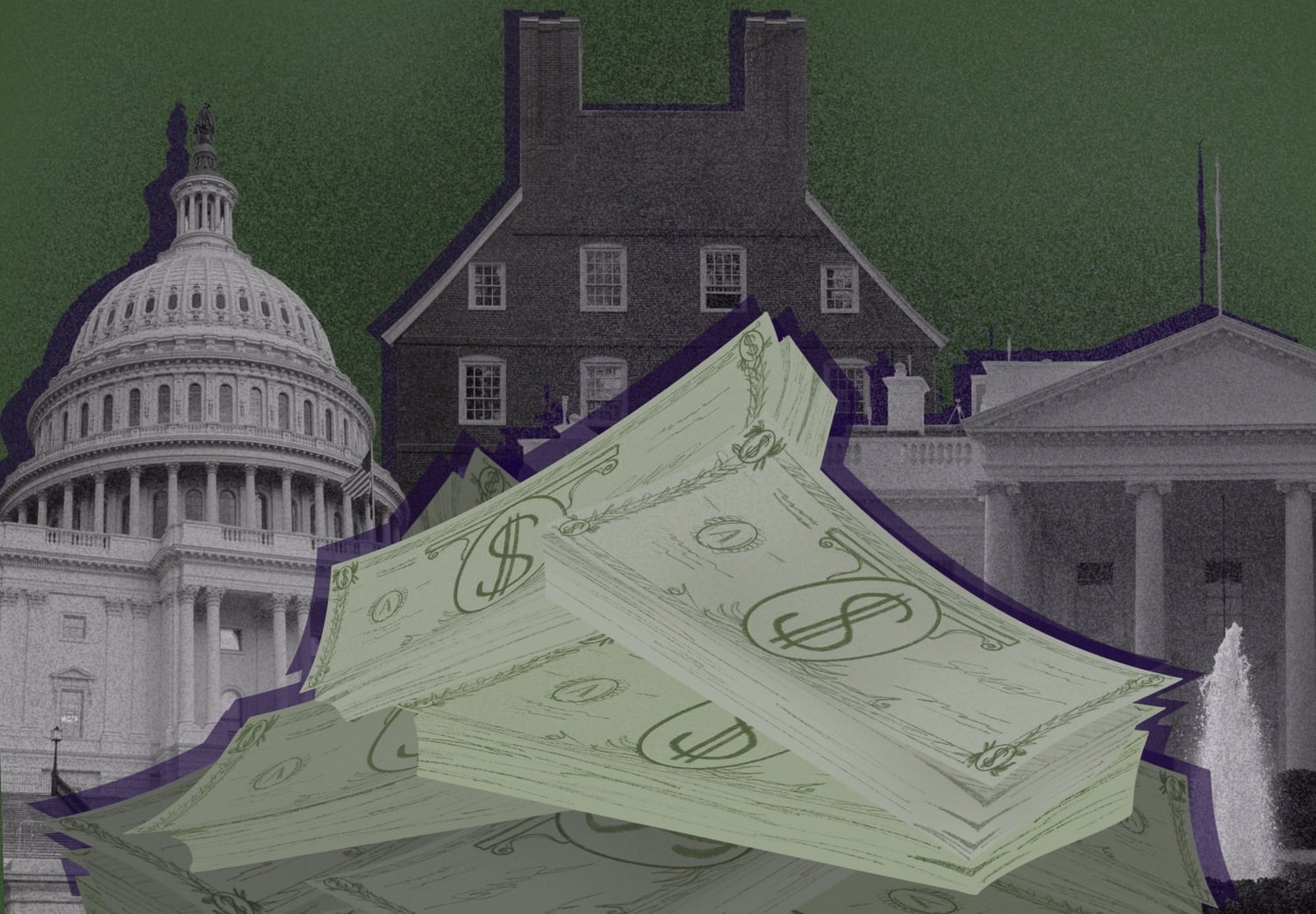
When Harvard President Alan M. Garber ’76 visited Capitol Hill last July, Rep. Glenn Ivey (D-Md.) had a simple message: do not fold.
The two had sat down to discuss U.S. President Donald Trump’s escalating attacks on elite universities, and Ivey urged Garber to keep resisting federal pressure and avoid a settlement with the White House. They also discussed the status of international students at American universities.
Since April 2025, the Trump administration has frozen billions in federal research funding to Harvard over alleged civil rights violations, demanded changes to the University’s hiring and admissions policies, sought to revoke its ability to enroll international students, and opened investigations across more than a dozen federal agencies.
Harvard has sued the administration twice and remains the central target of its pressure campaign against elite higher education.
“My goal of that meeting was to encourage them to keep fighting against the Trump administration — to not reach a premature settlement,” Ivey said in an interview with The Crimson. “I thought it was important for Harvard to stand up. This was at a time when a lot of other universities had been knuckling under, frankly.”
“If anybody’s got the resources to fight back, it’s Harvard,” he added.
Ivey was one of more than 170 members of Congress that Garber has met with since April 2025, according to two people familiar with his visits to Washington — a pace that would have been unthinkable for a Harvard president just two years ago.
Garber’s congressional tour is the most visible front in a sweeping overhaul of Harvard’s federal advocacy strategy. The University spent nearly $1 million on federal lobbying in 2025, its highest total in more than two decades, and paid more than $126 million in legal fees in fiscal year 2025, a sharp increase from the previous year.
Harvard has also expanded the roster of D.C. law firms advising its advocacy on Capitol Hill to more than a dozen. And its boldest move came days before Trump’s inauguration, when Harvard retained Ballard Partners, a lobbying firm with deep ties to the president’s inner circle.
A year and a half later, the campaign has done little to slow the federal pressure on Harvard. The University remains under at least 10 federal investigations, is challenging 12 federal agencies in court, and faces an 8 percent endowment tax expected to cost it $200 million.
Get The Crimson in your inbox.
Despite spending more on lobbying, lawyers, and Garber’s own time in Washington than at any point in recent memory, the University has little to show for the effort.
Quiet Influence
Under previous presidential administrations, Harvard’s footprint in Washington looked very different.
Most of the University’s engagement with federal lawmakers was coordinated through the Office of Federal Relations, a small team within Harvard Public Affairs and Communications with staff based in both Washington and Cambridge.
The four-person office prioritized the Massachusetts delegation and Harvard alumni in Congress, according to a former Office of Federal Relations employee who worked there in the 2010s. Staff attended committee hearings and networking events but typically met with lawmakers only once a quarter.
Harvard presidents themselves visited the Hill only once or twice a year, the employee added. The office leaned heavily on alumni connections, maintaining a running list of every member of Congress who had attended Harvard. When a Harvard president traveled to Washington, the office would reach out en masse and assemble a dense itinerary of meetings.
Because most alumni lawmakers are Democrats, the employee said, the strategy left Harvard with comparatively thinner ties on the Republican side.
Much of the broader advocacy work flowed through higher education trade groups — such as the Association of American Universities and the American Council on Education — which coordinate lobbying for member institutions. AAU dues for a school like Harvard exceed $138,000 annually, while ACE dues for the largest universities run more than $20,000 a year.
The model placed a premium on quiet influence over public confrontation. Harvard rarely registered specific lobbying priorities of its own, preferring to operate through coalitions and personal relationships.
Even the 2017 endowment tax — a 1.4 percent levy on investment income at the wealthiest private universities passed under Trump’s first term — was not enough to push Harvard to overhaul its Washington operation, despite serving as an early sign that elite higher education had become a Republican target.
That changed in December 2023.
A New Kind of Lobbyist
Former Harvard President Claudine Gay’s widely criticized congressional testimony on campus antisemitism made clear that Harvard’s Washington operation was no longer enough.
WilmerHale, which has represented Harvard for nearly a decade across cases ranging from the Students for Fair Admissions affirmative action suit to ongoing antisemitism complaints, spearheaded Gay’s preparation for her appearance before the House Committee on Education and the Workforce.
The firm held at least two mock prep sessions with Gay ahead of the Dec. 5 hearing, sidelining outside public relations consultants and crisis communications experts. Former Harvard Corporation Senior Fellow William F. “Bill” Lee ’72, a WilmerHale partner who does not specialize in congressional testimony preparation, played a central role.
Gay’s legalistic answers — including her insistence that whether calls for the genocide of Jews violated Harvard’s policies depended on context — went viral and drew swift condemnation. She resigned weeks later.
The Corporation — Harvard’s highest governing body — eventually acknowledged the preparation had been inadequate.
“We prepared her for a deposition, we did not prepare her for a political event,” Corporation member Shirley M. Tilghman said at a Faculty of Arts and Sciences town hall in spring 2024. “We understand that we did not serve her well in her preparation for the testimony.”
Combined with the SFFA decision and accusations of antisemitic conduct on campus after Oct. 7, the hearing marked the beginning of a sustained federal pressure campaign against elite universities — and against Harvard in particular.
Alongside MIT and the University of Pennsylvania — the two other universities represented at the December hearings — Harvard began shopping for a lobbying firm. Its existing operation appeared too small, and too disconnected from the Republican base, to manage the public relations crisis at hand.
The University found what it was looking for in Ballard Partners.
Ballard brought in more revenue than any other Washington lobbying firm in 2025, and signed more than 200 new clients after Trump’s reelection. Headed by longtime Florida lobbyist and Republican fundraiser Brian Ballard, the firm has long maintained close ties to Trump.
Ballard was a top fundraiser during Trump’s 2016 campaign and at times represented the Trump Organization. The firm has since become one of the most influential lobbying shops in Republican politics. Trump’s chief of staff, Susie Wiles, worked as a partner at Ballard for eight years and continued bringing clients to the firm through 2022. Former Attorney General Pamela J. Bondi joined as a partner in 2019.
The firm also maintains a bipartisan roster, including Michael LaRosa, former First Lady Jill Biden’s press secretary, and Daniel McFaul, who served on Trump’s 2016 transition team and as chief of staff to former U.S. Reps. Jeff Miller (R-Fla.) and Matt Gaetz (R-Fla.).
Though the firm has recently fallen out of Trump’s favor, it remains one of the most sought-after lobbying shops in Washington.
“My assumption is that Harvard picked Ballard because Ballard is the Harvard of lobbying firms,” Chris Dorworth, a former partner at the firm, said.
Hillary Braseth, executive director of OpenSecrets, a nonprofit that tracks lobbying spending, said the choice reflected a calculated bet on access.
“For a university like Harvard, they probably want to give themselves the best chance at having dialogue or negotiation with the current president, and so they probably think the best way to do that is to hire a firm that historically has had a strong relationship with the administration,” she said.
According to a person familiar with the engagement, Harvard meets with Ballard on a biweekly basis for updates from Capitol Hill and the White House, including outreach efforts, emerging issues to monitor, and recommendations on which lawmakers and officials Harvard should meet with.
“We maintain a strict policy against discussing client engagements,” Ballard wrote in a statement to The Crimson. “It is a privilege to represent Harvard University, and we will continue to serve with the highest level of effectiveness and honor.”
Harvard’s turn toward outside lobbyists is part of a broader shift across higher education. The University of Pennsylvania, Johns Hopkins, Northwestern, Yale, Columbia, Cornell, and the University of California system all increased federal lobbying expenditures in 2025 as elite institutions faced investigations and threats to research funding.
Total lobbying spending across Washington reached $1.4 billion in the first quarter of 2026, the highest first quarter total since Congress began requiring quarterly reports in 2008.
Lobbying firms have responded to the surge in demand. Brownstein Hyatt Farber Schreck launched a dedicated higher education task force to help universities navigate congressional investigations and White House pressure.
The President as Lobbyist
Harvard’s expanded strategy has extended well beyond Ballard. As federal pressure mounted, Garber was pushed into a far more public and politically engaged role than his predecessors typically occupied.
Rather than relying primarily on the federal relations staff to manage relationships on Capitol Hill, the University has put Garber himself in front of lawmakers, think tanks, and policy leaders in Washington.
“President Garber and Harvard’s team in Washington routinely engage with members of the House and Senate from both parties,” a University spokesperson wrote in a statement. “These efforts are designed to hear the perspectives of elected officials, to share information on the teaching and research happening on campus, and to make the case for issues that affect Harvard and higher education.”
Garber has also expanded his presence in conservative policy circles. In March, he appeared at an event hosted by the American Enterprise Institute, where he discussed the Trump administration’s threats to higher education and acknowledged that Harvard had made mistakes in recent years, while emphasizing that the University would hold firm on principles such as academic freedom, according to a person who attended.
Several attendees reacted positively to his remarks and appeared to leave with a more favorable view of both Garber and the University, the person said.
Some Republican lawmakers have struck a more conciliatory tone. During an April visit to campus, Rep. Anna Paulina Luna (R-Fla.) told The Crimson that she believed Garber was handling the situation more effectively than Harvard’s previous leadership.
“I think he’s doing a lot better than the previous University president,” she said. “They were very accommodating with our requests, and so I think that that’s a step forward in the right direction. We look forward to coming back.”
But the meetings and the warmer reception in conservative circles have not translated into legislative wins for Harvard.
Other universities, through their own lobbying campaigns, successfully pushed Congress to exclude themselves from the top tier of the new endowment tax. Harvard is one of five universities in that top tier.
Privately, some members of Harvard’s leadership have expressed disappointment in the broader federal advocacy effort, according to a person familiar with their thinking. . The dissatisfaction inside Harvard appears to span the full slate of advocacy efforts rather than zero in on any single firm or tactic, the person said.
Braseth said Harvard’s calculus could shift again depending on the political map.
“My guess is, if there’s a brand new administration with different priorities and different sets of relationships, that the entire game is going to shake up again,” she said. “Depending on who takes the seat of power beyond this administration, will dictate all of what these entities end up doing in terms of their lobbying behavior.”
Jeff M.A. Hauser ’95, executive director of government ethics watchdog group the Revolving Door Project, said the clearest measure of Ballard’s value may be the penalties Harvard has avoided rather than the wins it can point to.
“The elite academic institutions were on the backfoot defensive entering 2025, and they had less of an affirmative agenda than a ‘let’s get out of this four year period with as little damage as possible,’” he said.
“I think a lot of the influence of Ballard is probably in the fights that we’re not having,” he added.
—Staff writer Megan L. Blonigen can be reached at [email protected] and on Signal at mblon.50. Follow her on X at @MeganBlonigen.
—Staff writer Caroline G. Hennigan can be reached at [email protected] and on Signal at carolinegh.53. Follow her on X @cghennigan.
Want to keep up with breaking news? Subscribe to our email newsletter
Have a tip for The Crimson? Share it confidentially