Artist Profile: Ria S. Cuéllar-Koh ’26 on Why Art Never Truly Ends
The first time Ria S. Cuéllar-Koh ’26 saw “The Old Man and the Old Moon” was when she was in high school, sitting in the audience of a local high school production. She loved it so much that she convinced her own high school theatre teacher to stage the play — then starred in it herself.
This kind of double immersion captures how Cuéllar-Koh lives out art. Now a senior with a joint concentration in English and History of Art and Architecture, she has build a restless and deliberate theatre life at Harvard. Cuéllar-Koh — Theater Editor of the 152nd Guard for the Harvard Crimson — writes for The Crimson, sings and manages the social media account for the Din and Tonics, and just directed David Henry Hwang’s play “Yellow Face” in the Loeb Drama Center.
As a freshman, Cuéllar-Koh didn’t arrive at Harvard expecting to direct. In fact, having done musical theater since fourth grade, she began her Harvard career with a hunger to perform. After an array of musical appearances, mentors who had worked with her repeatedly noticed an untapped talent for another role — directing.
“They were like, ‘We think you would be really good at this. Yeah, You’re just passionate about musical theater and just theater as a form in the way that I think would make for a good director,’” Cuéllar-Koh said when recalling how she was pushed into directing in an interview with The Crimson.
Her directorial debut was “TomTom” in 2025 — the nickname she and her team named “The Old Man and the Old Moon”. A very complex production, Cuéllar-Koh had to manage onstage actors, shadow puppetry, movement through the balcony, and folk songs that were threaded throughout the storytelling.
But “The Old Man and the Old Moon” also taught her something deeper. She spent much of that production consumed by self-doubt. Part of it came from her experience as a theater writer for The Crimson, which had sharpened her critical eye she applied to her own work.
“Whenever I engaged with a work of theater I would have ‘critic brain’ on, and I would do it for myself. And so often I was not able to appreciate what I had done because I was constantly kind of seeking out the [negatives] in it. And I could never stand back and say ‘Wow, like, look, I did a good job on this,’” Cuéllar-Koh said.
“Yellow Face” was different. The material asked her to work in the specific and messy register of personality and interiority — the semi-autobiographical play follows David Henry Hwang as he mounts his 1993 play “Face Value” — a contrast to the archetypal, fable characters in “The Old Man and the Old Moon.” Cuéllar-Koh had grown into the role of director.
“I think I’ve grown a lot in confidence,” Cuéllar-Koh said.
During rehearsals, The cast and crew also got a special opportunity to have a Zoom Q&A with David Henry Hwang — the playwright of the original play “Yellow Face” — himself. His main piece of advice was not to go easy on the play’s fictionalized version of himself — which contrasts with other autobiographical works that put the author in a more favorable light — even though the point being that Hwang’s depiction is “extremely not flattering.”
“He thinks of that [Hwang] as being a character named after him rather than an embodiment of himself,” Cuéllar-Koh said.
That unflattering quality, Cuéllar-Koh argues, is precisely what makes the play work. On the surface, “Yellow Face” is a farce — a white actor accidentally cast in an Asian role, and the chaos that follows. But underneath, it’s about something more profound.
“We follow David Henry Hwang, as he realizes slowly over the course of the play, that he has been, kinda of a, like he wants to be this kind of activist and an icon and a role model, but he’s not actually putting his money where his mouth is,” she said.
Cuéllar-Koh — who is of Korean Mexican descent and is from the Bay Area — was drawn to the play partly because it resists the kind of overly victimized or stereotypical Asian American media she doesn’t find relatable. While she respects this type of work and understands its place, it’s just not the exact kind of art she wants to be making. Cuéllar-Koh was drawn to“Yellow Face” because she found it self-deprecating, funny, yet genuinely meaningful.
“I think that is extremely relevant to the political moment that we’re living in right now. And, I think that’s something a lot of people will relate to and hopefully, find moving and inspiring,” she said.
With her cast, she tried not to keep this constantly in mind. The key was reminding everyone that they’re staging one specific person’s perspective rather than a preachy or universal truth.
“We are here to put on this work by this person. No one is expected to buy into — we’re not expected to treat this like it’s the gospel truth,” Cuéllar-Koh said.
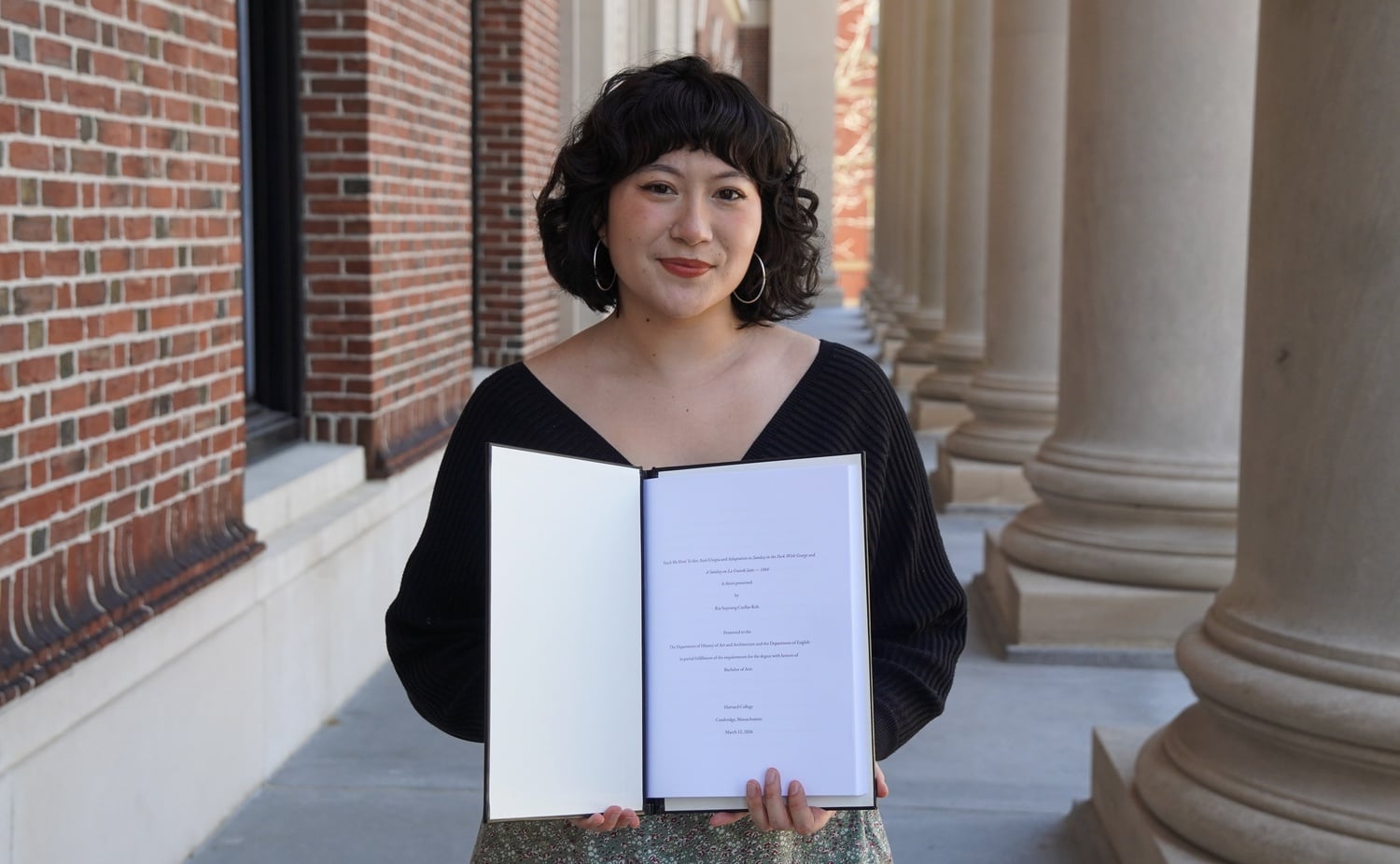
That instinct — toward work that moves people without telling them how to feel — runs deep for Cuéllar-Koh. It’s something she has spent four years thinking about across her joint concentration. She wrote her senior thesis on how Stephen Sondheim and James Lapine embedded a Marxist critique of capitalism into the 1984 musical “Sunday in the Park with George” through the formal techniques of pointillism — the Neo-Impressionist painting technique developed by Georges Seurat and Paul Signac in the 1880s.
“I do believe [art] is the most effective mode of communicating with another person and really informing them how you feel. And I think the audience takes away so much more, for example, in a work of theatre than they would if you sat down and told them the message you wanted them to take,” she said.
After graduating from Harvard, Cuéllar-Koh plans on staying close to the arts — likely as an administrator rather than a performer, but always living art out in some shape or form. What she’ll carry the most is something she learned from alumni at the 45th reunion of her acapella group, the Din and Tonics in 2024. She met doctors, musicians, and people in entirely different fields who all came to the same conclusion.
“But all of them said basically, ‘Doing the Din and Tonics is one of the most meaningful things that I ever did in my life and to this day, I love music. I keep music in my life. I still sing, I still do this.’ and that was so sweet for me to hear,” Cuéllar-Koh said.
For Cuéllar-Koh, that’s the whole point. Whether she’s directing a farce about identity politics or singing on a world tour with the Din and Tonics this summer, the throughline is the same: art isn’t something you do and leave behind. It stays with you, shapes you, and if you’re lucky, keeps giving back even after the curtain comes down.
Want to keep up with breaking news? Subscribe to our email newsletter
Have a tip for The Crimson? Share it confidentially